Tell Me a Mishap: The Telegraph Trail
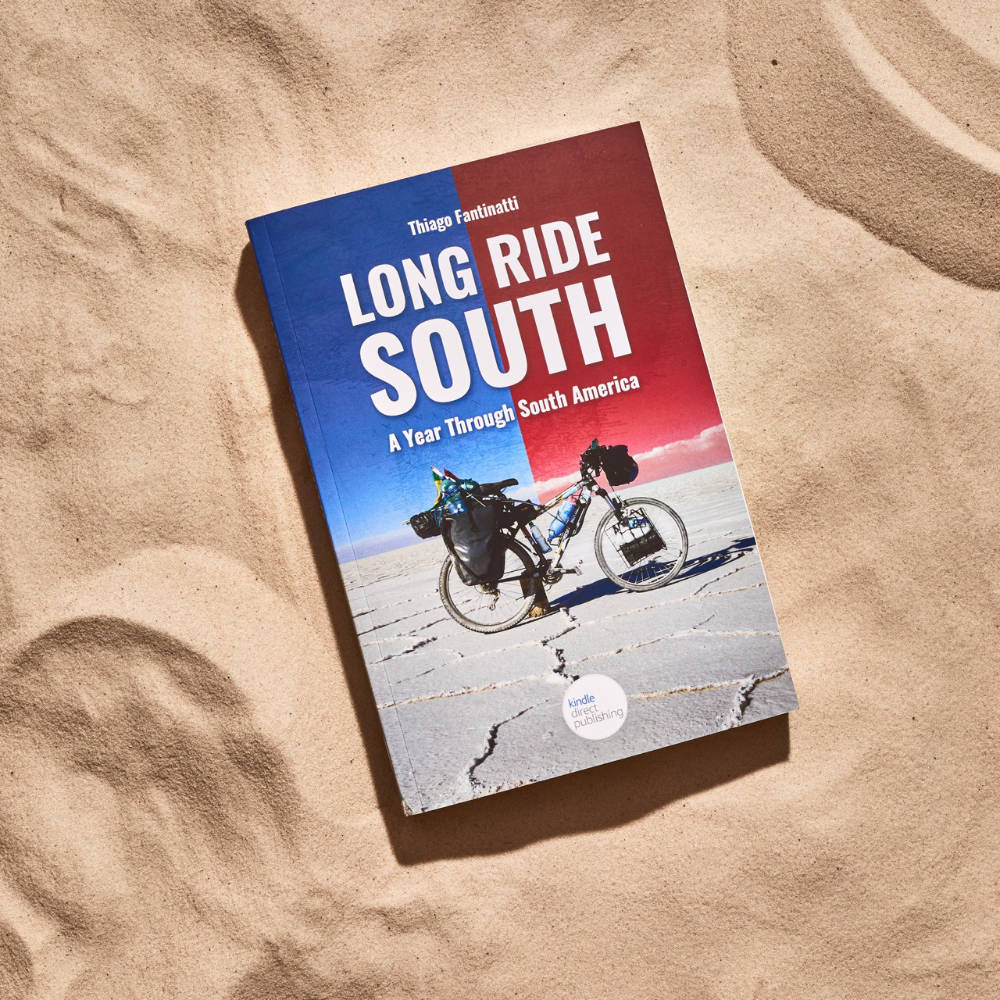
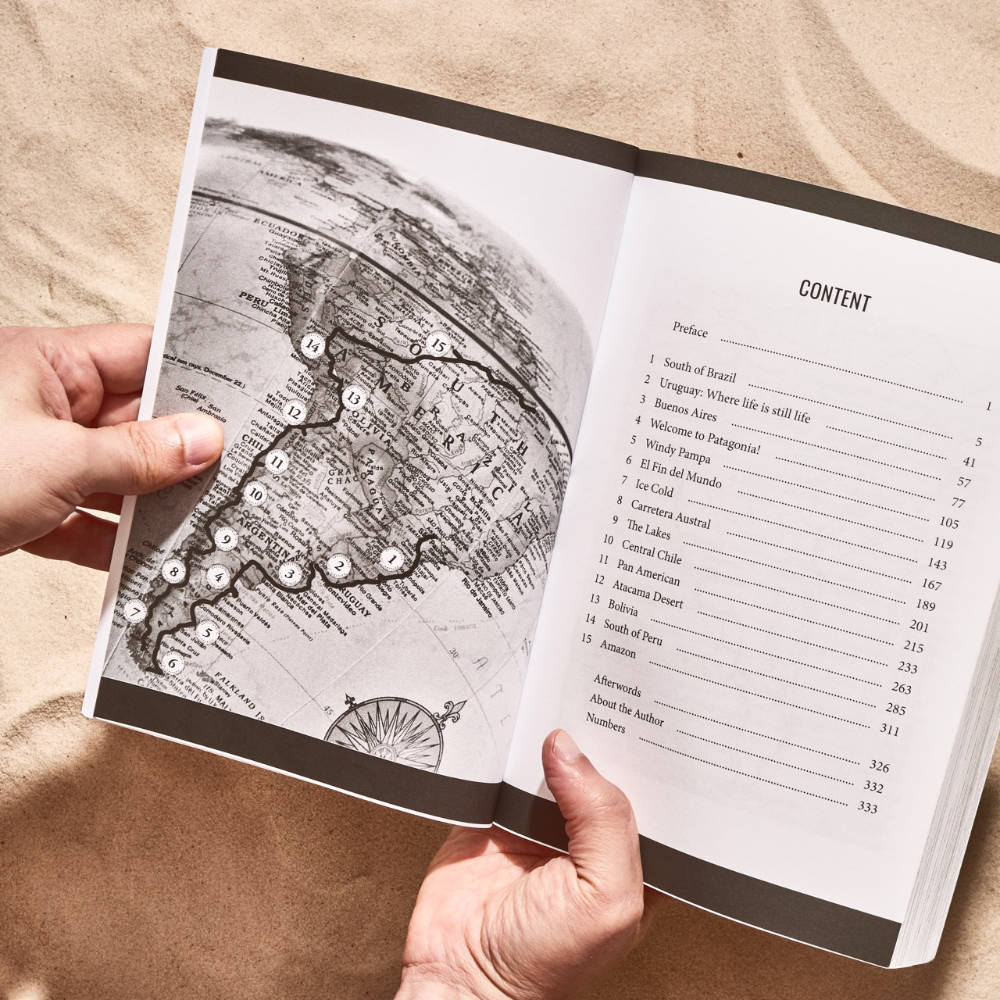
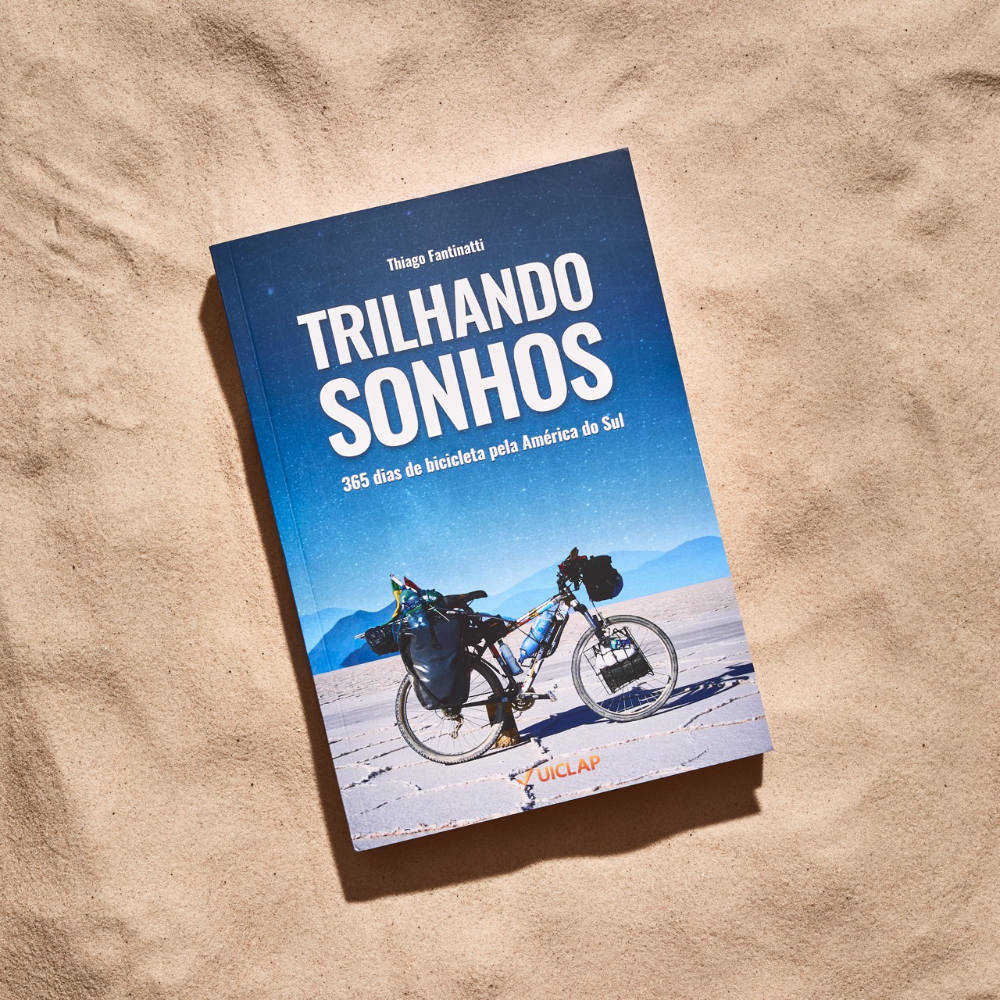
In 2013, three years after having traveled for a full year by bicycle across South America, I began to feel that itch typical of someone who is never quite satisfied. I decided it was time for another journey. Since I didn't have all the time in the world, I had to fit it into my vacation period. I chose a route I hadn't yet crossed by bike: heading from Paraná to the state of Rio along the coast.
I chose alternative routes. I left Curitiba the day after that rare snowfall hit here in Paraná. I descended the Serra do Mar coastal mountains with my teeth chattering from the cold. The first half of the route wound through dirt tracks and beaches until reaching the Rio-Santos highway, which I followed all the way to Paraty, in Rio de Janeiro.
I think the best part of the trip was the fourth day—ironically the hardest day and the one on which I pedaled the least. After all, it's from mishaps that the best stories are born.
I've always had a passion for the remote. Distant, hard-to-reach places have always drawn me in. Across the four corners of the continent I had found a few places like that, but discovering one right near home was at once a shock, a surprise, and now a source of joy. The Telegraph Trail tested me like few paths ever had before. Those 6 kilometers forced me to dig deep and pull out words I hadn't used in a while: endurance, rage, exhaustion, hope, fear, and challenge.
I set off from the small village located just 500 meters from the border with the state of São Paulo. I started late, around 10 in the morning. I didn't expect those few kilometers would take very long. I rode back about a kilometer to a fork in the road, near the payphone I had used the night before. Another kilometer, or maybe a bit more, and I found myself in front of a white gate and a house surrounded by banana trees. It felt strange and I thought I might have taken a wrong turn. I clapped my hands and a woman appeared, soon calling over her husband. I asked which way led to the trail. They pointed to a steep, narrow, mud-drenched track right beside me. I laughed and, for a fleeting moment, caught a glimpse of what my day was going to look like. As I turned away from the gate, I overheard the old man muttering to his wife that I’d never make it.
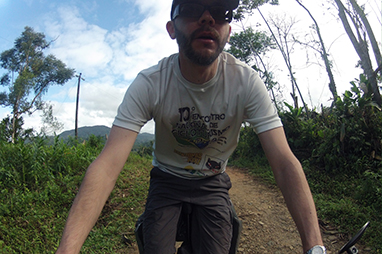
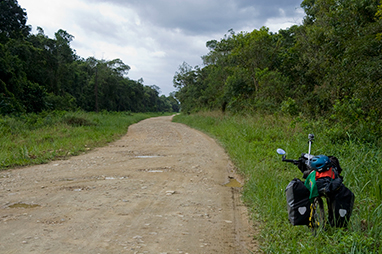
I ignored the warning signs. Stubbornness won out. I convinced myself the trail was rough, but would surely improve soon. That sweet delusion kept me moving the whole time.
The first few hundred meters felt like a rollercoaster: a steep, slippery series of muddy ups and downs. At no point was it actually possible to pedal—only push the bike (with immense effort). Right near the beginning, a steep ravine forced me to detach the panniers for the first time. I had to leave part of the gear on the ground, carry the bicycle across, walk dozens of meters ahead, and hike back to retrieve the bags.
An hour and a half slipped by, and I had covered barely one kilometer. Because I was right on the state line, boxed in by hills, there was no logical reason to assume the terrain ahead would remain this bad. Honestly, I kept hoping it would end soon.
I crossed paths with a boy riding a horse. I blurted out the question that had been sitting on the tip of my tongue: “Hey... do you know if there's far to go?” He laughed and said: “Man, you're toast! You haven't even really started yet.” I countered with another question: “And is the whole trail this bad?”
“Yeah, actually it's going to get much worse,” he replied.
Well, what could I say? What could I think? Honestly, I reasoned that a local boy's perspective might lack benchmarks and shouldn't be taken completely literally. We parted ways, and I solemnly ignored most of what he had told me.
After covering more than two kilometers, turning back felt absurd, especially since I remained convinced that easier terrain was just around the corner.
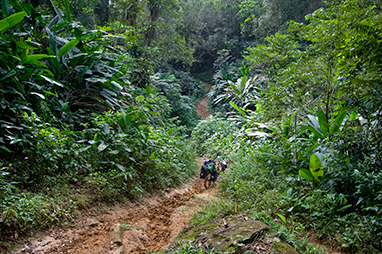
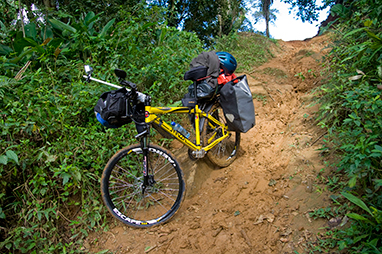
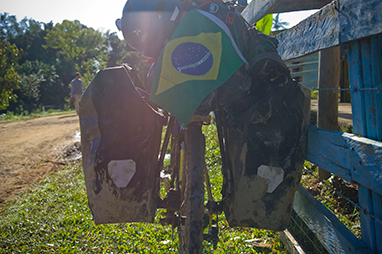
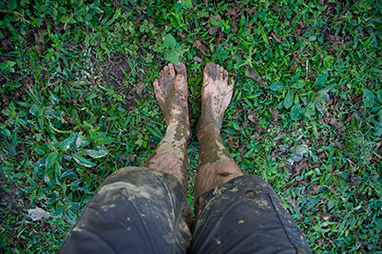
A river provided the perfect excuse for a stop. I needed to eat and try to wash away some of the mud clinging to the bicycle and myself. I waded right into the stream with the bike and scrubbed what I could. The clay felt like glue, binding the wheels to the frame. My sneakers were in tatters, dirtier than anything I had ever seen. In fact, rarely in my life—even in childhood—had I ever been so covered in mud. I washed off, ate, and rested for a few minutes. Soon after, I began to hear engine noises. At first it sounded like a chainsaw, but then I realized they were motorcycles, and a wave of relief washed over me: where there are motor vehicles, there must be roads! A few minutes later, I realized they were adventurers like me—seven dirt bikers caked in mud up to their ears and bearing terrible news. They told me I wasn't even halfway through, and that the rest was impassable! I can't even remember what ran through my head at that moment.
The motorcyclists took off. They moved so slowly that even an hour later I could still hear their engines in the distance.
The hilly ground gradually flattened out, but because of that, water and mud pooled everywhere. It had turned into a swamp. Luckily, the fresh 10-inch-deep ruts carved into the thick sludge by the motorbikes kept me from sinking all the way to my knees—though at times, that happened anyway.
“...calling for my mom crossed my mind a couple of times.”
At this stage of the crossing, with the trail worsening by the minute, I decided to take off my shoes and continue barefoot. Every time my feet sank into the mud, my sneakers slipped off, and I had to dig around blind in the muck like someone hunting crabs in a mangrove. I was taking the risk of cutting my feet—I could easily have stepped on a thorn, broken glass, or an old nail buried in the trail. But I didn't have much choice. Flying like Peter Pan or calling for my mom crossed my mind a couple of times. It's astonishing what passes through your head in extreme situations!
I had to be as practical as possible, and ditching the sneakers sped things up slightly, boosting my pace to a roaring 1 km/h.
I bumped into a family making the crossing. With young children along, they were carrying plastic grocery bags with provisions. The adults wore rubber boots, but two little boys were barefoot. They told me I was about halfway through and that they do this crossing at least twice a week. I thought to myself: “Now they are the real heroes.”
The other day a friend, Alexandre, who recently crossed Africa from end to end, posted on Facebook that he could divide humanity into two groups: those who have crossed the Telegraph Trail by bicycle and those who haven't. He said that anyone who has conquered it deserves the utmost respect. Of course it was a joke, but a very fitting one (laughs).
A heavily loaded bicycle turns the crossing into pure misery. On foot, even carrying grocery bags, it's far easier—you just walk. Even so, these local residents deserve all my respect. It's just one glimpse of how arduous rural life can be for some communities.
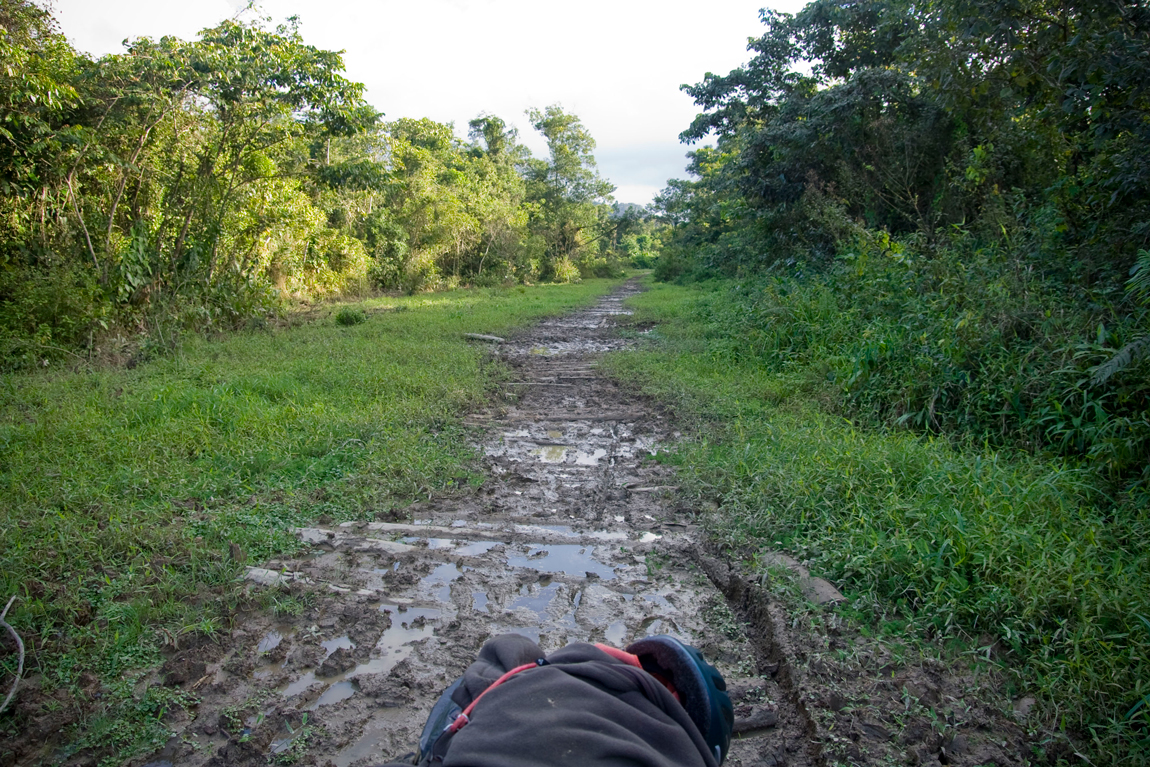
I kept moving forward and the conditions deteriorated further. Flatter terrain meant more standing water and deeper mud. Near the very end, there is a straight stretch of about 1 kilometer. In the distance, around 4 in the afternoon, I caught sight of a car and a patch of dry green grass bathed in the late afternoon sun. I couldn't hold it back—a burst of spontaneous, uncontrolled laughter came out of me. Spotting that car meant I would soon be out of there, because where there's a car, there must be a road. It’s remarkable how small things can bring such immense relief and happiness!
I passed one of the original poles from when the trail was first carved out: a slender metal pole standing for over a century.
About an hour later, I was clearing the final yards of the trail. Like an excited child, the sight of the finish line filled me with euphoria, and strength suddenly returned to legs and arms I thought were entirely spent. One yard at a time, slowly, and all of a sudden, I made it! My feet stepped onto firm, dry ground again. There are no words to describe the satisfaction of escaping that personal little hell before the sun went down. Whew!
Just ahead, I reached the car. There was a rural schoolhouse, a home, and three men standing nearby. I greeted them and simply collapsed onto the ground, sitting there breathless.
We talked for a while. I explained where I was headed and shared some of my joy for what I had just pulled off. I asked for water, but they didn't have any to spare. My thirst lingered. I asked for directions and they told me that about 3 kilometers further on lay a hamlet called Santa Maria, the southernmost settlement in the state of São Paulo. I pedaled on. Ah, what a blessing it is to actually ride! The dirt road was flat and in good shape. The bicycle and I looked pitiful. I was running on pure autopilot, exhausted as I had rarely been in my life. Soon, roofs appeared. I had reached Santa Maria.
There was a grocery store, and next door, I received help from Daniel and his family. They welcomed me in. I washed my shoes. I got to enjoy fresh, hot home-cooked food, take a warm shower, and rest on a real bed. I slept like a baby.
Tally for the day: roughly 9 kilometers covered between 10 AM and 5:30 PM, a few purple bruises on my legs, countless mosquito and horsefly bites, four pounds of mud glued to the bike, and several thousand calories burned.
I spent a whole year on the road across South America, and I can recall only two routes as brutal as this one: one was a hiking trail taken by mistake with three friends in Tierra del Fuego, Argentina—all of us pushing bikes. It took us six hours to cover six kilometers, and we even had to cook using seawater. The other was with a German cyclist named Ralph, when we crossed from El Chaltén, Argentina, toward Villa O'Higgins in Chile. We had to hire two horses to carry part of our luggage across seven or eight kilometers, followed by wading through an icy glacial river. Yet I think the Telegraph Trail was the toughest of the three—above all because I was entirely on my own.
Yesterday, I received an invitation from two friends who, like me, had each crossed a continent by bicycle. The invitation was specifically to ride the Telegraph Trail together. I was quite surprised—not by the invite itself, but by the fact that I actually felt like saying yes! Who in their right mind would choose to do that twice?
Like so many things I've done, had I known exactly what lay ahead, I doubt I would have had the stomach to face it. Yet contradictorily, now that I know what it feels like, taking it on again would be psychologically much simpler. Hearing what something is like from others will never equal having lived it yourself.
I recommend the crossing. Just make sure to pick a dry period. I went right after heavy downpours. Another crucial tip: pack plenty of bug spray.
From Guaraqueçaba in Paraná, via the Estrada do Costão, it's about 35 km to the trailhead, where a tiny community sits. After 6 km of muddy swamp trail and another 3 km of dirt road, you reach Santa Maria in São Paulo state. From Santa Maria to Cananéia is about 48 km, 80% dirt. The whole journey cuts across magnificent swathes of the Atlantic Rainforest—it's well worth it. You could easily split all of this across two days. I did it in three. Doing it in a single day is tough because the trail eats up so many hours—unless perhaps in midsummer, when daylight hours are at their longest.