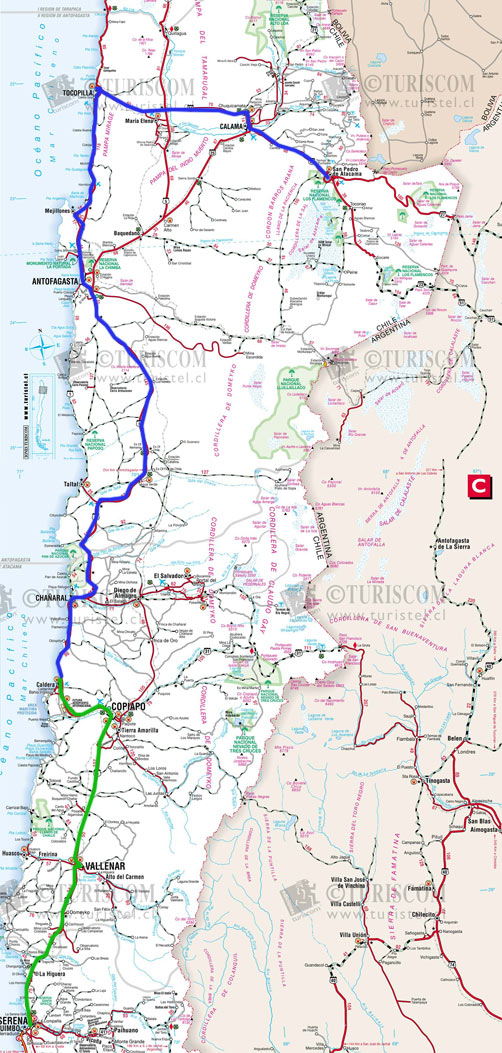
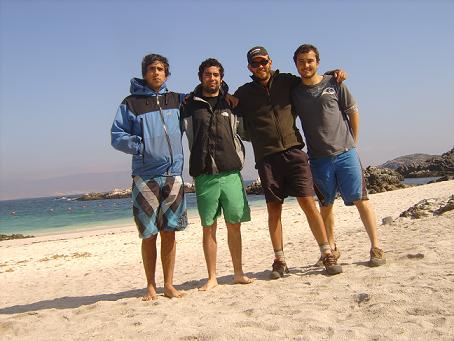
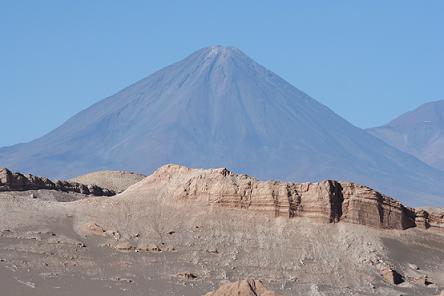
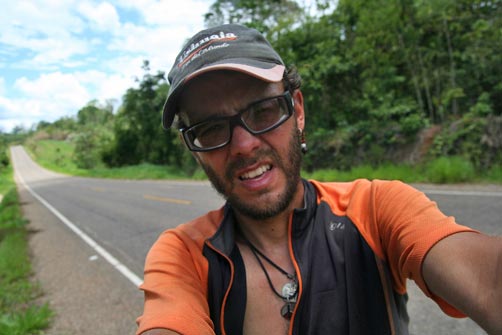
15,000 km, 365 days by bicycle and 138 field posts written in the heat of the moment. A human journey across South America preserved exactly as felt and recorded.
15,000 km cycled
365+ days traveling
7 countries
138 original entries
13 stages
No entries found
Try searching for another term or click the button below to clear the search.
STAGE 01 OF THE EXPEDITION6 entries in this stage
Preparation & Training (2008)
Feb to Oct 2008 • Training ride Curitiba-Florianópolis, Graciosa, wrist fracture and preparations
Entry #01(ID: 55)
Monday, September 29, 2008
Training Trip - Curitiba to Florianópolis (506 km along the chosen route)
Arrival in Curitiba
Our plan was to embark on a shorter trip before tackling the long journey across the Americas. Given our lack of experience, it proved to be a wise decision. We set off from Ourinhos in the early hours of February 7, 2008. The bus was running a bit late, and I believe we left just after midnight. The moment I stepped onto the bus, the stress from my previous workday began to melt away, taking my anxiety along with it. After all, I was on vacation! Many people asked us why we were taking a bus as far as Curitiba. I think it made good sense: the ride from Ourinhos to Curitiba is demanding—a solid 420 km. Naturally, we wanted to take a route closer to the coast; our goal wasn't to cross the state of Paraná, but rather to ride from Curitiba to Floripa.
We estimated we would cover around 420 km between the two cities, plus another 80 to 100 km around Florianópolis. We had no idea how many days we would spend on the road. Martinho had to head back as soon as we reached Floripa, but I hadn't figured out whether I would return with him or push on alone somewhere else. Truth be told, I wanted to head further south—perhaps all the way to Rio Grande do Sul; I'd even entertained thoughts of Porto Alegre.
Sometimes, when we dream up a journey, we view it through an overly romantic lens—everything seems picture-perfect. In practice, however, things are never quite so simple. Regardless, boarding that bus marked the beginning of an old dream coming to life, and romanticized or not, it was mine.
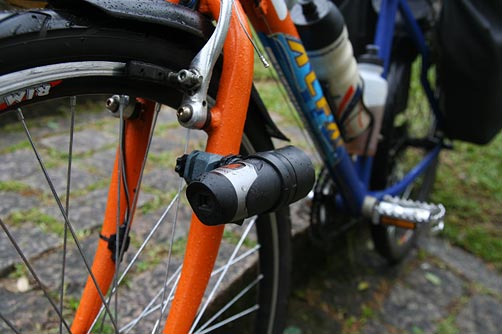
We pulled into Curitiba’s bus terminal around 6:00 a.m. on February 7 and set to work assembling our bicycles and organizing our gear right there on the bus platform. A modest audience of passersby lingered nearby, watching us curiously while sipping coffee on their way to another day of work. We stopped at an information booth for the usual basic questions about distance and direction. I was already familiar with Curitiba, but didn't know the shortest route to the Estrada da Graciosa, which we already had in mind. We spent about thirty minutes chatting with the gentleman at the counter. It is always wonderful meeting people under such circumstances and seeing their reactions when we tell them about our travels. We left the bus station knowing we had to take the BR-116 toward São Paulo, as the start of the descent down the Serra da Graciosa lay slightly northeast of Curitiba. That’s exactly what we did, pausing only for another half hour at a bakery near the highway to enjoy a hearty breakfast and top up our tire pressure at a gas station. We took photos and chatted with the "natives," as we like to call the locals. We even found out that the owner of the bakery inside the service station hailed from a town near Ourinhos—though its name escapes me now. We set out along the Régis Bittencourt (BR-116), knowing next to nothing about what lay ahead. The highway carries heavy traffic, connecting two vital regions of the country, yet it makes for surprisingly smooth cycling thanks to a wide, generous shoulder. We stopped twice along the way: once to buy water, and again so Martinho could tighten his handlebars, which were working loose. A drizzle began to fall, prompting me to slip a special latex rain cover over my camera—one of my professional tools—so we could keep shooting in the rain. It’s a digital SLR, fairly bulky with the lens attached, but the image quality makes the hassle of hauling it everywhere well worthwhile. As we put Curitiba behind us, the sprawling metropolis gave way to dense forest. After 41 km, we spotted our first sign reading "Estrada da Graciosa." Overjoyed, we took photos in front of it. Just ahead stood the entrance to the Graciosa: a striking brick portal with grand gateways for vehicle traffic and rustic timber accents. We snapped a few photos there. A signpost displayed distances to coastal towns ahead. The portal looked delightfully weathered and historic. Our next stop was Morretes, 34 km away. We assumed it would be all downhill from there; I personally imagined we’d roll into Matinhos on the coast just in time for lunch. Wishful thinking—once past the portal, we realized there were still climbs ahead. Soon, a thick fog rolled in accompanied by a gentle drizzle. We were on cloud nine and didn’t care in the slightest. I mounted our camcorder to my bike's front fork and we rode on. We paused at scenic creeks and breathtaking viewpoints, and before long, the real descent finally began.
The Graciosa portal
From Serra da Graciosa to the Coast
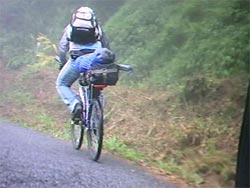
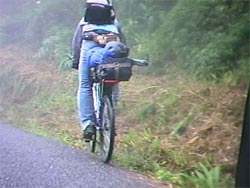
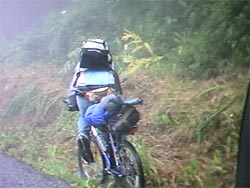
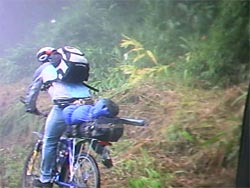
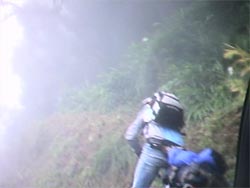
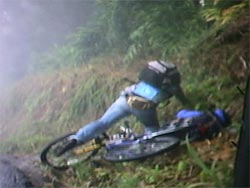
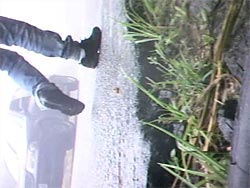
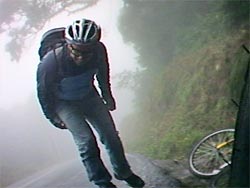
Gravity began lending a helping hand, and the kilometers started flying by. Then, to our surprise, on a sharp bend, we both wiped out. A few minutes and hearty laughs later, we dusted ourselves off, realizing this road was perilous and demanded we slow down. Luckily, neither of us was hurt, and best of all, the spill was captured on video, since my bike camera was rolling right behind Martinho. Had there been a cliff edge, we would have plunged right over. A kilometer further down, we realized Martinho's front tire had punctured in the crash. Backtracking a few meters, we pulled up at a roadside kiosk. We replaced the punctured tube and treated ourselves to fresh coconut water. We chatted for a bit with the vendor, who told us he had six children! Pressing on, we soon hit a stretch that is no cyclist's dream: ten kilometers of cobblestones. I personally despise the vibration, which leaves my hands aching terribly. Our pace slowed to a crawl. We took advantage of the slow roll to film and photograph anything that caught our eye. The mountain range is gorgeous, and its vistas—even under overcast skies—are nothing short of phenomenal. The weather cleared up, and we came upon a picturesque river where we lingered a while, followed shortly by a handsome iron bridge. More photos!
The Estrada da Graciosa was now behind us. We were practically at sea level and starving, as it was already around 1:30 in the afternoon. That was when we noticed Martinho’s tire was getting soft again. We picked up the pace to reach Morretes as quickly as possible and grab lunch. Morretes is an extraordinarily tranquil town, brimming with colonial-era architecture. As soon as we arrived, I asked a passing girl where we could find a bike shop and a restaurant. Martinho headed to the bike shop to inspect his tire, and right after that we ducked into a restaurant. On the menu: a glorious plate of barreado. I ate heartily, instantly feeling my batteries recharge. We rode out of Morretes around 4:00 p.m. bound for the coast. We hoped to reach Matinhos swiftly and then press on to our destination for the night: Guaratuba. But our troubles were only just beginning. We tackled a tough stretch marked by rolling climbs and sweltering heat—something I hadn't anticipated so close to the ocean, especially hauling loaded bikes (I estimated our gear at around 15 kg). We headed toward the state highway connecting Curitiba to the port of Paranaguá. It was busy with traffic, but a fine road nonetheless. Around 6:00 p.m., the skies opened up into a torrential downpour. We had already logged around 100 km, and I was genuinely feeling the fatigue. The rain showed no mercy, dogging us all the way to the coast. We rode a considerable distance in pitch darkness under heavy rain. I hadn’t anticipated cycling into the night, so my headlight was buried deep at the bottom of my panniers; digging it out in that driving rain was out of the question. We made a brief stop at a highway police post so Martinho could use the restroom, and I suddenly realized how chilled to the bone I was. Stopping in conditions like that is never a good idea. The road seemed endless—a bleak, dark, freezing straightaway. It wasn't easy. I noticed that despite the wet and cold, the Lycra tights I had bought were doing their job admirably, significantly blunting the chill. We finally reached Matinhos and phoned home to let our families know we'd made it to the coast. Soon we pushed on toward Caiobá to catch the ferry across to Guaratuba. The rain intensified, soaking a good portion of our gear. In truth, it turned into a full-blown storm. Even items stowed inside canvas panniers got damp; only what we had packed inside PVC dry bags remained completely dry. We boarded the ferry amid relentless rain and fierce winds. I began shivering uncontrollably. It's brutal to stop, stand motionless for several minutes, and then have to get back in the saddle and pedal through the rain. It takes true willpower!
Serra da Graciosa/PR
By that point, we had clocked around 150 km. It was blatantly obvious that we needed to find shelter for the night. It was already 9:30 p.m. Arriving in Brejatuba, right next to Guaratuba, we bought some groceries for dinner and began the tedious hunt for the house of an acquaintance of Martinho's, who was supposed to give us the key to a beachfront house where we could sleep. Several kilometers and phone calls later, we finally tracked down the place and the key, thanks to a "native" whom I had the bright idea of asking about the person we were looking for. My cyclometer read 162 km—the greatest distance I had ever covered in a single day on a bicycle. Finally, between 10:30 and 11:00 p.m., we were sheltered.
Arrival in Santa Catarina
Our original plan had been merely to spend the night, but we soon discovered our clothes were filthy and soaked, and much of our gear was waterlogged as well. That included an actual puddle of water pooled inside my pannier! So we decided to spend the entire day washing and drying our things. Fortunately, the morning broke with glorious sunshine, allowing us to dry everything out. There was a little bar across from the house where we enjoyed a cold beer. In the afternoon, after a quick nap, we headed to an internet café to back up our photos, send emails, and download videos from the camera. By late afternoon, we tidied up the house, had dinner, and packed most of our gear. We agreed to make an early start the following morning if the rain held off. And it did—the sun graced us once again. Unfortunately, an early start eluded us. We always seem to run late for one reason or another. But since we were on vacation, there was no point stressing over it. Around 9:30 a.m., we were still getting ready to roll out. We stopped at a gas station to check tire pressures, and shortly down the road I discovered that the previous days' deluge had wrecked my cyclometer. After fiddling with it for several minutes, I gave up and bought a new one at a bike shop. A pity, really, as my old one sputtered back to life a few days later. We finally found our rhythm around 10:30 a.m. Before long, we crossed into Santa Catarina. A little frayed by the heat and delays, we nonetheless arrived at the beach in Itapoá. We snapped a few photos and decided to ride a few kilometers right along the beach. After all that relentless rain, this was our first sun-drenched beach. Riding on the sand, however, proved to be a terrible idea: the bikes got packed with grit, producing a grating, excruciating noise from the drivetrains!
Continuing along the coast, we hit an unpaved section. We knew it was coming, but quickly realized this would be a grueling day. I can never build up any speed on this kind of terrain because of the relentless washboard corrugations that form on sandy dirt roads. The heat intensified and my hands began to throb. We pulled over at a beachfront kiosk where I downed an ice-cold fruit juice. We rested there for a few minutes before pressing on toward the island of São Francisco do Sul. We arrived at Vila da Glória, home to a massive pier and a ferryboat that shuttles passengers across to the island. We ended up waiting there for over an hour. Martinho made some phone calls trying to track down an acquaintance in the area. I took the opportunity to browse the web, charge my phone, and update a few people on our whereabouts. It’s amazing how every corner has an internet connection these days. I also emailed a photo of us to a friend named Fernando Cavezali, who had gamely agreed to act as our press officer. Fernando managed to get an article about our training trip published in two local Ourinhos newspapers. At 4:00 p.m., the boat carried us over to the island of São Francisco. It was the last departure of the day, so we had to make it no matter what. The sun was scorching, and hunger was gnawing at me. I was famished! After a quick search and a brief debate over whether to eat or push on, we found an eatery. Martinho can ride for hours on an empty stomach, but under these conditions, going too long without a proper meal completely wipes me out. I get sluggish and lethargic; I need real fuel. São Francisco do Sul boasts a major port and possesses historic architecture much like Morretes, seemingly dating back to the early twentieth century.
Barra do Sul/SC
Departing Barra do Sul
Our next destination was the coastal town of Barra do Sul—a place I had come to know during the summers of 1999, 2000, and 2001. Leaving the island, we found a smooth, fast-rolling road. Our pace was excellent along this stretch, and we stopped to savor some freshly pressed sugarcane juice. The roughly 20 km stretch before reaching Barra do Sul was somewhat wearing, but we finally made it. We covered about 95 km that day. As soon as we arrived in the late afternoon, we headed down to the beach, where I immediately sensed something had changed. I mentioned to Martinho that the ocean seemed much closer than before. We pedaled around until we found a campground, where we decided to spend the night. I also went looking for the house of some old friends, but given the sweeping changes the area had undergone over the past seven years, I couldn't be certain whether I actually found it. We spoke with several locals who confirmed my suspicions: the sea had grown fierce and reclaimed a wide swath of the beach, sweeping away dunes and even houses. I was stunned; I never imagined a landscape could alter so drastically in such a short time. There used to be a lovely beachfront home right at the edge of the water; of that house, only the concrete foundation remained amidst the sand. It made me reflect on how fragile and ephemeral things are, and how they truly come to an end. On the other hand, I realized that nature always reclaims its due, and the coastal vegetation seemed greener and more vibrant. It was as though nature had simply taken back what was rightfully hers.
We pitched camp under assault from monstrous mosquitoes that bit straight through our clothes! I took a great shower, and we treated ourselves to a banana crumb pastry called “cuca”. Delicious! In the middle of the night, a light rain began to fall. We woke at dawn for our fourth day of grind. I snapped a picture of the sunrise, and we promptly set to packing our gear and striking the tent. Dismantling a tent that is soaked and caked in sand is never easy. The sand clings stubbornly, meaning you end up packing extra weight in grit and water. Packing Martinho’s gear is always an ordeal. It takes forever because he opted not to bring panniers; he constantly needs a hand fashioning an elaborate contraption of bungee cords and bags lashed precariously atop his rear rack. After saying goodbye to the campground owners, we rode down the main street all the way to the end of the beach. We had decided against backtracking to the paved highway, choosing instead to follow a dirt road along the coast that we knew existed, though we had no clue about its length, let alone its condition. A few kilometers in, we spotted motocross riders tearing up the dunes. It was quite a spectacle, watching them jump in full gear. Then we encountered a roughly 100-meter stretch of road completely submerged in murky, dark water that reeked strongly of iron. For a brief second, we considered turning around, but chose to push through. I switched the video camera back on, snapped a few photos, and waited for an oncoming car and motorcycle to pass so we could gauge the depth (about 30 centimeters in spots). Naturally, I let Martinho test the waters first. I hung back, watching to see if it was actually rideable. He pedaled across with considerable effort. Seeing that, I decided to go for it. “First lake cleared!” I called out—only to discover there was plenty more ahead. Martinho took a glorious header straight into the drink trying to cross the next pond. Once again, beautifully captured on video! For that puddle, I dismounted and pushed my bike through. My once-white socks were now an earthy brown, and even the bottom of my panniers got splashed. Next came the worst stretch of the entire trip: 20 km of loose sand with those washboard corrugations I adore so much! Once again reduced to a snail's pace until we finally reached federal highway BR-101. As soon as we hit the highway, we pulled into a gas station to hose down the bikes and stock up on water. We always drank bottled mineral water throughout the trip. Riding along the BR-101 is pure bliss. Despite the heavy traffic, the shoulder is as smooth as a freshly laid carpet. A sheer delight. We treated ourselves to an all-you-can-eat barbecue lunch (rodízio) and continued toward Balneário Camboriú. The sun beat down mercilessly, but I realized that beating the heat boils down to three essentials: sunglasses, sunscreen, and water. If you have those, you're set. At times I’d take off my sunglasses and wonder how on earth I was managing to pedal under that blazing sun. But you adapt. At no point during the trip did I suffer from heat exhaustion or sunstroke. Through the trials of the journey, I came to realize that sharing close quarters with someone 24 hours a day, day in and day out, is no simple feat. You have to let little things slide; otherwise, you can easily squabble for minutes over trivial nonsense. Martinho is a great companion, but he occasionally acts like a father, which gets under my skin. I tend to be somewhat individualistic and like to keep a big-picture view. Martinho is intensely detail-oriented, yet somewhat disorganized, and can be even more absent-minded than I am (he’ll want to kill me when he reads this!). Still, we’re learning together—much like in a marriage!
Our route
Arrival in Balneário Camboriú
We finally rolled into Balneário Camboriú. I’ve visited this marvelous city countless times, and it always brings back fond memories. I love its bustling nightlife and multicultural atmosphere—lively, yet stress-free. As soon as we arrived, we headed straight for the waterfront. After a few minutes of debate, Martinho decided to call an old friend who might lend us an apartment where we could crash for the night. Two bizarre figures laden with gear, clad in black Lycra tights and helmets under that blazing sun amidst scantily clad beachgoers, naturally drew a few stares. Soon, a young woman started snapping photos of us with her phone. She asked if we had ridden all the way from Ourinhos; I laughed and replied that we had started in Curitiba, so it was really a slacker's tour! I gave her my email so she could send over the pictures, and we headed off to Denise’s apartment to pick up the key. We arrived at the apartment. Martinho and Denise spent hours catching up while I nearly fell asleep where I sat. After a three-way discussion, we decided to spend a full day in Camboriú, as we wanted to visit some gorgeous nearby beaches before pressing on. The atmosphere in Camboriú is fascinating. The streets are always packed at night, and out of every ten people you pass, at least six are speaking Spanish. The number of Argentines is staggering, eclipsed only by Bombinhas Beach further south. Ah, what a relief it was to sleep on something soft again! Even though it was a sofa (Martinho took the bed), it was wonderful; I slept like a baby. When we camped in Barra do Sul, I kept waking up throughout the night because the ground was rock-hard! The next morning we woke up at a leisurely hour. I stepped out to find a bakery for a proper breakfast and then took a stroll along the beach. I cooked lunch: a big plate of spaghetti. Truth be told, it was the first time in my life I’d ever cooked pasta, and thanks to Martinho’s instructions, it turned out delicious! In the afternoon, we went on our excursion to explore the nearby beaches, riding unladen without panniers. We logged around 22 km in total, following the Rodovia Interpraias scenic road that links the coastal coves—a route I adore. We rode through Laranjeiras just as a gentle drizzle began to fall, then continued to Taquaras and Estaleiro beaches. Both are exceptionally stunning places! At Taquaras beach, I couldn't resist jumping into the surf. Martinho followed suit shortly after. While swimming, something hilarious—and nearly disastrous—happened: a wave caught me square on and swept away my glasses! They were relatively expensive prescription lenses I’d had made especially for the trip. What a blow. Worse still, my spare pair was back at the apartment, and I have seven diopters of severe myopia! I paced back and forth along the beach, searching in vain. Half an hour later, I walked over to a fellow fishing about thirty meters away and said: “If you hook a pair of glasses, hang onto them—they’re mine!”, and soon his kids and friends were scouring the shallows like mad. The fisherman and his wife joined in to help as well. I was already disheartened and had given up hope. Just then, a boy of about twelve came running toward me with the glasses clutched in his hand. What an explosion of joy! I ran to meet him, hugged him, and thanked everyone there profusely. Finding them was sheer miraculous luck. I rewarded young Marcos with a tip, leaving both of us beaming. We snapped a group photo to send them later. Losing and retrieving my glasses made my entire day. Heading to Estaleiro beach, we had quite a scare: on some of the descents, a bicycle easily exceeds the posted speed limits. We were flying down a steep slope when I noticed Martinho struggling hard to negotiate a sharp bend. He nearly wiped out! It's frighteningly easy to lose control on wet pavement in a tight curve at over 50 km/h. But we came out unscathed. Bike rim brakes don’t work very well in the rain; brake pads wear down rapidly in grinding mixtures of water and grit. That scare convinced me that I need to install at least one disc brake on my bike for the next expedition. We returned to Camboriú just before nightfall to grab a pizza and take a walk around town.
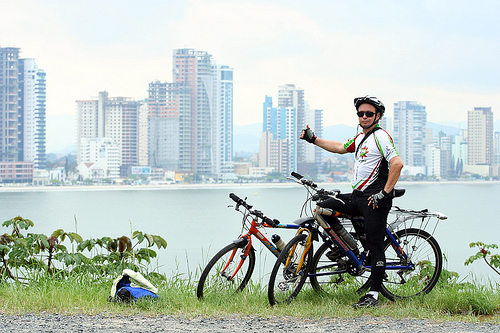
Martinho with Balneário Camboriú in the background
Itapema and Bombinhas
The next day, we went to return the apartment keys to Denise. We said our goodbyes and hit the BR-101 heading south once more. Our next stop was the beach at Itapema, followed by Bombinhas. We had an easy, leisurely ride that day, as Camboriú is relatively close to Bombinhas. On the way to Itapema, we pulled into a gas station and spotted a bicycle plastered with stickers and loaded with gear leaning against the wall. I said: “Martinho, look—there’s a madman here!”, and sure enough, sitting in the corner having lunch was a character wearing a ball cap. His name was Alejandro Ramos, an Uruguayan. We chatted for a few minutes and took photos with him. He told us he had been on the road for a whole year and began rattling off the Brazilian states he had traversed, in a thick accent: “I’ve done Rio Grande do Sul, Santa Catarina, Paraná, São Paulo, Rio de Janeiro, Espírito Santo, Minas Gerais, Bahia...” and so on. The last one I recall him mentioning was Maranhão! He told us he had logged roughly 10,000 km. It was a fascinating encounter. Passing through Itapema, we stopped at a pharmacy to ask for directions. Just as Martinho pulled up to the curb, his cycling shoe caught in the pedal clip, sending him tumbling and rolling across the sidewalk. It all happened in a flash—he fell, rolled, and sprang back to his feet, while his bike hit the ground with a resounding crash. As he walked into the pharmacy, a fellow inside quipped: “Well, to each their own way of getting off a bike!”. It was hilarious. We dropped by a shop owned by two friends of Martinho and chatted for over an hour. Afterward, we headed to a steakhouse for lunch. We knew full well that heavy grilled meat, blistering sun, and the road don't mix well, but it was simply irresistible! An hour later, we rode along Itapema beach toward the peninsula that shelters the beaches of Bombas and Bombinhas. Passing through Porto Belo, I remembered that this was where the Schurmann family had recently set sail on their great voyage retracing the route of Portuguese navigator Ferdinand Magellan. I have immense admiration for them. The road leading to Bombinhas features brutally steep hills with virtually no shoulder. At that point, I dismounted to push my bike up safely on foot. Martinho, ever the warrior, never dismounts! Upon reaching Bombinhas, we went looking for a campground. To our surprise, rates were far steeper than usual, inflated by the sheer influx of foreign tourists in the area. We pitched our tent under a gentle drizzle. It's astonishing how fast we can set up camp now! Once again, we could rest. We camped at a spot called “Retiro dos Padres”—a gorgeous cove with a tiny beach framed by rocks. Our tent stood barely three meters from the boulders where the surf crashed. There's nothing quite like falling asleep to the ocean breaking right beside you! Night fell, bringing with it our saddest dinner yet: hot dogs on plain bread! Still, not bad, and hunger makes the best sauce.
The morning of our seventh day greeted us with brilliant sunshine, which was a blessing, allowing us to dry out all our damp gear. The day wore on and we lingered. We strolled over to neighboring Lagoinha beach and decided to hop on a schooner tour. It wasn't cheap, but it was well worth it. The boat carried us over to Porto Belo Island and dropped anchor so we could snorkel. The four-hour excursion was wonderful, even including a visit to a marine natural history museum. We returned to Bombinhas around 3:00 p.m. and had lunch. We still had to figure out a way to reach Florianópolis that very day.
The Destination
I faced a decision: stay on the road for a few more days alone, or head back with Martinho once we reached Floripa. Martinho had pressing work commitments two days later. I told him: “Martinho, I'm going to keep going solo.” He said: “Cool, man, sounds good to me.” We struck the tent and headed back out toward the highway, bound for Florianópolis. Having left far too late in the day, it became clear that night would overtake us once again. Then, to our utter surprise, we ran into our friend Alejandro again! An incredible coincidence. Alejandro was also heading to Floripa and rode along with us. It was over that roughly 80 km stretch that we realized just how eccentric Alejandro truly was. We discovered he was a smoker—in fact, he lit a cigarette every ten kilometers without even slowing his pedal stroke! He drank exclusively tap water and regaled us with wild tales of his adventures, romantic escapades, and broken bones along the way. I quizzed him about cycle touring outside Brazil, and Alejandro answered every question. I asked if he had ever pedaled in the Andes and what the roads were like in Uruguay and Argentina. He told me Uruguayans are exceptionally welcoming toward cyclists, while Argentine drivers are completely reckless. The bit about Argentine drivers was nothing new to me, but soon enough, I’d find out firsthand. Alejandro also claimed that once, near São Paulo, he crashed and broke his arm, yet kept pedaling with a fractured limb. I still don't know whether to believe everything he told us. He also claimed that once, while flying down the Serra de Santos, the highway patrol pulled him over for speeding! One wild yarn after another! Alejandro had a reflective decal of sorts fixed to the back of his helmet. A great safety feature—I have two motorcyclist-grade reflectors on mine. His glowed brilliantly, so I asked where he'd bought it. He grinned: “I swiped it off the Raposo Tavares highway in São Paulo!”. Turns out he had pried off one of those cat's-eye reflectors from the roadside guard posts! Funnily enough, Alejandro seemed widely recognized by local truckers; every rig that roared past gave him a friendly blast of the horn.
We rode into the night toward Floripa. We pulled into a truck stop bustling with long-haul drivers where, according to Alejandro, we could score free coffee. We drank our coffee, and as we stepped outside, a circle of truckers gathered around us, eager to hear our stories and ask questions. A fascinating encounter! Alejandro guided us through a shortcut near Floripa that shaved off about five kilometers. Another quirk of our eccentric Uruguayan companion: he catcalled every streetwalker he spotted along the way! Perhaps he actually knew them.
I had a friend named Luciano living in Floripa, but unfortunately I couldn't reach him because I only had an outdated phone number.
Before long, we reached the island. We said our goodbyes to Alejandro. We lingered just past the Hercílio Luz Bridge, the city’s postcard landmark. I still hadn’t made up my mind about pressing on alone. It was already 10:00 p.m. and we had no one else to call in town. Our only options were to hunt down a campground or check into a hotel. My mind drifted back over everything we had experienced over those past seven days. I weighed the financial costs against what we had achieved. After all, we had pedaled 506 km in a week—five days in the saddle, two days resting. I realized that, up to this point, I had taken a monumental step toward realizing my lifelong dream. Then I turned to Martinho and asked, “Shall we head home?”. I was missing my girlfriend. I had already spent a fair bit of money. I had reached my goal. I was exhausted and longed for home. We hadn’t failed—far from it. We had completed the journey without major mishaps. In that quiet moment, a profound sense of accomplishment washed over me. We decided to head to the bus station to check departures for Ourinhos. There was a bus leaving in three hours. That settled it. All I wanted was to sink into that bus seat and sleep all the way back to Ourinhos. And that’s exactly what we did.
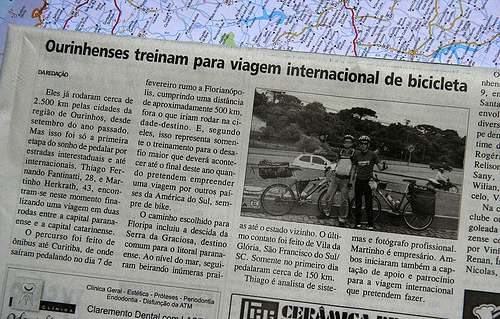
Newspaper article about the trip
posted by Fantinatti | 2:59:
Entry #02(ID: 56)
Monday, September 29, 2008
Our crash on Serra da Graciosa in Paraná, February 2008
At times, descending Serra da Graciosa, we reached speeds over 50 km/h, and it was on a sharp bend that we took a spill. All duly captured on video. After that, we eased up on the pace a bit.
The camera mounted on the bike's fork
posted by Fantinatti | 7:28:
Entry #03(ID: 57)
Monday, September 29, 2008
Visit to Antônio Olinto in Timburi/SP - May 4, 2008
On May 4th, we visited Antônio Olinto Ferreira in his motorhome in Timburi, SP. Someone I consider our advisor and who gave us invaluable tips for our journey.
During our meeting, we talked about the route we plan to follow and about gear. Olinto was remarkably attentive to both of us (mere beginners). It is wonderful to meet someone who has accomplished so much on a bicycle and yet lives life with such eloquent simplicity. I got an autograph in his book, and Martinho bought some travel guidebooks created by Olinto and his girlfriend Rafaela.
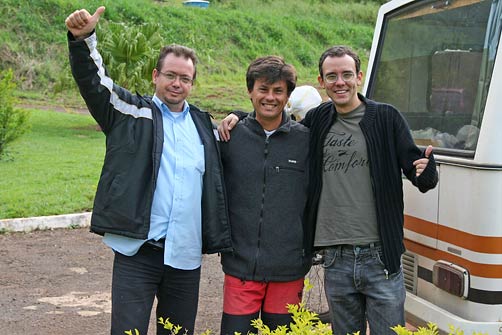
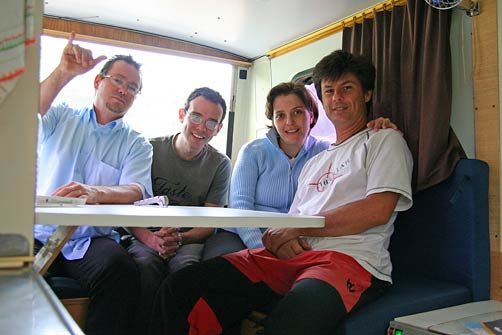
Martinho, Olinto, and Thiago
Olinto cycled around the world 15 years ago, clocking more than 45,000 km over a journey of more than three years. On his website, you can see photos and videos of his adventures: www.olinto.com.br
Martinho, Thiago, Rafaela, and Olinto
As I write this, Olinto is probably heading off on yet another of his adventures, this time to the far north of Europe. A warm hug, my friend! Best of luck on your adventures!
posted by Fantinatti | 7:31:
Entry #04(ID: 58)
Monday, September 29, 2008
Crash on the Second Day of the Journey - September 8, 2008
Friends,
I saw my trusted orthopedist today, September 10th, and he confirmed that my left wrist is indeed broken. He spotted the fracture that the doctor in Ibaiti missed. The tip of the radius bone is chipped. I'll be in a cast for 28 days.
I'd like to say that the cast will be dropped off by bicycle in the exact same spot where I fell... One obstacle more or less makes no difference.
Yesterday, September 8th, the second of the 250 planned days of my journey, I suffered a rather nasty crash near the town of Ventania, PR, about 160 km from Ourinhos, at around 2:00 PM. After lunch and a rest at a roadside diner, we set off, and about 1 km down the road on a steep downhill, I got distracted for a single second and the drop-off at the shoulder threw me off. I was doing around 50 km/h, and a crash at that speed with all that luggage can be compared to crashing a small motorbike.
I ended up with scrapes on my back, the side of my hip, and my ankle. I sprained my left ankle and took a hard blow to my left knee. I was treated at the ER in Ibaiti, PR, and had an X-ray of my left arm, which seemed broken, but fortunately they found no fracture, just a sprain in my wrist and elbow. I was given medication and am taking painkillers. Today I'm seeing my own doctor for a second opinion. The arm wasn't put in a cast.
When I crashed, Martinho, who was riding ahead of me, didn't see me and was alerted by truckers about 1 km down the hill. I sat there waiting for help because I was in so much pain. Shortly after, a car with two people pulled over, and Martinho came back up. They picked up the bike, which had its rear rim badly damaged, and Martinho helped me fix my shorts and put on my shoe that had been torn off.
They took us to the diner, and a young man named Maurício who was driving by gave us a ride to Ibaiti for medical attention about an hour and a half later, as emergency rescue was taking too long.
The bikes and most of the luggage were left at the diner, and today, the 9th, Martinho is going to pick them up.
My leg woke up feeling fine today and could theoretically pedal already, but my arm might take 3 to 5 weeks. Starting next week, I'll begin leg workouts at a gym so I don't lose my conditioning. As soon as I'm recovered, I'll set off from Ourinhos again, and this time to do it right.
This was my first serious wipeout caused by shoulder defects in more than a year and nearly 7,000 km in the saddle.
I always take the positives from every situation. I didn't hit my head, I crashed close to home, and I didn't have fractures. And a few lessons: don't bomb down hills with full touring bags, and pay closer attention to imperfections in the road shoulder. Lessons learned right on time.
I intend to restart as soon as I'm able. More carefully and more slowly.
As the main character says in the movie "The Pursuit of Happyness": This part of my life is called "learning."
Thank you, everyone!
Thiago - 09/09/08
posted by Fantinatti | 7:52:
Entry #05(ID: 59)
Thursday, October 9, 2008
Fracture, Luggage, and Preparation - October 9, 2008
Fracture
Yesterday, October 8th, one month after my crash, I had the cast removed from my arm. If I had to rate the condition of my arm on a scale of 0 to 10, it would go like this: at the moment of the crash (-1); in the cast (0); and right now I'd give it a 4. It's no longer broken, but it's practically useless :-). The doctor said that in 10 days I'll regain full range of motion.
Once I can support my weight with my arm extended, it'll be time to hit the road again.
I plan to restart from the exact spot where I crashed. After thinking it over, I thought that was a good idea since the nearly 160 km stretch up to that point is already done. That way, Martinho gains two more riding days and can venture further as well.
I'll probably start out with some kind of arm brace at first. I don't have time to wait until my arm is at 100%, since summer is approaching and after Christmas the race against the sun begins, as the days start getting shorter again. Anyone who has ever broken a bone knows how it is. It would take over 60 days for the arm to be completely back to normal. I intend to set off 45 days after the crash.
Luggage
Three factors contributed to my crash. The first was the shoulder's drop-off being too high. The second was high speed, and the third was my momentary distraction. Those three factors combined in that single second brought me down, but had I been riding without luggage, I would have managed to save it. This got me thinking about cutting down on the weight and volume of my gear.
My bike isn't heavy. Straight from the factory, it weighs 12.5 kg. With the mounts, rear rack, and other accessories, it comes to 16.9 kg. When I crashed, I was carrying roughly 26 kg of gear, which together with the bike added up to around 43 kg.
The last time I set out, on September 7th, I had cut a few items, like a 1.5 kg pair of combat boots, for instance. All told, I trimmed it down from 30 kg to 26 kg. But now I want to shed even more.
I was carrying an adapter to use 35mm lenses on my camcorder. The results with this gear are incredible—you get all the focal depth, selective focus, and perspective of an SLR camera, but on a camcorder. The trouble is that the adapter and its accessories weigh over 1.5 kg. It's out. Unfortunately.
Ditching the adapter also means leaving behind the protective case for it. That saves volume as well.
I might also leave behind the small action camera that mounts to the bike. It's compact, but it has weight, and the image quality isn't anything special.
The folding Kevlar tire is staying behind too. When I bought it, I thought I'd start on skinny tires and planned to use it in case of transitioning to rough terrain. It's not that heavy, but it takes up a lot of space.
If I manage this reduction in luggage, I won't need the front panniers anymore, nor their racks. Doing rough mental math, I reckon I can shed about 5 kg in all. Not bad at all.
Another idea I scrapped was buying a netbook. It weighs almost 1 kg and would have helped me edit some photos. But that's out as well.
I'm going to keep only the two cameras in the handlebar bag. The rest I'll shift to the back. I'll secure it better, too.
That should make the handlebars much more stable.
Another modification I plan to make is on the rear rack. I'm going to weld an "X" brace onto it close to the frame. That'll make it stiffer.
I believe these changes will make riding easier and safer. I regret not being able to take everything I'd like, but I have to do what's best.
Preparation
During this past month, I haven't just been sitting around at home. I've been going to the gym daily to spin and strengthen my legs. The pain in my knee and ankle is completely gone. Incredible as it may seem, my conditioning is great. The acid test will happen soon. I'll know if I'm ready to hit the road again if I can make it to Santo Antônio da Platina, PR, and back. It's a demanding route, nearly 100 km round trip.
The Bike
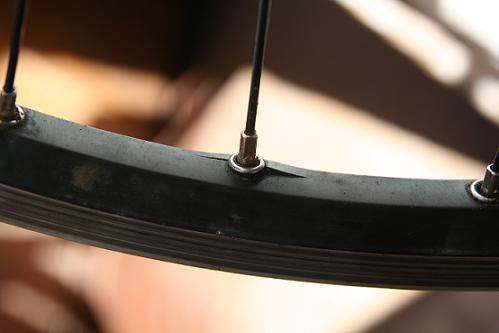
The only thing I had to fix on the bike was replacing the rear rim. It was beyond repair because it was badly warped. It's like new now, and you can't even tell it was swapped.
posted by Fantinatti | 3:25:
Entry #06(ID: 60)
Thursday, October 23, 2008
Back in the Saddle - October 22, 2008
Talking with some experienced cyclists and describing my crash, I came to the conclusion that I probably broke my left arm before I even hit the ground.
When I went down, there were no impact marks and my hand was clean—it never touched the asphalt, and neither did my whole arm.
I think I fractured my wrist when the handlebars whipped around and I flew over them. It must have twisted my arm in the process. That also explains the elbow dislocation.
Finally back in the saddle!!
Rain, sun, and flat tires... that's life on the road... you gotta love it! I think by the end of the month I'll be ready to resume my journey...
Today, October 22nd, 43 days after colliding head-on with Murphy's Law on a curve and fracturing my arm on the second day of my trip, I was finally able to ride... I wanted to ride to Santo Antônio, which would have been around 98 km round trip, but I got a flat tire in Jacarezinho right in front of a tire repair shop... so I let him patch it for me... I decided to turn back from there because there wouldn't be enough daylight to make it there and back. It ended up being 52 km... It's not huge, but for someone who broke an arm, it's not half bad. It's hurting a lot, but manageable, haha...
posted by Fantinatti | 4:31:
TRILHANDO SONHOS BOOK
Enjoying the story? There is so much more in the book!
The crash on the Graciosa road, the wrist fracture, and the heavy doubts before departure were just the prologue. In the book Trilhando Sonhos, you can follow in intimate detail how the courage to leave everything behind and take on South America on two wheels was born.
STAGE 02 OF THE EXPEDITION13 entries in this stage
The Departure & Southern Brazil
Nov to Dec 2008 • Fresh start, Santa Catarina, Rio Grande do Sul and Chuí border
Entry #07(ID: 61)
Tuesday, November 11, 2008
Restarting the Journey
We restarted the journey from the exact spot where I fractured my arm. We set out on November 2nd, and since yesterday, November 4th, we've been in Curitiba.
Tomorrow, the 6th, we're heading toward Joinville, already across the border in Santa Catarina.
For now, I'll have to owe you new photos on the website, as the internet café I stopped at won't let me update the site due to a technical limitation.
We caught quite a lot of rain on the first day. It poured for about five hours straight out on the road. We spent the night in the town of Castro, covering roughly 109 km that day.
On the second day, we left Castro bound for Curitiba, but that would have meant 160 km under a scorching sun. We managed to ride as far as a truck stop called Panorâmico, about 32 km past Ponta Grossa. We ate at the truckers' diner and pitched our tent behind the RodoNorte highway assistance base. We also used their kitchen to fix some breakfast.
On the third day, we rolled into Curitiba. We're staying at the house of an acquaintance of Martinho's named Verônica.
As soon as possible, I'll post new photos to the site. Most likely once we're in Santa Catarina.
In total, we've already covered more than 420 km. Today alone, riding around Curitiba, we'll clock over 35 km..
posted by Fantinatti | 2:00:
Entry #08(ID: 62)
Saturday, November 15, 2008
Santa Catarina
Hello everyone,
Please excuse the lack of accents since I'm typing on my Palm and haven't figured that out yet.
I'm writing from the beach in Imbituba on the southern coast of Santa Catarina. Tomorrow morning, the 16th, I'll continue heading south through the state.
I don't know when I'll manage to get into an internet café to upload more photos to the site, but I promise to post new ones soon.
I spent three nights in Floripa staying at the home of a friend and former student named Eugênio.
Martinho, my touring partner, has already returned to Ourinhos. He caught a bus out of Floripa.
I took a break in Floripa to recover from some pain in my right knee. I started feeling twinges back in Curitiba, and it only got worse. I practically crawled into Floripa. To make matters worse, my chain snapped. But we replaced it quickly. It's better now. I dialed back the pace and took some anti-inflammatories. I think the knee took a beating from the hard pace early on.
Crossing Paraná wasn't easy, and when we arrived in Santa Catarina, we were greeted with rain and more rain.
Now the rain has finally stopped.
Yesterday was my second day riding solo, and it feels quite strange. Yesterday, I also lost my first tire. I knew the stock tires that came with the bike weren't anything special, but the rear tire didn't even last 2,000 km. It blew out, tearing right near the bead. Lucky I had a spare. As soon as I arrived in Imbituba, I bought a new tire.
Today I decided to stay in Imbituba and went to the beach. My first ocean swim of the expedition.
I can't wait to reach Rio Grande do Sul. I reckon in another two days I'll make it.
I've picked up a new habit: I now have a chimarrão gourd. Every time I arrive somewhere, I brew one. It has become a ritual.
I still haven't gotten used to the routine of having no routine... and being alone isn't easy...
posted by Fantinatti | 7:50:
Entry #09(ID: 63)
Monday, November 17, 2008
Generous Doses of the BR-101
Once again, I apologize for the lack of accents in the text.
I'm writing from a little roadside motel just outside the city of Criciúma, in southern Santa Catarina.
It's incredible what you can stumble upon out here. A room for 20 reais, and they even have Wi-Fi.
Yesterday, in the city of Laguna, I wanted to camp, but couldn't find an open campsite. I ended up finding a hotel with a suite the size of a house: two bedrooms and even laundry facilities, all for 18 reais.
The BR-101 South is one massive construction zone. They're widening it into a four-lane highway, so there are dreadful stretches with no shoulder, but also fantastic newly paved sections—especially when I get the smooth, fresh asphalt all to myself, since traffic hasn't been opened yet.
I have good news. As if by a miracle, my knee stopped hurting. I rode 90 km today at a solid clip and felt nothing. Covered those 90 km in 4 hours. Not bad at all.
Tomorrow I should reach Gaúcho territory. As soon as I get to the town of Torres in Rio Grande do Sul, I'll post new photos to the site.
Yesterday I bumped into another cycle tourist near Laguna. His name is Leonardo. Brave guy, that Leonardo—carrying at least three times more gear than me, including a trailer hitched to his bike. He's from Nova Petrópolis, near Gramado, north of Porto Alegre, and was riding north to Balneário Camboriú for a cycle touring rally.
Just a short while ago, I met a very humble older gentleman traveling by bicycle. What blew my mind was that he carries two dogs on his bike, tied on with a piece of cloth. I was deeply impressed. And these aren't small dogs either. While I'm in the hotel, he's out there resting under a tree. Some sights really touch your heart.
I'm constantly struck by the plight of people and animals along the road.
Yesterday, rolling into Laguna, I found a puppy. A beautiful little thing, lost by the side of the highway, sitting there all by herself. I didn't know what to do. I stayed there with her for about 20 minutes until an elderly man came by with a wheelbarrow and carried her off to safety.
posted by Fantinatti | 7:32:
Entry #10(ID: 64)
Monday, November 17, 2008
Ilex Paraguariensis
Today I woke up earlier Drank chimarrão all alone Searched for the night in memory Searched in vain
Today I woke up lighter Didn't even read the morning paper Everything must be suspended Nothing should carry weight
I've lived through so much already Have so much yet to live I'm right in the middle of the ROAD And no defeat will conquer me
Today I woke up free I owe nothing to anyone There's nothing tying me down HERE
It was still night I waited for day to break Like someone heating water Without letting it boil
Today I woke up Now I know, living in the dark Until the flame ignites
Warm green herb deep inside belly bowels Bitter mate, deep into the night Strange road
Ilex Paraguariensis (Engenheiros do Hawaii)
Note: This is the scientific name for yerba mate, and I wrote the lyrics from memory... haha
posted by Fantinatti | 9:27:
Entry #11(ID: 65)
Thursday, November 20, 2008
Happy Birthday to Me!!!
I'm still in Torres, RS. The day started with heavy rain and a cold wind here, so I decided to stay one more day. I've ridden in these conditions before, but I'm staying in a hotel that costs just 12 reais a night!! And heading out into the cold, wind, and rain to start the day is pure misery.
To be precise, I'm staying in Passo de Torres, SC, but you just cross the bridge 300 meters away and you're in Torres, RS. Hotels are cheaper on this side.
Yesterday I walked almost all over Torres on foot. It's a pretty town, but not very big.
Tomorrow I'm riding on to Capão da Canoa or Tramandaí, and the next day to Porto Alegre. In fact, I already have three contacts in Porto Alegre: Leonardo (whom I met along the way), Vera and her family (whom I met in southern SC), and a German named Clauss, from whom I might buy a heavy-duty tire—one that WON'T BLOW OUT!! haha.
My knee has definitively stopped aching and I'm discontinuing the anti-inflammatories. The broken arm feels good as new and is "bone-dry," as doctors say, so you can clearly see the callus on the chipped bone.
Yesterday I learned you shouldn't leave your underwear drying on the windowsill and head out. The weather can turn, and the wind will blow it right away. Lost a pair that way...
and it keeps on pouring outside....
posted by Fantinatti | 2:22:
Entry #12(ID: 66)
Thursday, November 20, 2008
Cycling Performance
Even though I'm not the least bit preoccupied with this, I'll share a few numbers regarding the mileage logged so far.
Up to here in Torres, I've clocked 1,142 km. If I divide that by 21 days, that's an average of 54 km per day. But I spent 7 days completely off the bike: 1 day in Curitiba, 1 day in Camboriú, 2 days in Floripa, 1 day in Imbituba, and 2 in Torres. So that makes 14 riding days. That comes out to an average of nearly 80 km per day, which is right in line with the 75 km a day I expected to do.
Over the past few days, I averaged 90 km. That includes the 92 km push to reach Torres, battling a headwind the entire time.
I expect that past Porto Alegre my daily average should go up, since the roads are good, very flat, and carry far less traffic. The same should hold true for Uruguay.
posted by Fantinatti | 4:35:
Entry #13(ID: 67)
Monday, November 24, 2008
Gaúcho Lands
I am writing from the home of a couple here in Porto Alegre. I met them at a gas station in southern Santa Catarina. They gave me their contact info, and as soon as I arrived here, I gave them a call. They've been wonderful to me. Tomorrow I'm staying put and having lunch with them. She is a writer and he is a singer-songwriter.
Ever since crossing into Rio Grande do Sul, I've had nothing but rain and cold wind. Only today, between Osório and Porto Alegre, did the sun finally come out... and what a sun it was!
I spent three days in Torres in the north of the state waiting for the rain to clear, but it never let up. So I pushed through the downpour to Capão da Canoa and Osório.
In Osório, I learned what real wind is. The town is known as the national wind capital. It's difficult even to walk down the street. They even have a wind farm there.
Today I left Osório and rode to Porto Alegre, a journey of over 100 km along the Freeway highway. With a ripping tailwind, I covered 100 km in 3 hours and 50 minutes... my all-time record.
Of all the state capitals I've visited, Porto Alegre is the strangest, and my first impression wasn't great. I was expecting more (forgive me, Porto Alegreans).
From here, I'll head back to the coast and continue my journey south. I already know the rain has stopped further down, having seen it on TV. In fact, cattle in the southern part of the state are dying of thirst due to severe drought.
posted by Fantinatti | 12:21
Entry #14(ID: 68)
Monday, November 24, 2008
Where to Go?
A strange yet fascinating thing is how accustomed I'm becoming to not knowing where I'll spend the next night.
I just finished lunch here at the home of my new friends. It's in Porto Alegre, near the municipality of Alvorada.
In a little while I'll call my other contact here; only then will I know whether to head back into downtown Porto Alegre or pedal toward Capivari do Sul, where I plan to spend the night.
What once felt like a dilemma—not knowing when or where to go—now feels completely comfortable. I don't really mind whether I leave today or not. :-) The only thing that truly matters is having shelter when night falls...
posted by Fantinatti | 12:17
Entry #15(ID: 69)
Monday, November 24, 2008
Poll :-)
What do you think is a cycle tourist's worst enemy?
a) Heat b) A hangover from a night of drinking c) Poor nutrition d) The climbs e) Laziness f) Potholes g) Trucks h) The wind
If you answered H, you got it right...
Once again, my apologies for the lack of accents, as I'm typing this on my Palm.
Ah, the wind...
Today I left Porto Alegre and passed through the town of Viamão. I rode past the Tarumã racetrack, where the penultimate Stock Car race of the season took place yesterday. I slipped in because the gate was open and got to see the track and the crews packing up... shortly after, I was politely invited to leave... haha.
Today my goal was to reach the town of Capivari do Sul, but I only managed to make it halfway. The wind is blowing ferociously from east to west, and by 7:30 in the evening (with the sun still out), I threw in the towel. The very same wind that blew me into Porto Alegre in record time wouldn't even let me reach 50 km today. But that's alright. Tomorrow I begin skirting Lagoa dos Patos, heading toward the south of the state and Chuí.
posted by Fantinatti | 10:40
Entry #16(ID: 70)
Wednesday, November 26, 2008
Hell and Heaven
November 25th was both the worst and the best day of the journey so far. Let me explain...
I set out from Águas Claras toward the towns of Capivari do Sul and Palmares do Sul. I knew the wind would be an issue, but I had no idea it would be this brutal.
After pedaling about 12 km, I heard someone shout: "Want some lunch?" I turned around and saw a man standing by the side of the road. I asked, "What do you have there? A diner?" He replied, "No, I live here." That was the first surprise of the day.
Retired firefighter sergeant and assistant referee Bittencourt invited me inside, and I sat down to lunch with his family. Their hospitality was incredible. After lunch and a good chat, he gave me a pair of official referee shorts, a shirt, a traditional gaúcho knife, and a medal. Then we took photos. It was truly wonderful.
Bittencourt and his family
I pushed on toward Capivari do Sul, and the headwind kept worsening. At times it was almost comical. I had never witnessed wind like this, not even in ferocious storms. It's simply impossible to pedal faster than 9 km/h... I was thoroughly depleted, and thank goodness I had food with me. On top of that, my front rack snapped, though I managed to fix it easily.
I fought through 40 km against this unbelievable headwind, even pushing the bike on foot for about 4 km. I was utterly worn down. That was the toughest stretch of the trip so far—the bitter part of the day.
Past Capivari, I turned south and caught a fierce crosswind. Less punishing than a headwind, but if you're not paying attention, it will blow you clean off the road.
As soon as I rolled into Palmares, I went looking for a hotel or guesthouse. I found one for 40 reais that had everything (breakfast and even internet), and another for 20 reais that had nothing at all—just a bare bed, lol... I went to the market to buy groceries to cook and crossed paths with a couple who immediately asked where I was from. They told me they were with a circus that had just arrived in town. They invited me to pitch my tent next to their camper trailer. I didn't think twice. I thought it was fantastic.
Anderson and Luana welcomed me with open arms into their modest three-square-meter trailer. Incredible human beings. I pitched my tent right alongside. They cooked a delicious dinner, and we spent the evening watching several Cirque du Soleil DVDs... Today I even had lunch with them again, and now tonight (already back at the hotel), I dropped by to say goodbye, since I'm leaving at first light. Tomorrow they finish setting up the big top. Spending the evening with them was the most wonderful experience of the journey so far.
Now they're going to need a bigger trailer, as Luana is two months pregnant.
Anderson told me so much about how circus life really works.
Anderson and Luana
posted by Fantinatti | 10:55
Entry #17(ID: 71)
Sunday, November 30, 2008
Heading for Chuí
I think pretty much everyone knows where Chuí is. This little town is famous for sitting right at the very southern tip of the map of Brazil. It borders Uruguay, and on the other side of the border it's spelled Chuy, with a 'y'.
I still have about 220 km to go before reaching Chuí. I'm in Rio Grande, near Pelotas, deep in southern Rio Grande do Sul. Today, Sunday, I didn't pedal at all. I simply took a boat to cross from São José do Norte to Rio Grande.
During the 300 km I rode alongside Lagoa dos Patos—that narrow strip of land down here in southern Brazil—I didn't see the ocean or even the lagoon itself. The strip is narrow, but the road runs straight through the middle of it. I only caught sight of the lagoon today. Naturally, it's vast, but it's staggering at first glance. It's an inland sea!
Over my last three riding days, I covered 120, 30, and 134 km respectively... which works out to a solid average of over 95 km a day.
The route over these past days has been completely flat. A landscape dominated by rice plantations and howling winds! Very few towns and sparse rural hamlets.
Rio Grande is the last 'major' city in Brazil, with roughly 200,000 residents.
Actually, the southernmost point of the country isn't Chuí, but Barra do Chuí, on the coast. I'm planning to pass through there. At that spot, I'll be the southernmost Brazilian on the map :-)
I've logged 1,734 km up to this point. Only slightly less than I had hoped to cover. The rain and my knee have set me back a bit.
posted by Fantinatti | 11:02
Entry #18(ID: 72)
Tuesday, December 2, 2008
Rio Grande of the Southern Winds
Yesterday I departed Rio Grande bound for the South. The wind shifted and is now blowing straight from the south—which is to say, right into my teeth. I pedaled 21 km to a settlement called Quinta. Along the way, I battled the strongest winds I have ever witnessed in my life. I had never experienced gusts like that. I had to pull over because it had simply become too dangerous. The wind blew me right off the road, and crossing a bridge, I was completely powerless against its violent fury. Even pushing the loaded bike on foot, it was tough to move forward at times. It felt like fighting upstream against a raging river current.
When I got to Quinta, I saw on the map that about 15 km further ahead lay a town called Sarandi, so I pressed on. To my surprise, Sarandi isn't a town at all, just a scattering of small farms. I wound up pitching my tent next to a pasture in front of a homestead. I weathered the night in the tent buffeted by fierce winds and rain, but inside it was warm and comfortable.
Early this morning there was a light drizzle, and I lingered in the tent hoping for a glimpse of sun to dry it out, but the rain only grew heavier.
Just as I had resigned myself to setting off under the drizzle on an empty stomach, I passed the house of a gentleman named Antônio Xavier and stopped because the weather was foul. We shared lunch, and he persuaded me to stay the night here.
Antônio told me that three months ago an American couple touring by bike had passed through. He showed me their calling card. Gynna and Ben had pitched their tent in his backyard.
Mr. Antônio's home is exceptionally humble, like everything around here. But his hospitality was incredible.
Early tomorrow morning I set off south. As soon as I reach Chuí, I will upload fresh photos to the site.
posted by Fantinatti | 5:01:
Entry #19(ID: 73)
Saturday, December 6, 2008
The Far South of Brazil
I am in the town of Santa Vitória do Palmar, a place of 35,000 residents roughly 15 km from Chuí. I stayed here because I wanted to spend a couple of nights in a small hotel; the week has been rather exhausting.
Tomorrow (Sunday) I pedal on to Chuí and will make a detour to Barra do Chuí.
The last 250 km in Brazil haven't been easy. There isn't much out here. Endless stretches of flat road trailing into infinity. All that meets the eye are rice fields and pastureland.
It felt as though Saint Peter didn't want me to leave the country. The headwind was relentless, but on the final day I rode 102 km to get here without issue. The wind finally died down!
After leaving Antônio Xavier's house in Sarandi, I pedaled 58 km to the fire brigade outpost at the Taim Ecological Reserve. It was cold and drizzling, so they let me pitch my tent in the courtyard. We watched the Internacional soccer match, the telenovela, and the following day I even had lunch with them.
Leaving the reserve, I even spotted a caiman. I also saw plenty of dead capybaras on the roadside shoulder, and I even rescued a turtle from certain death. I cycled past a turtle shell right in the middle of the road. I circled back to see if it was still alive. When I picked it up, I saw the turtle pulled all the way inside, terrified. I carried it safely into the roadside brush. Poor thing, it would have stayed in the middle of the highway until it was crushed. Semis were roaring right over it.
The following night I slept in Igor and Juliane's garage. They work at a gas station out in the middle of nowhere! I had dinner with them and we watched TV.
Igor and Juliane
Yesterday, before reaching Santa Vitória, I met two guys at a gas station. They are cousins from Criciúma, Santa Catarina: José Ceolin and Dário Ceolin. They took pictures with me, and I pedaled on. Later they overtook me on the highway and pulled over. They surprised me with a gift of 50 reais. We took more photos. They were driving to Montevideo on vacation.
José and Dário
I've been seeing lots of motorcycles on the highway because of a major biker rally in Punta del Este, Uruguay, which is quite close from here—only about 200 km away.
posted by Fantinatti | 10:19
TRILHANDO SONHOS BOOK
The road is just beginning... Want to go deeper?
From the biting southerly winds of southern Brazil to the first solitary tests along BR-101, every kilometer of this start is chronicled with photos and profound reflections in the book.
Dec 2008 • Castillos, Punta del Este, Montevideo and Colonia del Sacramento
Entry #20(ID: 74)
Wednesday, December 10, 2008
Chuí / Chuy
The moment I rolled into Chuí, I headed straight for the avenue that forms the border between Brazil and Uruguay. All you have to do is cross the street and you're in Uruguay. I snapped a photo right there and set out for Barra do Chuí, some 10 km to the southeast. Barra do Chuí is the southernmost beach in Brazil. I rode right up to the final meters of Brazilian soil and took some pictures. Afterward, I pedaled along the beach, which I soon learned is the longest continuous stretch of beach in the world, running all the way back to the city of Rio Grande. Standing there at the very edge of Brazil was a profound experience.
Upon arriving in Barra do Chuí, I met an elderly Canadian gentleman who immediately offered me a place to stay. His name is Norman Yelled. I stayed in an enormous, spotless house for 20 reais.
I took photos with Norman, and he jotted down extensive notes on my maps pointing out municipal campgrounds and intriguing places across Uruguay and Argentine Patagonia.
Norman has crossed the entire continent in an RV roughly 50 times. He also lent me a travel guidebook to browse through that evening.
The following day I stopped at the last (or first) Bradesco bank branch and went to a currency exchange booth. I almost walked into a casino... Then I set off for Punta del Diablo, some 58 km further south, now in Uruguay.
posted by Fantinatti | 10:38
Entry #21(ID: 75)
Wednesday, December 10, 2008
Punta del Diablo
I am staying at a modest hotel in the town of Castillos. After three days in Uruguay, I was finally able to take a proper shower. Over recent days I've been doing what I call a very, very low-cost trip... meaning I've been spending next to nothing. Yesterday in Punta del Diablo, I spent a mere 80 Uruguayan pesos—roughly 8 Brazilian reais.
Before reaching Punta del Diablo, I stopped at the Fortress of Santa Teresa in the north and was struck by its rugged beauty.
Soon enough, I spotted a motorcycle bearing Colorado (USA) plates. It belonged to a guy I had seen back in Chuí. His name is Hugo. He told me he has circumnavigated the globe by motorcycle and bicycle and works for the Discovery Channel. He speaks Portuguese remarkably well. We arranged to meet at a bar called El Timón in Punta del Diablo, some 35 km further south.
The moment I arrived in Punta del Diablo, I was captivated by the sheer beauty of the beach and the serene vibe of the settlement. Another thing that startled me was the apparent lack of planning: houses are built haphazardly right on the sand.
I was lounging by my bike on the beach soaking up the sun when a local Uruguayan named Marcos came over and offered me a place to sleep at his house. Marcos speaks fluent Portuguese, and I accepted on the spot.
Moments later, two guys from New York appeared. One was holding a medium-format camera, which I adore. We chatted for a while, and they took several portraits of me.
I lingered on the beach until late afternoon and ended up meeting four young Uruguayans—two lads and two delightful young women. We shared a mate on the sand and chatted about Brazil. I discovered they watch Brazilian telenovelas down here. Currently they're airing *Paraíso Tropical*, dubbed in Spanish of course. One of the girls confessed she watches *A Favorita*, hahaha... via satellite dish, which explains why her Portuguese is so good. Northern Uruguay clearly absorbs plenty of Brazilian culture.
Later, I grabbed a pizza for 100 pesos. The figure sounds daunting at first, but it works out to just 10 reais. Right then, another cycle tourist materialized out of thin air, his bike laden with heavy panniers and gear. Before I could even ask him in English where he was from, he blurted out: "Man, where are you from?" Hahaha... a fellow Brazilian! His name is Denis. He's been touring the globe by bike for eight straight years! We talked endlessly and headed together to Marcos's house to spend the night.
I decided to stay an extra day in Punta del Diablo. We grilled up a small barbecue for lunch, and later I caught up with Hugo from the Discovery Channel again at a bar.
In that same bar, there was a family speaking French, whom we assumed were from France. Denis, who speaks fluent French, struck up a conversation, only to discover they were from Quebec, Canada.
While Denis chatted in French with the Canadian grandmother, I leafed through Hugo's photo album filled with pictures from across the globe—even from the summit of Mount Aconcagua, the highest point in the Americas.
Later that day, a Swedish fellow dropped by, asking where we were from.
I won't even mention the sheer swarm of Argentines.
I had never seen so many foreign travelers in a single place. That's the contrast with Brazil: here, Americans and Canadians don't have that lingering fear of being mugged.
Come evening, we cooked a warm soup and camped on the veranda of an empty beachfront house right on the ocean's edge. Early this morning I departed for Castillos, while Denis pedaled on toward Brazil after eight long years away.
Tomorrow I'll attempt to reach Punta del Este... let's see if the legs hold up.
Unfortunately, the hotel computer is excruciatingly slow, so I won't be able to upload fresh photos today, but I have plenty saved up.
posted by Fantinatti | 11:20
Entry #22(ID: 76)
Saturday, December 13, 2008
Punta del Este
Just when I start thinking this journey might settle into a predictable routine of pedaling from one town to the next, life catches me completely off guard.
I arrived here in Punta del Este yesterday afternoon. I passed through the town of Maldonado and rode straight down to the beach. When I got there, I took a few photos and met two French guys and an Ecuadorian. We chatted for a bit, and they invited me for a beer later that night. I went with them to the hostel where they were staying. A hostel is a network of budget travelers' lodges where everything is shared and you meet people from all over the world.
The crew staying here includes French, Argentines, English, Ecuadorians, and Brazilians. It's absolute madness. A complete cultural whirlwind.
Later on, I asked a girl in English if the shower was hot, and she asked me if the bathroom light worked. I said I had no idea since I had just arrived. A few minutes later I asked where she was from, and she said: Brazil!! Hehehe... a Carioca from Rio... it was hilarious. It's hard to tell if someone is Brazilian at first glance, especially when your English isn't great like mine.
That evening we rounded up a group and hit a bar. It was my first real night out of the trip. And since I'm only made of flesh and blood, I figured I had earned it. We stayed out until 2:00 AM, then caught a local bus to Maldonado to shoot pool in a dive bar. We played pool in a dive bar in the heart of Maldonado until 5:00 in the morning. It was unforgettable...
I spent a little more than usual, but nothing outrageous. Splurging for one day won't hurt. I doubt I'll run into many places quite like this along the route. I've already heard that Mar del Plata in Argentina isn't nearly as good as this.
Today I chose to linger an extra day, and we spent it soaking up the sun on the beach.
Tomorrow I should push on toward Montevideo.
The people I'm meeting are proving to be the very best part of this expedition. Before leaving, I thought cycle touring was about discovering places, but really, it's about connecting with people.
Tereza from Bahia. Mariana from Rio. Pedro from São Paulo. Pablo from Ecuador. Ian and Camille from France. Rafael from Argentina. Margaret from England.
posted by Fantinatti | 5:34:
Entry #23(ID: 77)
Monday, December 15, 2008
A Vacation Within a Vacation...
I am writing from a hostel in Montevideo.
Today was a 140 km grind with no wind and sweltering heat exceeding 30°C (86°F).
I'm in Montevideo now, but I still want to talk about Punta del Este.
I ended up staying an extra day in Punta because it was just so wonderful. I took a vacation within a vacation. The vibes were so good there, and after tumbling into bed after 5:00 AM two nights in a row, on Sunday I managed an early night and was able to rise early today, Monday.
Staying at that hostel in Punta was an extraordinary experience. Yesterday I finally managed to carry a conversation in English with ease when an American traveler checked in. As for the English girls' English, I can hardly catch a word because of their thick accent.
I already miss Pablo from Ecuador, Tereza, and Mariana. I have no words, my friends... Gracias por todo!
Our three-day friendship is like the sandcastle we built together at La Boca beach. It turned out so beautiful, and perhaps it will only last until the next rising tide... or maybe not! :-) Who knows.
I will never forget Uruguay and Punta del Este.
posted by Fantinatti | 9:51:
Entry #24(ID: 78)
Monday, December 15, 2008
Impressions of Uruguay and Montevideo
Well, so far I am absolutely enchanted by Uruguay.
Out on the highway today, a driver pulled over just to chat with me. A Brazilian businessman who lives out here. We talked about the expedition, and then he handed me 1,000 pesos. Hehe... He told me lunch today was on him, but with 1,000 pesos I can eat lunch for an entire week down here! :-)
Montevideo struck me as very well organized, and even though I rolled in at 6:00 PM, the traffic isn't nearly as chaotic as in Porto Alegre or Curitiba. There is just a faint haze of exhaust fumes because most cars here run on diesel. I really like this city... and there are plenty of beautiful women around, too, haha.
In about three days I expect to board the Buquebus ferry in Colonia and cross the Río de la Plata estuary bound for Buenos Aires.
I leave Uruguay with the absolute certainty that I will return soon.
That Brazilian fellow told me that Uruguay is one of those rare corners of the world where life is still real life. I couldn't agree more.
posted by Fantinatti | 10:17
Entry #25(ID: 79)
Wednesday, December 17, 2008
After Montevideo...
I'm in Santa Lucía. Today I decided to leave Montevideo and head north to stay at a really good municipal campground here—free of charge, of course. Norman, a Canadian cyclist I met back in Chuí, had recommended it to me.
On the way, I passed through Canelones, a town of about 70,000 residents. I asked a police officer for directions, and he spoke to me in Portuguese...
Yesterday at the hostel in Montevideo, we had a pool tournament. Brazilians against Spaniards and Germans... I lost.
I went to a market right in downtown Montevideo with a really great Australian guy I met; he had come from Rio de Janeiro. There, I ran into a Brazilian couple.
Today was 66 km on the hottest day of the entire trip. On days like this, the water gets as warm as tea... but it quenches your thirst just the same.
Today is my tenth day in Uruguay, and tomorrow morning I'll set off to pedal the 128 km to Colonia del Sacramento.
The trip has been very smooth, and I haven't had a flat tire since Santa Catarina. I haven't hit any rain in a long time either. I'm completely acclimatized and can easily ride 100 km under the baking sun without any trouble.
posted by Fantinatti | 5:50:
Entry #26(ID: 80)
Thursday, December 18, 2008
Adios, Uruguay!!!
Well, I'm writing from El Viajero hostel in Colonia del Sacramento. This is the last city I'll be visiting in Uruguay.
I spent the night at the municipal campground in Santa Lucía. I was able to do laundry there... The campground is great and free of charge.
From Santa Lucía to here was 150 km of relentless pedaling. A tough route and scorching sun. Much hotter than yesterday.
Today was one of those days of pushing past physical limits. I had to ride straight through because I ran out of Uruguayan pesos, arriving here with only 150 pesos left—the equivalent of about 15 reais.
I arrived completely exhausted at 8:30 p.m. It doesn't get dark here until a bit after 9:00, so I arrived in daylight. I headed straight out to eat a chicken chivito...
The hostel here is really nice, and I've already started spending my US dollars. The daily rate here is 14 dollars. I'll probably stay here for two days to rest. After that, I'm off to Buenos Aires. In all, it'll be 12 days in Uruguay. A wonderful country. I recommend this country to everyone.
Today I had already pedaled 78 km under the blazing sun when I saw the sign saying there were still 72 km to go... haha... Sayings like "If you're in the rain, you might as well get soaked" and "Relax and enjoy it" popped into my head, haha... I couldn't stop because I was low on Uruguayan money and there wouldn't be any exchange bureaus along the way. I put on my headphones and pressed on, savoring my last kilometers in the country. I arrived running on fumes. If I had had to ride a few more kilometers, I wouldn't have made it.
Along the way, a couple on a motorcycle rode past and handed me a two-liter bottle of ice-cold water... Ah, I didn't even care where it came from—I drank some and poured the rest over myself... the heat was unbearable and my water was piping hot.
Even after all that, I feel good physically. No aches or pains, and I could easily keep riding tomorrow if I wanted to.
I ran into a few Brazilians here, and I'm sharing a dorm with a really nice Dutch guy. There's a TV with movies, internet, and a bathroom in each room.
posted by Fantinatti | 11:48
TRILHANDO SONHOS BOOK
Loving this crossing? The complete adventure is in the book!
The deserted beaches of Castillos, the genuine warmth of the Uruguayan people, and nights under starlit skies come alive with unpublished details in Trilhando Sonhos.
Dec 2008 to Jan 2009 • Buenos Aires, desolate steppe desert and Valdés Peninsula
Entry #27(ID: 81)
Sunday, December 21, 2008
Pleasant Surprises in Buenos Aires
I arrived here today, the 20th, shortly after noon. I made the crossing across the mouth of the Río de la Plata—a 40 km boat trip in about one hour.
Buenos Aires is just like any big city. But arriving by boat and disembarking in an upscale neighborhood gives it a special touch.
Aside from the good parts, the rest was hellish. It's sweltering here, and combining that with the heavy traffic made finding the hostel quite stressful.
I'm staying at a 10-dollar hostel. The usual setup... travelers from all over the world.
This afternoon I checked my emails and had an interesting surprise. A 29-year-old French cyclist named Vincent is also crossing South America by bike. When he passed through the Taim Ecological Reserve in Rio Grande do Sul, the Ibama environmental rangers told him that I had passed through there... And today, in Buenos Aires, he decided to email me, and later came over to my hostel.
Tonight I rode over to the hostel where he's staying, about 5 or 6 km from here. I rode with him, and it was the first time I've ridden my bike unloaded, without panniers... Oh, how effortless it feels, haha.
When I arrived at his hostel, guess who I ran into? ... Pablo from Ecuador and Amélie from France! Haha... We shared a big hug, reminisced about our days in Punta del Este, and made plans to tour the city tomorrow (Sunday).
It's incredible how small the world is.
Later, around 11:00 p.m., I rode back to my hostel. Riding across downtown Buenos Aires by bike at night is quite an adventure... You have to be extremely careful not to get run over or mugged. That said, the city looks gorgeous at night.
On Monday, I'll be riding toward Mar del Plata alongside Vincent. He's a great guy and started his journey in Rio de Janeiro.
Let's see what other surprises this journey has in store for me.
posted by Fantinatti | 12:58
Entry #28(ID: 82)
Tuesday, December 23, 2008
Muchas Gracias, Buenos Aires
I'm writing from my tent here in the town of Verónica, Argentina.
I'm not sure if Boca Juniors won the championship, but I think so. Huge celebrations in the streets.
Buenos Aires was fantastic. On my second day there, I moved over to Pablo and Vincent's hostel. I also met two Brazilian girls who had just been robbed at gunpoint—they took their money and their camera... Yeah, what a shame...
Afterward, I walked around the streets with the girls and took some photos of them, since they lost all their travel pictures in the robbery.
Catching up with Pablo was a chapter of its own. Haha... He has now departed for Santiago, Chile. I'll definitely have to visit him in Quito.
I'm riding with Vincent, the French cyclist, and it's been great.
When I reach Mar del Plata, I promise to do three things: get a haircut, replace my bike chain, and upload new photos to the website.
I highly recommend Buenos Aires. But keep your wits about you—it's an urban jungle just like São Paulo... Still, well worth it. Guaranteed fun!
posted by Fantinatti | 11:43
Entry #29(ID: 83)
Friday, December 26, 2008
Merry Christmas and a Happy New Year!
I would like to wish everyone a Merry Christmas and a year full of accomplishments.
I'm in Pinamar, and tomorrow we set off for Mar del Plata. It's going to be packed to the gills there, as half of Buenos Aires seems to be heading that way. We're crossing an area the size of Uruguay in just six days! We've spent the last four nights camping in our tents.
As soon as we get to Mar del Plata, I'll post new journal entries and photos. I'll also update the route map. The last few days in Argentina have been exhilarating.
Right now I'm typing this from my mobile phone, so I'm very limited.
Warm wishes to everyone.
posted by Fantinatti | 9:55:
Entry #30(ID: 84)
Monday, January 5, 2009
Eastern Argentina
Well, I have so much to write about—let's see if I can remember it all.
Oh... first things first... We were featured in a newspaper sold all across Argentina! While we were in Mar del Plata, they did a report on tourism and included us in the story. There's a photo and some quotes from us as well. I'll post it on the site later.
I'm in Bahía Blanca. It's the final city of the first of the three major stages of my journey. Starting tomorrow, I head south toward Viedma. Vincent wants to head a bit further inland, but after yesterday I don't know if that's such a good idea, given the strong headwinds howling from the west.
I had estimated 3,300 km in 60 days, but I've logged 3,591 km in 66 days. Not bad at all.
The clock has already started ticking in my head, as I only have six months of travel left. It sounds like a lot, but it really isn't. I'm going to have to pick up the pace to make it to Ecuador by June.
Our stay in Mar del Plata was almost as great as Punta del Este. We rolled in full of energy after clocking 140 km. We arrived just as thousands of Argentine holidaymakers were also descending on the city—it was madness.
I had to stay three days in Mar del Plata because I needed to replace a broken spoke on the rear wheel that snapped in Buenos Aires. On our last night, we were getting ready to turn in early, but we were invited out for beers by a group of five Australian girls... Vincent and I had no valid argument to decline, so off we went. The result: beers turned into a late-night party, and we stumbled back at 6:00 a.m. So we had to stay an extra day in that pricey place! :-) Besides, it was great because the girls didn't speak Spanish, giving me a good chance to practice some English.
Between Buenos Aires, Mar del Plata, and Bahía Blanca, we mostly slept in our tents. I'm very comfortable camping in a tent now, and sometimes I even prefer it because there are no mosquitoes.
Christmas
I spent Christmas camping in Cerro de la Gloria. I cooked up a big plate of pasta, and we bought a good bottle of wine (wine is dirt cheap here). I spent Christmas in the middle of nowhere with a crazy Frenchman... haha.
New Year's
I rang in the New Year at a campsite in the lovely little town of Mar del Sur. It was quite cold, and we celebrated midnight with two Argentine couples who were also camping there. It was great. Genuine Argentines, hardworking folks, everyday people... not like the *porteños* of Buenos Aires. The *porteños* from Buenos Aires are somewhat like certain people from São Paulo (I can say this because I was born in São Paulo)—they think they live in the greatest place on Earth and can sometimes be rather insufferable...
What's truly bizarre is knowing that I'll spend half of this year pedaling.
Well, my Spanish is getting better. I understand everything, speak enough to get by, but write almost nothing.
A few *porteños* aside, it's impossible not to fall in love with the Argentine people. This is turning out to be an eye-opening, transformative experience...
Patagonia
Tomorrow I head south, and in a few days I should enter Patagonia geographically. I know I'll pay for all my sins down there. It's a harsh, unforgiving region, and if it feels sparsely populated here, imagine down there. It won't be easy. The Argentines even chuckle when I say I'm going to cross it solo, haha... and I laugh along with them.
A Dog's Day and a King's Feast
Yesterday was one of those days that stick in your memory forever. Picture a day that starts with howling gale-force winds dumping a whole kilo of dust into your tent. Then I had to pedal 90 km through heat I'd only ever seen on the hottest days of a Brazilian summer, battling a relentless, punishing headwind the entire way. A ferocious, hot, dry wind like in a desert. Your mouth gets so parched you feel like your tongue is going to hit the ground. I drank about 6 or 7 liters of water in the span of 12 hours. It wasn't easy. At times yesterday, I asked myself if being battered by the heat and wind like that was really worth it. Then I remember everything I've lived through on this journey, and it truly is worth every bit.
We reached Bahía Blanca and went straight for food... Oh man, how we ate! A true feast fit for a king.
The Bike
My bike has started having trouble with broken spokes—two more snapped yesterday. If it keeps up like this, I'll have to replace all of them soon, perhaps switching to stronger touring spokes.
Vincent Degove
Traveling with Vincent is great fun. A few days ago, we hooked up the solar panel to the MP3 player and small portable speakers. We spent two days riding to great music, haha. I've learned more about France and the European Union from Vincent than about Argentina itself. France and its quirky, dirty politics, haha... I'll think twice before criticizing Brazil again. By the way, our president enjoys an enviable reputation down here. Everyone loves President Lula... but as for Cristina... hmm, she's not on good terms with the public.
¡No hay nada acá!
There really is nothing out here. It's not like Brazil where every gas station has a great churrascaria... Out here, there aren't even gas stations. It's unbelievable. I'm still in Buenos Aires province, and all you see are endless plains upon plains... dry, wind-scoured pampas. Nothing else!
I have so many details to write down, but there's just too much to fit onto a website. I think the rest will have to wait for a book.
posted by Fantinatti | 9:11:
Entry #31(ID: 85)
Thursday, January 8, 2009
Argentine Patagonia
Well, first of all, I'd like to apologize in advance because I won't be able to upload new photos to the site—the internet café here in Río Colorado is pretty limited! So we'll have to go a few more days without photos. But I have plenty, and they're gorgeous.
January 6th and 7th were quite special.
January 6th
We departed Bahía Blanca heading south, kicking off the second stage of my journey—a phase I've dubbed Patagonia.
Shortly after leaving Bahía Blanca, my bike chain snapped, and I had to deal with that for the first time in my life. Fortunately, I carry the right tools, and about 25 minutes later I solved the problem by removing a damaged link.
We rode a few more kilometers and came to a desolate junction. A totally deserted, windblown crossroads. We initially took the southbound route toward the coast, but 4 km later we stopped and decided to double back to the junction and head west instead of south. The wind was slowing us down to 10 km/h... painfully slow. Since the coastal route went south and then west, we decided to flip it: head west first, then south. In other words, we detoured 200 km further inland. With this detour, the total distance will be about the same, but I'll be staying away from the coast for a few days.
Arriving in Patagonia
We passed through an agricultural inspection checkpoint that serves as one of the gateways to Patagonia. The inspectors ask to search your panniers for fruit and meat, which are strictly prohibited from entering.
We pedaled 129 km under ideal conditions—great mileage for the day.
The landscape here has changed drastically, turning into true arid scrubland. A desert where the vegetation endures bitter cold for half the year and blistering heat for the other half.
Toward the end of the day, we got caught in a summer downpour for about 10 km and reached a road sign indicating the small settlement where we planned to spend the night. We turned onto a dirt road searching for the village at 9:30 p.m., while it was still fairly light out. We pedaled 5 km and found nothing at all. To make matters worse, the rain intensified, turning the track into treacherous mud. Five minutes later, hail started pelting down... haha... All we could do was shiver with cold, shield our heads from the icy barrage, and laugh. What made it worse was that it was already 9:45 p.m., with only 20 minutes of daylight left. The rain stopped, leaving us soaked to the skin. Luckily, the temperature didn't drop. We decided to head back to the highway. We had to pitch our tents on a grassy strip near the roadside. We found a spot about 50 meters off the road and pitched our tents practically in the pitch dark at 10:10 p.m., on damp, uneven, muddy ground. It felt like Patagonia's way of welcoming us! A stark reminder from Patagonia to stay alert and not make mistakes. She doesn't forgive slip-ups! I went to bed covered in mud and without dinner, haha...
We camped right on the border between the provinces of Buenos Aires and La Pampa.
January 7th
The next morning, we woke up from the previous night's nightmare. We brewed some coffee and had bread with dulce de leche. As we were packing up to leave, Vincent noticed his front tire was flat. Naturally, it had to be fixed. The problem was that his spare inner tube simply didn't fit—it was a size too small. On top of that, his rear tire was completely bald, so he decided to swap it for a brand-new tire he had bought in Mar del Plata. To our surprise, after dismantling everything, we found that new tire didn't fit either! And to make matters worse, while removing it, the valve stem tore off the inner tube.
The only solution was to patch the front tube, stretch the undersized tube so it would squeeze onto the rear wheel, and remount the bald tire. It worked. Whew!
We rode past a sign that read: BIENVENIDOS - PROVINCIA DE LA PAMPA - PATAGONIA ARGENTINA. Man, I loved that!
The bigger problem came right after. Because of the two hours Vincent spent wrestling with his bike, our water started running out and we had to begin rationing! It's a dreadful feeling. I even flagged down a car on a dirt track to ask for water, but they didn't have any. Shortly after, a car with a family pulled over across the highway, and Vincent managed to get half a liter of juice from them.
We rode quite a stretch on just one liter of water until we reached a farmstead, where we were able to stock up on over six liters. What a relief!
We then pedaled over 60 km into a punishing headwind. I don't even complain anymore! *¡Hay que fazer!*
We eventually reached a lovely campground on the banks of the Río Colorado. A beautiful river. At the campsite, we met a Japanese couple who have been touring on a motorcycle for a year. That evening, an Argentine family invited us to share their dinner... mmm, what a delicious *parrilla*! We spent hours chatting until 1:00 a.m.—or rather midnight, because right then they let me know I needed to adjust my watch. La Pampa province is one hour behind Buenos Aires.
Today we ran into another cycle tourist: Pablo, who rode all the way from Mar del Plata to Ushuaia and is now on his way back. A great guy, and he gave us some valuable tips about the deep south of Argentina.
Today we decided to stay put and rest. Tomorrow we set off at 6:00 a.m. to cover the 150 km to General Conesa.
Denis
Today I received an email from my friend Martinho and radio host Edu Bala from Ourinhos, letting me know that Denis, the Brazilian cycle tourist I met back in Uruguay, is visiting my hometown! Haha... what a crazy small world.
posted by Fantinatti | 8:59:
Entry #32(ID: 86)
Wednesday, January 14, 2009
No One Around, Silence in the Desert...
The last few days have been fascinating. We are crossing a massive desert. Patagonia is extremely arid, and you can pedal for five hours without seeing a single thing... Fortunately, we've had tailwinds. But I know it won't stay this way forever, and I'm already mentally preparing to face winds of up to 100 km/h. We'll see.
It's brutally hot, and sometimes the water gets way too warm. Vincent reminded me of a clever trick: slip a thick sock over the water bottle. By wetting the sock once an hour, you can enjoy refreshingly cool water, even with road temperatures hitting 45°C. As the water evaporates, it draws heat away from the bottle... pretty much like our sweat works. It's brilliant!
I'm in Puerto Madryn, at the foot of Península Valdés... Tomorrow we backtrack 20 km and head into Valdés. We're going to spend three days there, as it's a huge area. I hope to see penguins for the first time, as well as sea lions.
Vincent will ride another 500 km or so with me to the city of Comodoro Rivadavia. After that, he heads straight for Chile, and I continue toward the end of the world... Tierra del Fuego! By the way, we met two really cool couples in Las Grutas and scored places to stay in two towns further south. The first is Trelew, just a bit south of here, where we'll stay at Maximiliano and Lara's place. And further south, already on Tierra del Fuego in the city of Río Grande, I should stay at Pablo's house. They gave me their contact details and told me to call. It's fantastic having a local contact on Tierra del Fuego—it's a rather isolated and desolate place.
I have two more broken spokes on my bike, but I don't think I'll have any problems on the peninsula since we'll be touring it unloaded without panniers. Maybe in Comodoro Rivadavia I'll replace all the spokes.
Crossing the Patagonian desert is turning out to be an incredible experience. Naturally, doing it on a bicycle makes it that much tougher, but I love the desert. Besides, the complete absence of anything gives the place a deep serenity... in theory, you can pitch a tent anywhere.
Below, I'll post a few photos of the desert—the ones I liked the most.
No one around The silence in the desert Desert highway...
We are alone And none of us Knows exactly Where we will end up But we don't need To know where we are going We just need to go We don't want To have what we don't have We just want to live With no motives, no goals We are alive, and that is everything Above all, it's the law Of the Infinite Highway...
When I used to live And die in the city I had nothing Nothing to fear Yet I was afraid Afraid of this road Just look at that, imagine that When I used to live And die in the city I had everything Everything around me Yet all I felt Was that something was missing And at night I woke up Drenched in sweat...
We don't want To remember what we've forgotten We just want to live We don't want To learn what we already know We don't even want to know With no motives, no goals We are alive, and that's enough We only obey the law Of the Infinite Highway Highway! Highway!...
posted by Fantinatti | 7:26:
Entry #33(ID: 87)
Friday, January 23, 2009
The Adventure on Península Valdés
Well,
We are back in Puerto Madryn. We ended up staying an extra day here before heading out to Península Valdés because we were having such a good time. As always happens in larger towns, we meet people from all over the world, and every table where I sit down to have a beer with Argentines turns into a masterclass in Spanish. And from meeting so many French travelers and listening to Vincent speak French, I'm even starting to understand a bit of French myself. Honestly, the French and Brazilians are usually the coolest folks around.
It's incredible how characters, people, keep emerging throughout this journey—it feels just like reading a novel. The sheer number of people I've met is mind-blowing.
Península Valdés – World Heritage Site or Private Property?
On the 77th day of my journey, we set off for Península Valdés. It was a 95 km ride to the town of Puerto Pirámides—one of the most breathtaking places I've ever visited. As soon as we reached the campsite, which is huge, we ran into Joaquín, a guy we had met in Puerto Madryn. He was on his bicycle along with his friend Luis. We decided to ride around the peninsula together. Whenever I asked people if it was possible to tour the peninsula by bicycle, they told me camping was supposedly forbidden because it's a protected reserve. But against all odds and warnings, we decided to give it a shot.
While still in Pirámides, a French guy named Max turned up and joined our crew. Max had previously crossed all of Russia by train on the Trans-Siberian railway. He has also visited Mongolia and Australia, and toured New Zealand by bicycle.
Before this trip, I deliberately avoided researching too much about the places I would cross. I wanted to discover everything firsthand, and in my ignorance I had imagined Valdés covered in pine groves and coniferous forests... but in reality, the peninsula is far larger than Santa Catarina Island and completely barren. As far as I can tell, there are no natural sources of fresh water. Picture a desert landscape with pristine beaches teeming with elephant seals and sea lions...
The paved road ends at Pirámides. The rest of the peninsula is entirely *ripio*—gravel roads with loose sand and jagged stones. It wouldn't be an easy ride, but I pedaled all the way from home and I wasn't about to give up easily. On the first day, we covered 76 km, and it was fantastic. We camped with a family of Joaquín's friends whom we met along the way and enjoyed a hearty barbecue in brisk 10-degree weather.
On the second day, we pressed on toward Punta Buenos Aires. A place that is COMPLETELY untouched. We pitched our tents in utter isolation. There wasn't another human soul within a radius of at least 30 km. It was one of the most remote places I have ever been, and I doubt I'll find myself somewhere so secluded again. That day, I began worrying about our water supply, and I confess that for the first time on this trip, I felt a pang of fear—especially when Luis and Joaquín rode ahead to search for water at a military outpost where two people supposedly lived. At one point, I don't know what happened, but my GPS betrayed me... It showed our position some 500 meters off the route we had ridden the day before, pointing to a road that simply didn't exist. At that moment, we had to rely on our instincts and stay calm... fortunately, we soon found the guys, and now we had a little more water. Whew! Right when we met back up with Joaquín and Luis, a dog appeared out of nowhere! That dog followed us under the blazing sun for over 55 km all the way to Punta Norte...
When we reached Punta Norte, we camped out of sight of the *GuardaFauna* rangers, since camping on the peninsula is strictly forbidden—even though traversing it by bike requires several days. After we pitched our tents, the reserve staff spotted us and ordered us to take them down... The trouble was it was already pitch dark, which made me rather furious... We ended up having to sleep on the floor of the public restroom. Fortunately, it was spotlessly clean. And oh, the dog that had run 55 km alongside us slept in there with us too!
By the third day, we had already been warned that we couldn't camp on the peninsula anymore, so we bluffed and told them we were heading back to Pirámides—except we didn't. We rode toward Caleta Valdés, all the while shadowed from a distance by a sharp-nosed woman in her pickup truck... as if we were a threat or a gang of delinquents.
To me, it's an absurd paradox. You are allowed to drive across the peninsula in a motor vehicle, but cycling is banned. Shortly after, a ranger on a quad bike showed up, clearly under orders to escort us back to Pirámides, but we outsmarted him, haha... We pulled up outside a small private homestead, and the gentleman living there gave us shelter. Which meant the *GuardaFauna* couldn't do a thing. We were on private land with the owner's permission, haha! Besides, I told them I was exhausted, and that if they wanted us back in Pirámides they would have to drive us, since it was another 70 km away.
The bottom line is that despite the ban, despite the terrible washboard roads, the bureaucratic park rangers, and the howling winds, we cycled more than half the peninsula. Without polluting and without leaving a single scrap of trash. I stayed on the peninsula for as long as I wanted.
We spent five days in total harmony with nature, I took incredible photos of wildlife, and visited places that not even Argentine tourists get to see. In all, we clocked 485 km across the peninsula.
At certain moments, I felt somewhat violated and mistreated. We were just four harmless cyclists traveling by bike... but for some reason beyond me, we bothered them... perhaps four self-sufficient travelers carrying and cooking their own food, who don't buy tour packages and don't hire guides, really do pose a threat to the Valdés Tourism INDUSTRY.
Even so, the overall experience was overwhelmingly positive... touring the peninsula was worth every pedal stroke. It wasn't easy... and right now Vincent is sending an email to our journalist friends in Buenos Aires, telling them how Brazilian and French cycle tourists are treated on the peninsula. We'll probably end up in the newspaper again.
I don't understand how something classified as a World Heritage Site can be treated as private property WHENEVER CONVENIENT!... Maybe that's why they charge 8 pesos for a can of Coke (about 6 reais)—to pay off landowners, staff, and line the pockets of those running mass tourism here.
A word of advice: do come, because it's worth it. You'll see beaches with hundreds of sea lions, elephant seals, and penguins... and if you're lucky, you might spot an Orca beaching itself to snatch a seal... but... come by car. Preferably a noisy diesel guzzler that spews black smoke. Be sure to speed above the limit so you can run over the wildlife. You certainly won't be bothered by anyone, and you'll love it! Just don't come by bicycle...
Later today, we plan to push on to Trelew and continue our journey south. We have two friends waiting for us there.
I still owe you the photos... I just broke my memory card reader, haha..
posted by Fantinatti | 4:20:
TRILHANDO SONHOS BOOK
Feeling the Patagonian winds? There is much more in the book!
The sheer vastness of the Patagonian steppe, total isolation, and the raw mental grit needed to cross the Argentine desert are told with unvarnished, heartfelt emotion.
Feb 2009 • Strait of Magellan, Ushuaia and Tierra del Fuego National Park
Entry #34(ID: 88)
Monday, February 2, 2009
Magellanic Penguins, Magellanic Clouds, and the Strait of Magellan
Well,
First off, please forgive any typos or grammatical slips in my posts on the site. I always write in a hurry... that's why.
I'm in Comodoro Rivadavia, the largest city in the province of Chubut, with roughly 300,000 residents. I've always wanted to see this place. Che Guevara passed through here during his motorcycle trip across South America and, if I'm not mistaken, it was the southernmost city he visited.
We are staying at our friend Roberto's house. We met back in Puerto Pirámides, and when we arrived here we headed straight to his place. Yesterday Roberto gave me a book about Che Guevara as a gift—my very first book in Spanish!
It's hard to talk about South America without mentioning Che, who was also Argentine. Many consider him a killer, while many see him as a liberator... hehe... I think he was both...
Another historical figure worth mentioning when thinking of the South is the Portuguese navigator Ferdinand Magellan. In the 16th century, he led the first circumnavigation around the globe with his Spanish crew. Sadly, he was killed in a skirmish with indigenous islanders shortly before returning to Europe. But his name lives on in so many things: in the penguins he discovered here in Argentina (Magellanic penguins), in the dwarf galaxies visible in the night skies of the Southern Hemisphere (the Magellanic Clouds), and in the Strait of Magellan, which I will soon cross by ferry toward Tierra del Fuego, the southernmost tip of Argentina and Chile.
Hardships
Before Península Valdés, I had three punctures... now I have 13, haha...
Patagonia is not for the faint of heart. This must truly be the toughest stretch of the entire expedition. The past few days were an all-out battle against the scorching heat, howling winds, biting cold, and deep isolation. Sometimes it's truly grueling!
Farewells
...and Vincent remarked: "This journey is one long series of goodbyes." I agree with him. Leaving a town can be really hard at times.
From here, Max will take a bus to El Chaltén, and Vincent will only ride another 78 km with me. After that, I'll be on my own again. I expect to face serious hardships further south. But my mind is set firmly on what I set out to accomplish.
I'll probably go several days without updating the website. Sometimes I cross regions that are completely cut off, so the internet is dead last on my list of priorities.
posted by Fantinatti | 8:35:
Entry #35(ID: 89)
Friday, February 6, 2009
Alone on the Road Again!
Vincent is gone... After cycling across nearly all of Argentina together since Buenos Aires, crossing the flat Pampas and braving ferocious winds side by side... for over 2,000 km and more than 40 days... he headed off toward the Andes and into Chile.
Now I'm on my own again, and I have to relearn how to be alone. I no longer have someone to make me laugh through the tough moments, and I have no backup.
Personally, I enjoy being on my own. I can make every decision my own way, and I feel comfortable with that. But touring with Vincent was fantastic because we never argued. We always sorted things out smoothly, and I'm definitely going to miss his company.
Max has moved on as well. He caught a bus from Comodoro to El Chaltén. He covers the longer stretches by bus and then cycles the most scenic and interesting sections. Farewell, you crazy Frenchman!
Right now I'm crossing Santa Cruz province solo, riding toward the city of Río Gallegos... and after that, I'll have about 300 km left to Ushuaia, which is and always has been my primary goal. What's more, Ushuaia will be the furthest point from home on this entire journey—nearly 6,500 km away. After that, I'll head back north through Chile and Argentina until I cross the Andes and ride north along the Pacific coast.
Comodoro Rivadavia
I used to imagine Comodoro as a town full of hillbillies—ugly and uninspiring. But I was dead wrong. I will never forget the days I spent there. We stayed for a few days at Roberto's house, who was incredibly generous to us. It was an absolute blast. A huge thank-you to Roberto and Quique. I'll be waiting to welcome you guys in Brazil!
posted by Fantinatti | 4:16:
Entry #36(ID: 90)
Sunday, February 8, 2009
A Few Videos from Max
This is just an ordinary day in Patagonia. We had been riding across a completely barren, deserted region for several days before reaching the city of Comodoro Rivadavia in southern Argentina. Narrated by Max, in French. Max's videos are always hilarious. I'm not in the frame because I'm about 500 meters ahead.
Our return to the town of Puerto Madryn after cycling across Península Valdés in Argentine Patagonia over five days. Five days without a shower, pedaling through a desert in the most remote place I've ever set foot in. Narrated by my friend Max in French.
posted by Fantinatti | 2:18:
Entry #37(ID: 91)
Sunday, February 15, 2009
Heading to the End of the World – Part I
Southern Patagonia was relatively easy. After spending a few days at Roberto's house in Comodoro Rivadavia, I rode on to Caleta Olivia together with Vincent. When we arrived, we said our goodbyes, and Vincent headed towards the Andes and Chile.
I spent more than 45 days with Vincent and I think I gained a lifelong friend. We covered more than 200 km together across the Argentine pampas. It was an unforgettable adventure.
After Caleta, I continued south alone. Luckily, the wind was in my favor, and I logged three 100+ km days in a row.
I arrived in Río Gallegos and really needed a shower and a bed. I found a small hotel and shared a room with a Colombian guy named Pablo who was riding a motorcycle to Ushuaia.
The next day, with butterflies in my stomach, I set off for the border with Chile and Tierra del Fuego.
To get to Ushuaia, you have to cross through a section of Chile.
Leaving Río Gallegos, I realized things wouldn't be quite so easy. I suffered a lot fighting a fierce headwind on that first day. Sometimes there's nothing you can do except be very, very patient.
Soon I reached customs. Every time you cross a border, you have to exit one country and enter the other—meaning you have to go through two customs checkpoints, one on each side. And there are always long lines. What a drag! My passport is filling up with stamps, because I still have to cross into Chile, then back into Argentina, and then finally back into Chile. Just a glance at the map of this region is enough to understand why.
Once I entered Chile, I was stuck at customs for a long time because the wind was ferocious. Gusts of 120 km/h.
I had to keep moving, and after two hours at border control, I got my rain gear ready, as it was alternating between rain and sun every ten minutes. As I left, I spotted an abandoned restaurant about 300 meters away. I decided to camp there since it offered shelter from the wind. I pitched my tent, cooked up a hearty plate of pasta, and lay down. A little later, around 11 p.m., a car pulled up. The restaurant wasn't abandoned after all—it was being renovated, having just been bought by two brothers. They invited me inside to have barbecue with them. What a wonderful welcome to Chile!
The next morning I set off early in 2-degree cold, heading into Chilean Tierra del Fuego. I crossed the Strait of Magellan by ferry.
Finally, I was in Tierra del Fuego. It's so emotional to arrive here after so much time on the road. I rode across the Chilean section, with 60 km of pavement and about 120 km of gravel and dirt. It took me four days to cross Chilean Tierra del Fuego. I camped three times in the middle of nowhere amidst howling winds.
Without a shadow of a doubt, this stretch of the journey has been the hardest so far. At times I had to push the bicycle for 15 km because 100 km/h crosswinds wouldn't allow me to stay on the bike. At times, even pushing the bike was impossible. This was tougher than the rains in Santa Catarina, the winds in Rio Grande do Sul, the 42°C heat in northern Patagonia, and worse than the isolation. After this, I feel like I can survive anything!
When I arrived at customs again to re-enter Argentina, the winds got even worse. Gusts of 120 and 140 km/h... Nobody could move forward, and even the trucks were struggling, having to crawl along at 10 km/h. Over the 10 km stretch between Chilean and Argentine customs, I didn't even have to pedal; even on the uphills I had to ride the brakes.
I couldn't leave Argentine customs and ended up splitting a room with Andy, an American who couldn't go on either, at a hostería right next to the border post. I spent my last 70 pesos on that and was left with nothing!
Today I left early for Río Grande with little wind, and it was smooth. I'm 220 km from Ushuaia, which I consider the main milestone of the entire trip.
Ushuaia is the icing on the cake for me. The summit of the mountain. It's going to be incredible to get there by bicycle, since many do it by motorbike and that's already a fantastic story.
posted by Fantinatti | 5:00:
Entry #38(ID: 92)
Friday, February 20, 2009
Heading to the End of the World – Part II
I am in Ushuaia, my main goal on this journey.
Ushuaia holds the title of the southernmost city in the world—that is, the city located farthest south on the entire planet. A thousand kilometers to the south lies the Antarctic Peninsula and vast sheets of ice.
Ushuaia has around 50,000 inhabitants and is the capital of Tierra del Fuego province. In the month of January, which is the warmest, it has an average temperature of 9.6 degrees. It's a gathering place for adventurers and travelers from all over the world!
In my last post, I made a mistake saying I rode over 200 km with Vincent; in fact, it was over 2,000 km, and when I do the math properly, it was closer to 3,000.
I'm staying at an incredible hostel. A family-like atmosphere with people from all over the world. Today when I woke up, I stepped outside and to my right could see the Beagle Channel, where British naturalist Charles Darwin sailed aboard HMS Beagle in the 19th century; and to my left, I could see the snow-capped mountains... pristine white with snow.
Pleasant surprises
When I arrived in the town of Río Grande, 220 km from here, I called two people I had met 2,500 km earlier in Las Grutas, and I ended up staying at their place—Pablo and Noelia. I was planning to leave for Ushuaia the next day, but they invited me to drive with them to Ushuaia because Noelia had a doctor's appointment. At first I said no, thinking it would spoil the magic, but then I figured it would be good to scout the route before riding it on the bike. So I left my bike at their house and we went by car. It was a really fun trip, and the gorgeous route only made me want to ride it all the more. In Ushuaia, we had lunch and took a tour around the town. In the afternoon, we went up to a glacier in the mountains. We took a chairlift up to around 780 meters and then hiked up to 1,100 meters. There I was able to touch soft, fresh white snow for the first time. It was incredible. Afterward, we drove back to Río Grande.
The next day, I set out to ride the route by bike. Along the way, I met two German girls who were just beginning a one-year journey here. Soon I reached the town of Tolhuin. A lovely little town near Lake Fagnano, the fifth-largest lake in South America.
When I arrived at the campsite on the shore of the lake, I was left speechless. I usually always say something, even when I'm alone, but this time I couldn't say a single word. The landscape is breathtaking, like a painting. The deep blue water of the lake framed by snow-capped peaks in the background. Wow!
At the campsite, I met an Argentine guy named Matías who is cycle touring around Argentina. I decided to stay another day at the campsite because I simply couldn't bring myself to leave. The place is incredible.
It's amazing here. The sky never goes completely dark at night. At midnight, you can still see that lingering glow from where the sun went down.
For someone like me, who knows the proper names of dozens of stars, seeing the Southern Cross high in the sky is impressive! Back where I live, it's always low on the southern horizon, but down here it hangs right at the top of the sky!
When I left Tolhuin, Matías rode with me. We also met two Swiss cycle tourists. We rode the final 105 km to Ushuaia together, braving rain, hail, and a bit of snow, and now we're staying at the same hostel. Matías wants to stay in Ushuaia for another three weeks or so. He wants to find work on a ship to see if he can make it to Antarctica. I think he's going to succeed.
Today I'm going to take care of a few things here. Buy some souvenirs and upload photos to the site. I also want to visit a Chilean island south of here, which is home to what is truly the southernmost settlement, called Puerto Williams. And I want to spend at least one day camping in Tierra del Fuego National Park, 15 km away.
I should stay here until Monday. After that, I'll head back into Chile.
Lessons learned
Over the past few months, I've learned the meaning of many words—and I'm not talking about my Spanish vocabulary, I'm talking about Portuguese. I discovered words like: dream, friendship, companionship, patience, grit, perseverance, struggle, loneliness... and now I fully understand the true meaning of the word glory! It wasn't easy getting here. Only I know. I pedaled my bicycle over 6,600 km to get here in 111 days. But every single day was worth it—every single day!
posted by Fantinatti | 11:17
Entry #39(ID: 93)
Friday, February 20, 2009
The Road Trip with My Friends from Río Grande (Photos)
Me, Noelia, Pablo, and Gerardo
Pablo, Noelia, Gerardo, and me
Stepping on snow for the first time
Touching snow for the first time
... eating snow for the first time
posted by Fantinatti | 5:17:
Entry #40(ID: 94)
Monday, February 23, 2009
Adventure in Tierra del Fuego National Park
We left on Saturday at 7 a.m. to go to Tierra del Fuego National Park, 15 km from Ushuaia. Linda and Daniel rented bikes and came along with Matías and me. We had to arrive before 8 a.m. because after that hour you have to pay 50 pesos to enter. On the way, Daniel's bike had a little issue, so we were delayed a bit. I rode ahead and managed to arrive before 8. Shortly after, Matías, Linda, and Daniel arrived. The route is gorgeous, filled with snow-capped mountains and rivers. We also saw some horses that looked to me as if they had never been ridden. Along the way, I took photos of beautiful places. We decided to take a 6 km trail that was marked on our map as strictly for hikers on foot. Matías and I had our bikes fully loaded with everything we owned, including 4 kg of lamb meat to have a barbecue once we reached the campsite. We hit the trail around noon and soon discovered what a foolish mistake we had made. The path is very difficult, even on foot. Wooden stairs and a dense forest with very rough, rugged terrain. After we had covered 1 km, it was already too late to turn back, and we kept holding onto hope that the trail would improve at any moment. But no—the path kept getting harder and more complicated. What made it even more frustrating was that just up above there was a smooth road, great for riding a bicycle. The day wore on and our pace was sluggish. We practically had to carry the bikes—especially mine, which at times required three people just to haul it up. The result was that we did 6 km in 6 hours! And personally, I was exhausted. It was far worse than riding 80 km. Still, it was worth it; it was a good day that deepened our friendship. We even cooked some pasta along the way using seawater. Not recommended, as it's very salty, but we needed to eat and were low on water.
We arrived at the campsite and soon ran into Max and Sofia, who are hitchhiking. We cooked the lamb and ate. That night I slept with Matías in my tent, while Linda and Daniel slept in Matías's tent. It was freezing cold at night and I didn't sleep very well.
In the morning, I said goodbye to Matías and headed back to the hostel in Ushuaia with Linda and Daniel.
All in all, it was a 50 km excursion. And those 6 km of trail, I will never forget. :-)
An important decision
I'm still in Ushuaia and won't be leaving until Wednesday. I made a difficult decision, but a very important one for me.
To continue toward Punta Arenas, in southern Chile, I would have to retrace the route I took to get here and recross the Chilean part of Tierra del Fuego that caused me so much agony because of the 100 km/h winds. The worst part is that coming down, I had crosswinds and tailwinds, and even then riding the bike was tough. I had to push the bike for over 15 km because the wind was ferocious. Riding back, I would face those winds as cross-headwinds and head-on winds, and honestly, I don't think anyone needs to go through that experience more than once. It was by far the hardest part of the trip, and at times I felt genuine fear because of the wind. I took a few light falls and I definitely don't want another fracture. Nor do I want to spend 10 days crossing that area, which is surely how long it would take—on a road I already know.
I looked for a boat to take me to Punta Arenas, but there aren't any. Only large, very expensive ships.
Due to these factors, I came to the conclusion that it's time to take the first (and hopefully only) bus ride of the trip. I've already bought my ticket. I'm going from Ushuaia to Punta Arenas. It's not far at all, but I don't want to go through all that suffering again. Not alone, not again.
After Punta Arenas, I'll continue by bicycle across parts of Argentina and Chile on up to Peru. Obviously, I won't add these bus kilometers to my pedaled total.
I don't like the idea, but I have my limits and I need to enjoy the journey, not endure that martyrdom all over again. Never again alone.
I already know that everything is cheaper in Punta Arenas than here, so I'm going to upgrade my winter wardrobe since I'll be hitting autumn in the Andes and it's quite cold!
Linda and Daniel might join me. Getting tickets isn't easy right now.
posted by Fantinatti | 2:23:
Entry #41(ID: 95)
Thursday, February 26, 2009
Goodbye, Ushuaia!
I'm in Punta Arenas, in southern Chile.
On our last day in Ushuaia, we went to visit Laguna Esmeralda, 17 km from Ushuaia. I don't think I need to comment on it because the photos speak for themselves.
I stayed a long time in Ushuaia, and that city is one of those places where I could have stayed even longer if I didn't have to push on. I loved it.
I also loved the hostel where I stayed. The staff treat you like family. In my case, it worked out even cheaper because they found me on the street, and when that happens, they give you a massive discount. I paid the equivalent of 30 reais a night. Incredibly cheap.
Daniel and Lindalva came to Punta Arenas too, and today they continued on their journey. Yet another goodbye...
When I left Ushuaia, I did something really silly. I left my Palm on the bed, which contains all my notes and contacts. I only realized it once I arrived in Punta Arenas. Luckily, there was an Israeli guy staying at the same hostel who brought it to Punta Arenas for me today... haha... Phew!
Tomorrow I'm going to replace my worn-out tires that have been on the bike since Mar del Plata, and the day after tomorrow I'll head out for Puerto Natales. It will be about 300 km of nothingness—there are no towns... After that, I think I'll head back into Argentina to visit El Calafate and the Perito Moreno Glacier.
posted by Fantinatti | 10:54
TRILHANDO SONHOS BOOK
Arrived at the End of the World! But the journey goes much further in the book.
Reaching Ushuaia on a bicycle was a monumental milestone, but the hardships, extreme cold, and behind-the-scenes stories that never fit into daily posts await you in the book.
STAGE 06 OF THE EXPEDITION15 entries in this stage
Carretera Austral & Southern Chile
Mar to Apr 2009 • Perito Moreno, Villa O'Higgins, Coyhaique, Chaitén and fjords
Entry #42(ID: 96)
Wednesday, March 4, 2009
People, People, and Cultural Differences
People, People, and Cultural Differences
I may be traveling across South America, but I'm getting to know the world.
I've already met hundreds of people from all over. It's easier to say which part of the world I haven't met anyone from than the opposite.
When you travel for a long time and at a slow pace, as I am doing, certain cultural, social, and economic questions begin to hammer away in your head.
I have to be very diplomatic with my comments here. But I also feel my opinions should be respected.
Over the last few days, I've run into a lot of people from a country I won't name who have really disappointed me. Among Latinos, Spaniards, the French, Italians, and even Germans and Swiss, there is a natural empathy. People get along well, and with the Italians and French in particular, I feel right at home.
Meanwhile, the people from this country I mentioned are very strange. They don't look you in the eye, they don't say hello or good morning, even when staying in the same place as you. What's more, they don't make the slightest effort to learn the language of the place they're in.
When you're a guest in someone else's home, the bare minimum is to be polite. I think good manners are universal; otherwise, it's better to stay in your home country.
Chile vs. Argentina
There's an interesting tension between Chile and Argentina.
Bolivia used to have access to the sea. But Peru and Chile decided to fight over that strip of land, and Chile ended up keeping the part that belonged to Bolivia, where the city of Arica is today. It seems that soon after, Argentina took half of Tierra del Fuego from Chile—the part where Ushuaia, Tolhuin, and Río Grande are located today.
The fact is that after all these conflicts came the Falklands War, which the Argentines fought against the British 26 years ago. The British won, and today, although the Argentines claim otherwise, the islands are de facto British. Because of this, Argentines blame Chileans for helping the British, which I believe really happened.
Today, Chileans say they have nothing against Argentines, but Argentines don't much like Chileans.
Yet in the middle of all this, they have to coexist, because they depend on each other. Argentines have to cross Chilean territory to reach the far south of their country, and Chileans use Argentine southern highways because they lack good roads in the south. :-)
posted by Fantinatti | 7:01:
Entry #43(ID: 97)
Wednesday, March 4, 2009
From Punta Arenas to Puerto Natales
I'm in Puerto Natales, Chile. A small town of fewer than 30,000 inhabitants that is used primarily as a gateway to the glaciers and is a definite stop for travelers heading toward southern Argentina.
Today we have some nice warmth here, around 17 degrees. You can even go out on the street in a T-shirt.
It was 250 km from Punta Arenas to here. The wind gave no respite, which is why it took me 4 days.
On the first day, I met a Dutch guy on the road. He left Alaska 5 years ago haha... That night, I spent the night alone in an abandoned house. All alone and with howling wind outside... It wasn't easy.
On the second day, I ran into a few more cyclists from various countries. It seems all the crazy cyclists in the world come to southern Chile to freeze their butts off in the 'warm' summer down here. On that day, I was taking shelter in a small wooden shed in front of a ranch, because there was a bitterly cold wind and a storm that looked like snow was coming in. Soon I saw an older gentleman driving out and asked if I could pitch my tent on the ranch for the night. He said yes, and right after that I saw another cyclist arriving. That was when I met Ralph, a 43-year-old German who is now cycling with me.
Ralph is a great guy and will probably ride with me up to the Carretera Austral, which is a very famous route in southern Chile. He previously cycled across the whole of Africa on a 22-month journey!
The next day, we camped at another ranch. It was very cold—not sure what the temperature was, but it was cold... In the middle of the night, I woke up and noticed I could see things inside the tent; it wasn't pitch dark. So I stepped outside the tent and saw the starriest sky I've ever seen in my life! The nearest town was 80 km away, and I was literally seeing the ranch, my tent, and everything else illuminated purely by starlight. I could hardly believe it. Truly awe-inspiring! I stood there in just a T-shirt, in the middle of that bitter cold, gazing at the stars for about 10 minutes.
The next day, we rode on against a light headwind, and 15 km from Puerto Natales, Ralph fed a dog, which ended up following us all the way to town... haha... You can never feed a stray dog!
posted by Fantinatti | 7:05:
Entry #44(ID: 98)
Monday, March 9, 2009
Friends Along the Way...
When I was in Ushuaia, Vincent sent me an email saying he was in Bariloche. He gave me lots of tips about the Carretera Austral and even shared names of contacts and places that could help me out. He said he misses the days when he crossed half of Argentina with me. He also said he got emotional when he saw on my website that I had arrived in Ushuaia. He understands the Portuguese he writes very well and knows the meaning of that word... so it makes me really happy that he said that, because as a fellow cycle tourist, he knows that getting there isn't like taking a little spin around the block... haha.
Another important thing I should mention is that my friend Antônio Olinto is cycling down through Patagonia with his girlfriend Rafaela, and it's very likely that our paths will cross in the next 15 days... It will be really great, as he was a huge inspiration for me to undertake this journey.
posted by Fantinatti | 11:41
Entry #45(ID: 100)
Tuesday, March 10, 2009
The Awe-Inspiring Perito Moreno Glacier
The last few days have been quite interesting. We're crossing paths with dozens of cyclists every week. Each one coming from a different place, some with years on the road, like Nuno from Portugal, who has been traveling for 2 years and 9 months all the way from Canada.
I'm in El Calafate, a very touristy town. As always after a few days of roughing it, we treated ourselves to a nice little hostel.
At the hostel, Ralph ran into an Austrian woman named Conni, whom he had met on a naval boat in southern Chile. He did what I had wanted to do but didn't: take a boat from Navarino Island to Punta Arenas. He did it and said it was really cool—a military vessel and very cheap.
When we left Puerto Natales, Chile, Ralph playfully interacted with two stray dogs, and unfortunately they followed us. Ralph just can't see dogs without messing with them... One of the dogs followed us for 40 km and got hit by a car, while the other made it all the way to the village of Cerro Castillo on the Argentine border. And since it couldn't cross the border, we found someone to drive it back to Puerto Natales.
Yesterday we visited the Perito Moreno Glacier. I don't think I need to say much because the photos I took turned out incredible—not thanks to the photographer, but simply because it's the most gorgeous place I have ever been in all my life. Picture 250 square kilometers of ice rising 60 meters high! Wow! We also took a boat tour right alongside the glacier. An unbelievable place... I don't know if photos can truly convey the sheer scale of the place. Every now and then, the ice fractures and crashes into the water... And I'm talking about hundreds of tons of ice crashing down with a deafening roar like thunder. The most interesting part is that it was almost 30 degrees in Calafate, with all that ice sitting just 70 km away. Incredible! I highly recommend a visit... You will never forget it!
posted by Fantinatti | 11:52
Entry #46(ID: 101)
Friday, March 13, 2009
Patagonia... Strictly for Adults...
I'm in El Chaltén, a small town surrounded by mountains and nestled at the foot of the famous Mount Fitz Roy.
We arrived here today, the 13th, and the last two nights were a bit out of the ordinary. Here is how they went.
We set out from El Calafate and did 85 km on the first day. It was a smooth day, and we camped beside a gorgeous river with emerald-green glacial waters.
The first night is something to laugh about.
That evening, I went to cook some soup, and since it was windy, I had to cook inside the tent. Just as it was nearly done, the entire pot of soup tipped over inside the tent. So I yelled to Ralph: - Ralph, come on!!! - I'm not hungry anymore, he replied. - I need your help! - Oh shit! What happened? - Come on over and see for yourself. He stepped out of his tent and when he saw it, he said: - Oh shit! Take off all the stuffs, take off! Lets wash the tent on the river!
We hauled everything out of the tent and put the fully pitched tent right into the river. Perfect... 30 minutes later it was dry, ending the day cleaner than when it started. Problem solved. Well, not quite.
When we pulled the tent out of the river and turned it upside down, my iPod tumbled out, squeaky clean. Haha... Yep, I even remembered to take out my spoon, but forgot the iPod. Now it's drying out, and I'll try turning it on in a few days. I have lots of photos that are stored only on that iPod. I'll let you know later if it works again.
The second night was hands down the worst of the trip so far.
We pedaled against the wind all day long and managed only 60 km. We camped along the roadside in a low spot where there wasn't much wind.
At 12:50 a.m., a ferocious wind started up; it felt like 50 people were kicking and shoving the tent from every angle! Terrifying. The wind shifted direction and started hitting the tent broadside. I placed my two loaded panniers right on top of myself to add weight, and lay down in the corner of the tent, because if it lifted off the ground, I would be swept away by the wind along with the tent. For two hours straight, I held down the tent from the inside, with one arm on the ground and the other against the wall... I couldn't leave the tent, because the wind would blow everything away and I needed shelter. Then, on top of the wind, cold torrential rain began to pour. I gripped my sleeping bag tightly and stayed lying down. The wind intensified and water began leaking into the tent. I realized my sleeping bag was starting to get wet. That's when I switched from a passive stance to an active one and thought: to hell with the gear, I have to save MYSELF, period. So I strapped everything loose to my panniers and put on my jacket and waterproof outerwear over it. I was on a razor's edge. If the wind blew just a little harder, I would tumble 50 meters inside the tent into a fence that was there. Obviously, that would shred the tent and injure me badly.
I sat up and rolled up the sleeping bag, which was already wet. I tried putting on my socks, but they were soaking wet. I sat there bracing the tent from the inside with my back. At 4 a.m., the rain stopped and I yelled to Ralph to check if he was dry. In moments like these, you have to stay dry at all costs. I ended up falling asleep for a bit, and at 6 a.m. it rained a little more.
It was a harrowing night, and it was by the slimmest margin that the wind didn't carry me off, tent and all. I endured so much stress that I had stomach pains. Haha... This is very different from being stressed with your boss at work. Out here, your life is on the line and you have to keep your cool as much as possible. Getting hypothermia 76 km from the nearest town is definitely not part of the plan.
All things considered, I think I handled it like a breeze. I stayed calm and did what had to be done.
In the morning, I dried my things and we rode to a ranch 5 km away, where we had coffee and were very warmly received.
It was a dreadful night, but it passed... :-) It always passes!
posted by Fantinatti | 6:58:
Entry #47(ID: 102)
Saturday, March 14, 2009
Carretera Austral... Here We Come
I'd like to take a moment to send a hug to all the folks back at Santa Paula... and say that I miss you all... and a special thanks to everyone who believed in this journey's project from the very start.
Oh, Flavinha, I haven't forgotten your wedding! I'll find a way to get back to Brazil in July, don't worry! Hahaha...
Well, we're in El Chaltén and today we went on a hike (trekking) of about 10 km to a lagoon and a gorgeous mountain with a small glacier. Walking 10 km on a rugged trail and back is no walk in the park!
On Monday we will continue our journey, and I have some news about my route.
Previously, I was planning to take Ruta 40 to Chile Chico or Bariloche, but after tips from Vincent and other cyclists about the Carretera Austral in Chile, I changed my mind.
On Wednesday, we are going to cross two huge lakes toward the town of Villa O'Higgins (Chile). That's where a 1,350 km dirt road called the Carretera Austral begins. And that's exactly what I'm going to ride by bike. The Carretera ends in Puerto Montt, which will also mark the end of the second phase of my journey.
It won't be easy, as it rains a lot and the altitude fluctuates between 200 and 2,000 meters... It's possible we'll encounter some snow in the higher passes.
I also changed my mind because I'm tired of the desolate pampas, and the Carretera has less wind too.
Here is a link about the Carretera Austral, but it's in Spanish...
I should only return to Argentina in Bariloche, and shortly after that, I'll head back into Chile for good.
posted by Fantinatti | 8:34:
Entry #48(ID: 103)
Monday, March 16, 2009
La Poderoza!!!
Sometimes I don't have my camera in hand and end up taking photos with my phone. The quality is terrible, but the photo is worth a lot, and so is the moment.
This one doesn't need any translation, right...
After a hard day in the pampas of Buenos Aires province, nothing beats a cold cerveza
Vincent, digging in at a restaurant in Bahía Blanca, Argentina
Hahah... they know!!!
Vincent resting at a club in Tres Arroyos, Argentina
Mariana and me in Punta del Este, Uruguay
Our departure from Buenos Aires... It's always the same story, it's so hard to leave. It's always the same story, it's impossible to stay!
A chance reunion with my friend from Ecuador in the urban jungle of Buenos Aires...
Noelia and Pablo's family, in Río Grande, southern Argentina
I've been receiving messages from many people who crossed my path. I got an email from Matías, the Argentine guy I spent 5 days with. ¡Un abrazo hermanito! Hope you make it all the way to the Antarctic continent. ¡Cuidado que hace frío allá! I also got an email from Mariana, the carioca I met in Punta del Este, Uruguay. A big hug, girl! Pablo from Río Grande, Argentina told me that his wife, Noelia, finally got pregnant and probably already was when I stopped by there. I sent them an email with congratulations... Suerte amigos! I got an email from Pablo from Ecuador... Pablito, I'm going to knock on your door in Quito, you hear! Haha... A kiss, Tereza!!! Salvador awaits me, hahah...
I finally picked a name for my bicycle. She will be called La Poderoza... in honor of the motorcycle that Ernesto Guevara and Alberto Granado used on their journey across the continent in 1952.
I might be two or three weeks without updating the website. Getting internet access on the Carretera Austral can be tricky.
posted by Fantinatti | 6:09:
Entry #49(ID: 104)
Thursday, March 19, 2009
Arrival in Villa O'Higgins – Chile
I'm in Villa O'Higgins, Chile. A tiny settlement that isn't an island, yet it is an island, because you have to catch a boat to reach it from the south, and from the north as well. The village is surrounded by mountains that can rightfully be called the Andes Mountain Range. But what has impressed me most on this trip is that today, in the 21st century, everyone is connected. Even this outpost of 420 residents has Wi-Fi for everyone! There are no banks, but there is internet.
Here in Villa O'Higgins is where the Carretera Austral begins. Tomorrow we'll start riding it. But first, let me tell you how we got here.
We left El Chaltén the day before yesterday and took a dirt road toward Lago del Desierto. The route isn't tricky, but we ran into a ferocious headwind. At times the gusts easily topped 100 km/h. Thirty-seven kilometers later, we reached the lake only to discover the boat had already left. The schedule information we had was wrong. The only solution was to head to the campsite and wait for the next morning's boat at 10:30 a.m.
The problem was that the following day we had another boat to catch, to cross Lake O'Higgins into Chile, and we didn't know if we'd have enough time. It would be the last Wednesday ferry, and after that only on Saturdays, as the season is winding down.
After an hour-long boat crossing across Lago del Desierto, we reached Argentine customs. We had to hire two horses to pack our gear, since we had nearly 25 km to Lake O'Higgins, with the first 7 km to the border being particularly grueling.
The horses carried our gear and we went on just with our bikes. Even so, it was a rough slog. Nearly three hours pushing along a narrow, occasionally flooded trail.
Along the way, already on the Chilean side of the border, we ran into a river—and a minor complication: the bridge was completely destroyed. We had to cross it, because the clock was ticking and we were going to miss the second boat. Besides, backtracking along that same trail was out of the question; it would take us 20 hours to cover that distance loaded with all our panniers and gear.
We stood there for about 15 minutes figuring out how to cross the river. It's no Amazon, but it was a river carrying bone-chilling glacial meltwater.
Ralph went first, pushing his bike through the boulders and frigid water, and managed to make it across. I took off my socks and put my shoes back on. I rolled up my pant legs, unclipped the handlebar bag holding my cameras, and waded out to the middle of the river to toss the bag across to Ralph. That was the moment I felt just how freezing the water really was. It stings with pain, and within two minutes you lose all feeling in your feet.
I went back, grabbed the bike, and started wading across, holding on to it with a death grip. With freezing water crashing against the panniers, I made it. My feet felt like two blocks of ice. Phew... We made it across!
When I was right in the middle of the river, I thought: Man, now this is real adventure! haha... and I let out a yell to Ralph—a pure shout of triumph!
We still had about 15 km to ride to Chilean customs and the ferry landing. Ralph pedaled ahead. The road was in terrible condition. After 5 km we saw the first Chileans.
After a massive effort, I reached Chilean customs. When I stepped inside, the officer told me Ralph had already cleared through and that the boat was waiting for me a kilometer away, ready to depart. Once again, our timetable information was off. If we'd been five minutes later, we would have missed the boat.
I bombed down the hill full speed, and soon spotted the boat. I got on board, and two and a half hours later we were in Villa O'Higgins. Whew!
For the third time on this journey, I was entering Chile.
posted by Fantinatti | 5:50:
Entry #50(ID: 105)
Tuesday, March 24, 2009
The Carretera Austral
I'm in Cochrane, a small town of 2,500 inhabitants.
We set out from Villa O'Higgins and covered 228 km over four days. The southern stretch of the Carretera Austral is the most stunning part of the road and is in relatively good condition. At times it's extremely grueling—on the second day it took us two hours to cover just 6 km... You often have to push the bike, with very steep climbs and plenty of loose rock.
Here on the Carretera, I've learned that whatever is damp can be considered dry, and whatever is wet can be wet on several different levels, depending on how many days the soaked item takes to dry out... haha. It rains every single day, and the weather shifts in an instant. There's no wind, but the atrocious road conditions more than make up for it. At times there are long stretches of washboard corrugations that feel like they're going to shake the bike to pieces. But the bike has genuinely surprised me with its durability—as has all the rest of my gear.
The Carretera Austral snakes through the mountains and can be quite treacherous; one slip and you could plunge 500 meters down. There's no need to haul much water here, as water is everywhere. Every 50 meters there's a cascade, and if the water flows straight from the mountain, you can drink it without hesitation. In fact, we've been drinking the purest, best-tasting natural water I've ever had in my life—completely crystal clear... unbelievable!
The Carretera Austral is also known as the Carretera Pinochet because it was constructed during the military regime. Much like the Trans-Amazonian Highway, it was carved out to connect an isolated corner of the country, and took ages to complete—if you can even call it finished.
The landscapes are mind-blowing. Dense temperate forest that resembles a tropical rainforest at first glance, ringed by snow-capped peaks! Virtually zero traffic on the road.
Further north, a volcano is erupting. Its ash dammed up a river, which is now flowing right through town. Fortunately they evacuated the town beforehand. They'll have to rebuild the town further north. A complete disaster. I would love to visit a town like that, but we probably won't pass through there since we don't know if the road is open. We'll likely catch a boat further north to the Big Island [Chiloé] and continue from there, since it's paved. That way, instead of riding the full 1,200 km along the Carretera, we'd only do about 600 km—which, considering the weather and road conditions, is plenty enough for me.
I arrived here hoping to withdraw some cash, but wasn't able to. Thanks to Ralph, I'm not stuck *sin plata* here!
posted by Fantinatti | 3:00:
Entry #51(ID: 107)
Wednesday, April 1, 2009
The Wonders of Chile!
I'm in Chile Chico, a small town of fewer than 10,000 people near the border with Argentina. Chile Chico was the first Chilean town my friend Vincent visited after we parted ways along the Argentine coast.
Tomorrow we're crossing Lake General Carrera to continue our journey northward. After the lake, we'll finally hit some pavement! Phew!
The last few days were rough; we were stuck for two days because it poured for over 40 hours non-stop... We had some truly miserable moments, as no waterproof gear can hold up to 40 hours of relentless rain. We ended up backtracking to a café we'd passed along the way and rented a cabin to dry everything out. We were clean out of cash, but Patricio, the owner, trusted us, so we'll wire the money into his account. They were wonderful to us, and even gave us a huge discount.
We arrived here in Chile Chico yesterday, but unfortunately couldn't withdraw any money. I can withdraw cash directly from my Brazilian bank account, but I need a Visa connection... and here they only accept MasterCard... We were left stranded without cash! Then I had the idea of heading over to the town of Los Antiguos, in Argentina, just 15 km away... and there we managed to withdraw money! Haha... We took a bus there and hitched a ride back. We literally crossed an international border just to get cash from an ATM! But it worked out!
I wasn't able to meet up with my friend Antonio Olinto, because as I was riding out of El Chaltén on one side, he was riding in on the other... No matter, we were remarkably close to each other.
Below, I've picked out two photos from recent days: Chilean Patagonia by day and by night!
posted by Fantinatti | 7:21:
Entry #52(ID: 108)
Thursday, April 2, 2009
Water, Water, and More Water...
There's a photo I had forgotten to post here: the moment I'm crossing the freezing river near the border between Chile and Argentina.
Recently, when we were camped along the banks of the Baker River on the Carretera Austral, heavy rain set in during the middle of the night. I don't have issues with water getting into my tent anymore because back in El Chaltén, I was given a heavy-duty plastic tarp to cover the tent. Alberto, a local hostel owner, gave it to me. It's amazing how things happen right when they need to—precisely as I was about to enter the rainiest zone of the entire trip... Anyway, back to the story... The rain began and simply refused to stop. In the morning we left our gear at the campsite and hitched a ride to Puerto Bertrand, 5 km away. We didn't want to spend the entire day trapped inside the tent with the downpour outside. The following night, with the rain still falling, we began having issues with moisture. After 24 straight hours of rain, a tent just starts absorbing water—there's no way around it. We didn't sleep well that night, and in the morning Ralph admitted he had been terrified by the river's rising level, which had swollen by half a meter from the deluge. He told me he slept with his pocketknife clutched in his hand, terrified the river might surge and sweep him away, tent and all... The incredible thing is that I had done the exact same thing... through the night I kept my pocketknife right at hand so I could slice my way out in an emergency. The river rose even further, but thankfully didn't reach us. And moving the tent in the dead of a COLD, rain-soaked night was completely out of the question! In the morning we rode out through the rain to the café where we spent two nights, warm and well sheltered.
Another detail I forgot to mention is that Lake General Carrera, which we're crossing shortly, is the second-largest lake in South America, surpassed only by Lake Titicaca on the Bolivia-Peru border, which I also plan to visit.
posted by Fantinatti | 1:32:
Entry #53(ID: 109)
Tuesday, April 7, 2009
Coyhaique – Chilean Patagonia
I hadn't passed through a major city since Punta Arenas. Coyhaique can easily be called a big city, even with just 45,000 residents. It has everything, and above all, the city is clean, handsome, and well organized, like almost every small Chilean town. In fact, this town puts most Brazilian cities of similar size to shame. Sometimes Chile really surprises you.
On the way to Coyhaique, we ran into snow, rain, and ferocious wind... It was no walk in the park. And the terrain felt like a roller coaster.
Here I bought a new pair of shoes. Now my feet will actually stay dry when it rains. It's no fun having feet that feel like popsicles...
When we arrived, we ran into Zach and Thomas, two Americans cycle touring along the same route. They occasionally hitch rides, which is why they tend to arrive ahead of us.
Tomorrow we're riding together to Puerto Chacabuco, and from there we'll catch a ferry to visit several island communities in the Chilean fjords before heading to the island of Chiloé. It'll be a relief, since Chiloé has paved roads.
We decided that after crossing the island, we'll take another ferry to Chaitén, the town that was destroyed by a volcanic eruption. I met a French photographer in Puerto Ibáñez who told me he took incredible photos there. Naturally, this is no tourist attraction but rather a catastrophe; still, I'd like to do some documentary photography on site.
The volcano is a bit calmer now, but the town is finished...
Below is a video of our crossing of Lake General Carrera. We set out from Chile Chico toward Puerto Ibáñez on a day with calm waters! Haha.
posted by Fantinatti | 10:31
Entry #54(ID: 110)
Tuesday, April 14, 2009
The Raw Power of Nature – Chaitén
Over the past few days I visited my very first volcano, and as a bonus, experienced at least six earth tremors.
The town of Chaitén has been battered by the eruptions of the Chaitén volcano. Last year, a massive eruption forced authorities to evacuate the town. Fortunately no one died, but more than 5,000 people had to flee in a hurry, leaving everything they owned behind.
An Argentine town also suffered heavily from the ash fallout. The city of Esquel was blanketed in ash, as the prevailing winds in this region always blow east.
Locals told me that on the day of the eruption, the ash plume reached an altitude of 35 km. Now, the plume of steam and ash barely reaches 6 km.
In February of this year, a colossal landslide occurred. The volcanic dome had grown too massive and collapsed under its own weight. Now it appears to have two craters.
About two hundred residents have returned, but living conditions are dire. There is zero safety, since nobody knows whether another major eruption is imminent. What's more, people have to cope with falling ash still spewing from the volcano, as well as constant tremors. We felt at least six tremors in under 48 hours. The third tremor was quite strong—my bed shook violently. The ground jolts sideways for about three seconds and then stops. Sometimes you can feel a faint vibration lingering after the initial tremor.
The government compensated families who lost their homes, and those who relocated could even choose where in the country they wanted to resettle. But those who chose to return have received virtually no support. It seems the only construction work currently underway is aimed at saving the bridge, since other towns down the line depend on it.
Visiting this near-ghost town was an intensely moving, haunting experience.
posted by Fantinatti | 6:16:
Entry #55(ID: 111)
Thursday, April 16, 2009
Chile
The pace of the trip is slowing down haha... If it keeps going like this, I might just end up staying here forever... No, just kidding. I still have about 8,000 km left to cover.
When I first left Argentina, I was using Argentine slang and calculating prices in Argentine pesos to gauge whether things were expensive or not. Five thousand Chilean pesos is roughly 33 Argentine pesos, which in turn comes to about 25 Brazilian reais...
Now, having pedaled through a third of Chilean territory, I feel more Chilean by the day. And I love the local girls' accent—wow!
We are getting close to central Chile. A more urbanized, unequal Chile is beginning to emerge.
In a few days, maybe three, I should reach Puerto Montt, marking the end of the second phase of my expedition. Thomas and Zach will take a bus to Santiago and catch flights back to the United States. Zach is from Seattle and Thomas is from Alaska... They're a couple of jokers and keep me laughing constantly.
After Puerto Montt, I'll likely part ways with Ralph as well, since I plan to head east to visit San Carlos de Bariloche in Argentina. It will be my fifth time entering Argentina, though I'll be looping right back into Chile shortly after.
Touring in a group of four certainly has its perks. We can rent cabins and split the cost, and since it's the off-season, it ends up being dirt cheap. But I miss having deeper interactions with locals and other travelers. That's another reason why, after Puerto Montt, I might continue solo. Traveling alone has its own distinct advantages, especially when you want to meet people. I want to explore Osorno, Temuco, Valdivia, Valparaíso, and Santiago on my own. I actually miss big cities haha...
posted by Fantinatti | 6:48:
Entry #56(ID: 112)
Thursday, April 23, 2009
Phase Two of the Journey Completed!
Well, I've wrapped up the second phase of my expedition. Up to this point, that's over 8,600 km genuinely pedaled in the saddle.
I'm in Puerto Montt, just 1,000 km from Santiago. From here on, I'll be riding solo. Ralph, Thomas, and Zach are going to rent a pickup truck and drive to Santiago. Thomas and Zach need to return home, and Ralph wants to head to the Atacama Desert and Bolivia.
Spending so much time with Ralph, and later with Thomas and Zach, was fantastic for me—especially having to communicate in English with them daily. I've learned a ton, and I think my English is now about as solid as my Spanish.
If I were riding straight to Santiago, it would be a mere 1,000 km, but on Saturday I'll bid farewell to my friends and head toward Bariloche in Argentina. I'll ride east and cross the Andes range once again. Right after that, I'll loop back into Chile and pick up the Pan-American Highway heading north. In fact, that highway begins right here, and as we rode in, I caught my first glimpse of it.
I still haven't quite gotten used to the idea of moving on. Especially after so much time with these crazy guys, it's not easy. The thought of traveling solo again feels strange.
Vincent and Max
Vincent sent me an email saying he's in Sucre, Bolivia, and mentioned he bumped into Max there... Can you believe that? Haha... It really is a small world! Vincent also gave me a few addresses in Santiago; he has plenty of family and friends there.
Chiloé
Over the past week, we traversed the entire Isla Grande de Chiloé. It was a great ride, and we visited lots of fascinating villages.
We hitched a ride on a fisherman's small wooden boat from the main island to the tiny island of Mechuque... Wow, did that thing rock! It was my first time navigating the open ocean in such a tiny skiff. It felt just like flying in a single-engine prop plane. And since I had no desire to take an involuntary swim in the freezing South Pacific with all my gear, I'll admit I was a little on edge.
From Mechuque Island, even 100 km away, the Chaitén volcano was still an imposing sight on the horizon.
Chile
The country is changing before my eyes. It's much more urban now. Personally, I thrive on the buzz of big cities, and I have a feeling many great things are still in store for me in this country.
Puerto Montt has around 150,000 residents; it's lively and scenic. I like it a lot.
The cold seems to be closing in. Now that we're nearly mid-autumn, daylight hours are shrinking dramatically down here in the south. But that's all part of the journey!
A Few Numbers
I tallied up the distance I rode with Vincent: exactly 2,799 km across 43 days. A great daily average. With Ralph, we logged around 1,750 km over 53 days. The reasons for the lower mileage were the torrential rains down south and the punishing conditions of the Carretera Austral, where knocking out 50 km in a day felt like a triumph!
I'm confident that once I hit the Pan-American Highway, I'll average well over 90 km a day, because the highway is fantastic.
Below, in green, is the route we traced across Chiloé Island:
posted by Fantinatti | 7:07:
TRILHANDO SONHOS BOOK
Fascinated by the Carretera Austral? Live the journey in the book!
Gravel ripio, relentless rain, pristine fjords, and the wild force of southern Chilean nature. The book features expanded narratives and dozens of color photos from every remote corner.
Apr to May 2009 • Bariloche, Seven Lakes Road and San Martín de los Andes
Entry #57(ID: 113)
Monday, April 27, 2009
Back in Argentina... and on My Own.
Well,
I'm in San Carlos de Bariloche. Once I changed my mind and decided to ride all the way through southern Chile instead of through Argentina, Bariloche fell a bit out of the way, but here I am. I never imagined that one day I'd reach Bariloche arriving from Chile.
After talking to a few people, I decided to head to San Martín de los Andes after this. In other words, I'll cross back into Chile a little further north. That means I won't be passing through Osorno in Chile.
I covered the distance from Puerto Montt on the Pacific coast to here in three days: half the distance pedaling, and the other half crossing three lakes by boat—one Chilean lake and two Argentine.
The route was not easy. I had to cross the Andes range, choosing a route so rarely traveled that there weren't even any officers at the Chilean border post. I had to wait half an hour for someone to show up. Everything moves at a glacial pace at these remote border crossings.
It's a route surrounded by volcanoes and peaks rising up to 3,500 meters. The dirt road was rough, with a grueling 8 km climb. I reached the border pass (*paso*) after gaining 800 meters of elevation in just 8 km. The pass sits at 1,015 meters. Those 8 km felt like 50! On top of that, I was stressed about the boat schedule. By the time I finally crested the mountain pass it was already 11:00 a.m.—the boat's departure time—and I still had 4 km left to ride. Luckily, the boat was running late too, haha. It took me two full hours to conquer those 8 km of uphill.
Crossing the lakes by boat was an experience in itself. The catamaran on the first lake was the fastest and most beautiful vessel I've boarded so far. The tour guides speak Spanish, Portuguese, and English, and even offered lots of helpful tips about the roads without me even asking. Of course, it all comes at a price—around 95 reais.
I'm not taking boats because I'm lazy... but simply because the roads dead-end at the lakes, trapped as they are in the valleys between the mountains.
I think I've boarded around 16 boats on this journey so far.
I'll post some photos of the route later.
The Farewell
Back in Puerto Montt, I said goodbye to my friends. They rented a pickup truck and set off for Santiago. When the moment came, we shared a big hug, and it was obvious everyone was getting a bit emotional. I don't know if I'll ever see them again.
Ralph, Zach, and Thomas... Cycling with you was incredible, my friends. Thank you for everything, guys! And keep me posted, I want news! At least a little bit... haha...
Bariloche is just as touristy as Ushuaia or El Calafate, and since I only rolled in earlier this evening, I haven't had time to explore the city yet.
posted by Fantinatti | 9:34:
Entry #58(ID: 114)
Wednesday, April 29, 2009
Still in Bariloche.
Well, I'm still in Bariloche. Yesterday I replaced the bike's entire brake system because it was well overdue... and today I had to true the spokes on the rear wheel, so I had to stay an extra day. Lingering an extra day in Bariloche is hardly a hardship, haha.
I'm staying at a hostel that offers a discount for cyclists. I'm paying only 30 pesos a night, which works out to about 18 reais. I have unlimited internet and they even do my laundry. And since it's quiet, I have a room all to myself. Definitely worth it.
Here I met a Spaniard who works with the very same web technologies and methodologies that I do. We were able to talk shop. It had been a long time since I'd talked about work with anyone—even though I haven't worked in 10 months.
Bariloche is tranquil right now. There are two high seasons here, summer and winter... and right now it's neither summer nor winter...
A Bit of Trivia
This is the Puntiagudo Volcano...
The guide on the boat explained that it has this needle-like shape because its last eruption was 300,000 years ago, and the magma solidified inside the volcanic conduit into an extremely hard rock called basalt. Over the subsequent 300,000 years, erosion from wind, rain, and glacial ice stripped away the softer outer layers, leaving only the inner basalt core standing. Fascinating, isn't it? They know the exact timeline simply by radiometric dating of the rocks—and it's remarkably precise. Originally, it probably looked very much like the conical Osorno Volcano.
posted by Fantinatti | 11:33
Entry #59(ID: 115)
Saturday, May 2, 2009
The Argentine Lake District
I'm in San Martín de los Andes. A destination that was never part of my initial plans, but which has completely captivated me. I fell in love with this town at first sight. Without a doubt, it's the most gorgeous place I've visited so far—and believe me, I've passed through quite a few towns by now.
Well, the latest character in the story is Mariano. About 30 km after leaving Bariloche, I crossed paths with a Spanish cyclist heading in the opposite direction; he had started in Alaska and was wrapping up his tour in Buenos Aires. This fellow told me there was an Argentine cycle tourist ahead of me named Mariano who was going to spend the night in Villa La Angostura, a stunning mountain hamlet of 12,000 residents. I pedaled into town and tracked Mariano down. We agreed to ride together up to San Martín.
Mariano *es muy bona onda* (a really cool guy), as they say here. Mariano hails from Buenos Aires and began his tour down in Ushuaia. I think I'll ride another 40 km with him and then cross back into Chile via Junín de los Andes... The Argentine side of the Andes really is extraordinary!
Routing this section through Argentina was definitely the right call.
The road from Angostura up to here is gorgeous. We knocked out the 110 km in two days. Midway through the first day we were accompanied by a warm 25°C, and after months of getting used to bitter cold, pedaling in heat wasn't easy—plus we had 40 km of gravel.
Last night we pitched our tents by the shore of one of the region's many lakes. Around 4:00 a.m. I felt a chill, pulled on a wool sweater and trousers... and went right back to sleep, haha. Come morning, I realized why I had woken up: a water bottle left outside the tent had frozen solid overnight. It was definitely the coldest night I've spent in the tent so far. For water to freeze like that, the temperature clearly dropped well below zero. I was thrilled, though, because it proved my gear can handle the elements without issue. I reckon I could handle a night at -15°C if necessary and still sleep. That might very well happen up in northern Chile, in the Atacama.
Today we climbed up to 1,160 meters above sea level, followed by an 11 km downhill run... Mmm, pure bliss!
Curiously enough, the highest elevation I've reached so far was back on the Paraná plateau, right near home, at nearly 1,300 meters. Outside of Brazil, my highest points have been at Cerro Castillo in Chile, where I caught snow at 1,122 meters, and the border pass into Bariloche at 1,015 meters. I'm sure once I reach Bolivia I'll laugh at these numbers.
Tomorrow we're going to visit a local museum dedicated to Che.
Here in San Martín de los Andes, there is a zoning law requiring all buildings to incorporate at least 30% timber and stone. Street signs, storefronts, and billboards are all carved from wood; it's charming, and right now in autumn, the foliage is blazing in shades of green, gold, amber, and crimson. You can just picture how picturesque the town looks.
If I "find" myself an Argentine girl tomorrow, I swear I'm moving here! Haha...
posted by Fantinatti | 9:46:
Entry #60(ID: 116)
Monday, May 4, 2009
San Martín de los Andes
Sometimes you just have to stay a little longer. You can't simply say: "Hi, I'm Thiago, I've been traveling by bicycle for six months; I arrived today and tomorrow I have to take off because I still have so much ground to cover... you're really great, maybe we'll bump into each other somewhere down the line..." You just can't... sometimes it's impossible...
I've already abandoned anything that could remotely be called haste...
Well, Mariano left today. He headed north, and after Mendoza he'll ride across to Santiago and Valparaíso... I think there's a good chance we'll cross paths again in Valparaíso, as he plans to spend some time there.
The day before yesterday, right when we arrived, Mariano phoned a local girl named Victoria whom he'd met through CouchSurfing.com... We all went out for beers and wrapped up the night at 5:00 in the morning sipping wine at Victoria's place.
That is precisely what captivates me about travel. I never know how, where, or with whom my day is going to end.
Yesterday we visited the local Che museum. It's set in the very shed where Che slept back in 1952 when he passed through here. I'll post some photos later.
Here I also met a Swiss cycle tourist named Christian who has been on the road for two years. The funny thing is that he has crossed paths with a bunch of people I met along the way—including the Americans, Thomas and Zach... Yesterday he asked if I knew them, because he'd spotted a photo of me on their website, haha. He also asked if I knew Vincent, because he knows another cyclist who is, or was, traveling with Vincent in Bolivia... haha... I said: "Of course I know Vincent... we rode together for 45 days!"
Christian also passed along a wealth of practical intel on Bolivia and Peru.
And the Spanish cyclist I met near Bariloche sent me a treasure trove of information on the Atacama Desert: wild campsites, reliable water sources, and where to resupply... Incredible—a meticulously organized file packed with crucial details.
Ahhh... and Corinthians greetings to all! I just saw online that Corinthians won the championship!
posted by Fantinatti | 2:28:
Entry #61(ID: 117)
Wednesday, May 6, 2009
Farewell, San Martín de los Andes
Listen, GIRL The wind sings a song The kind that a band Never sings without a reason Tell me, GIRL Is the road a prison? I think it is You pretend it's not
I see the trembling horizon My eyes are misty I could be Completely mistaken I could be running In the wrong direction But doubt Is the price of purity And it's useless to be certain I see the signs saying Don't speed, don't die No smoking I see the signs Cutting through the horizon They look like knives Double-edged...
My life is as confused As Central America So don't accuse me Of being irrational Listen, GIRL Let's make a deal You hang up the phone If I get too abstract I could be a Beatle A beatnik, or a square But I'm no actor I'm not by your side For nothing...
In my mouth, instead of a kiss Spearmint gum And the shadow of the smile That I left behind...
On one of the curves Of the Highway Highway!
-------
About Argentina
I think that was the last time I set foot on Argentine soil... at least on this trip.
I have a travel guidebook that Tereza, a woman from Bahia, gave me in Uruguay, but I rarely read it... yet the times I did, it said that most Brazilians think Argentina is simply the second-best football in the world, the second-largest country in South America, and according to some, the porteños (residents of Buenos Aires) are a bit arrogant.
If that's all you think of Argentina, I invite you to visit this country...
Beautiful Argentina! ¡Muchas gracias!
posted by Fantinatti | 2:28:
Entry #62(ID: 118)
Thursday, May 7, 2009
Travel Notes...
In a little while I'll be leaving Junín de los Andes heading for the border with Chile. It will be 50 km of asphalt and 10 of dirt, crossing the border and the cordillera.
But before leaving Argentina, I'd like to post another of Che's travel entries here... about the town where I stayed for 4 nights and that was so good to me.
-----
San Martín de los Andes
"The road winds through the low mountains that merely signal the beginning of the great cordillera, descending steeply until it empties into the town—dreary and feucho (I don't know what feucho means), but surrounded by mountains covered in beautiful vegetation. Across the narrow tongue 500 meters wide by 35 km long lies Lake Lácar, with its deep blue and the yellowish greens of the slopes that fade into the town, which triumphed over all climatic hardships and transportation difficulties the day it was discovered as a tourist destination, securing its livelihood. Our first attempt at a public health post failed completely, but they indicated that we could try our luck at the National Park facility, whose attendant allowed us in and promptly gave us lodging in one of the tool sheds of the aforementioned facility. At night, the watchman arrived—a hefty man, easily 140 kilos, with a bulletproof face—who treated us with great kindness and gave us permission to cook there. We spent that first night perfectly, sleeping among the straw in the shed, well bundled up, which is essential in places like this where the nights get quite cold."
Ernesto Guevara. "Notas de viaje" January 1952
------
Well, I guess the translation didn't turn out too bad...
It really does get cold at night, Che!
posted by Fantinatti | 11:29
TRILHANDO SONHOS BOOK
Enjoyed the Andean Lakes? Dive deeper with Trilhando Sonhos!
Between majestic peaks and crystal waters in Bariloche and San Martín de los Andes, the journey takes new turns. Discover the author's innermost reflections on the printed page.
STAGE 08 OF THE EXPEDITION15 entries in this stage
Central Chile & Santiago
May to Jun 2009 • Ruta 5 Panamericana, Santiago, Valparaíso and the 10,000 km mark
Entry #63(ID: 119)
Saturday, May 9, 2009
Back in Chile for the Fifth Time
I'm in Pucón, Chile... A town as beautiful and touristy as San Martín. It sits at the foot of Villarrica Volcano, which last erupted in 1985.
Today I left Curarrehue, near the border, and pedaled the 39 km here under steady rain. Actually, the rain didn't bother me much because it was cold too, and in that case I can comfortably wear my rain gear without sweating excessively.
Well, let me tell you how the last few days and the crossing over the cordillera went...
When I left Junín de los Andes, still on the Argentine side, I crossed paths with an American cyclist and we compared notes. He was heading south—a bit late in the season, but heading south nonetheless.
About 30 km from the border, some 500 meters ahead of me, I spotted some unusual activity on the highway. People dressed in black, seemingly pulling cars over. As I got closer, I could see they were heavily armed. I eased off the pedals and let a car carrying a family pass me. It felt strange, as there was no police checkpoint nearby.
As soon as I reached them, I saw the Argentine Federal Police vests, and of course breathed a sigh of relief.
I asked what was happening, and the officer asked for my passport... He told me they were hunting for a dangerous criminal. He handed my passport back and waved me on. What a relief haha.
It was 55 km of asphalt, and just before the dirt road began, I crossed paths with another cyclist. A very friendly Chilean named César. It was the first day of his trip. We took photos of each other, and he said: - ¡Mira! Mira lo que tengo aca! He reached into his bag and pulled out a Brazilian flag! Then he said: - ¡Mi sueño es conhecer Brasil! I told him I was certain he'd make it and that he'd love it. He also told me he wants to reach Mexico and will ride the entire Brazilian coast...
Onward we went. The fierce, freezing headwind gave me no quarter that day. As I pedaled toward the border, the route deteriorated. An awful road riddled with washboard ripples and loose stones. The freezing wind wore down my spirits, and when I looked down, I was pedaling at 4 km/h! I decided to get off and push the bike for a bit... I'd spent the whole day eating junk food and was feeling weak, too.
The cold worsened, and I could see snow falling a few kilometers ahead. I had less than an hour of daylight left and decided to burn my last reserves of energy to at least reach the Argentine customs post.
Two kilometers before customs, I found a campsite and decided to stay there. It was too late and too cold to attempt the pass. I pitched my tent right beside Lanín Volcano.
Soon enough, I realized I'd forgotten to buy fuel alcohol and couldn't cook. Luckily, I had cookies, granola, and powdered milk. Not bad at all... I left a water bottle outside the tent to serve as an improvised thermometer. If it partially froze, it was zero degrees; if it froze solid, it was below. I slept soundly, but I'll never know whether it froze or not, because I woke up at 10:30 (Argentine time), 9:30 (Chile) hahaha... Had breakfast and hit the road.
I crossed the pass at an altitude of 1,260 meters, and then the road began to descend. But the condition of the dirt track was atrocious, and it was tough going even on the downhill. At Chilean customs, the officer asked me to open my panniers to check for fruit or meat and asked if I was sick. Probably because of the "swine" flu, as they call it here.
Well, I haven't gotten sick once in six months of traveling.
On the Chilean side, I reached a village called Curarrehue and crashed there... I was utterly wiped out.
Every time I cross into Chile, I have to do two things: set my watch back and try to unlearn the Argentine way of speaking.
Besides, Chileans have a peculiar accent, and some consider it the hardest Spanish to understand. Take this example: I went to buy a Coke that cost 850 pesos. The clerk said, "chocincuenta" (tchocincuenta)... hehe.. You have to tune your ear to it.
Being back in Chile is also great because I really enjoy Chilean TV whenever I have access to it... There are a few shows I like watching.
Now I have to cross the rest of Chile all the way to Peru. I'm in a country that's 4,300 km long and averages only 180 km wide... A country that boasts one of the rainiest regions on earth in the south, as well as the third-largest ice field in the world after Antarctica and the North Pole... and in the north, the driest desert on the planet, the Atacama.
From here in Pucón, I'll head to Villarrica, 26 km away, and then another 86 km to Temuco. That will put me just over 600 km from Santiago.
posted by Fantinatti | 8:37:
Entry #64(ID: 120)
Tuesday, May 12, 2009
Heading into the Heart of Chile...
Well, first things first—another one for the journey's gallery of chance encounters and crossed paths...
I arrived in Temuco this afternoon. It's a big city by Chilean standards, with over 250,000 residents. When I arrived, I went straight to the city center, since I didn't know where I'd be staying... I stopped on a street corner, debating whether to grab a bite or look for a place to stay. I decided to walk, pushing the bike one more block. That was when I heard someone calling my name.. haha.. I looked over, and it was Mariano, the Argentine!... We couldn't believe it. The city is huge, I was half-lost in it, and besides, I had no idea Mariano was even in Chile. Incredible.
Oh, and Vincent sent me an email saying he rode a bit with Ralph too haha! And that Max stayed behind in Bolivia because he's dating someone there! :-)
This trip is truly unbelievable.
Today I pedaled 80 km from Villarrica to here. A good part of it in the rain and biting cold.
I'm now just over 650 km from Santiago. And setting foot on Ruta 5 (the Pan-American Highway) makes the heart beat a little faster... it was an old dream of mine to ride a bicycle along this highway. Soon I'll be in the heart of Chile!
The cold has settled in for good, and it's normal to hit zero degrees or close to it during the night, sometimes below.
I spent 2 days in Pucón because it was pouring rain. It was well worth the wait, though, as the skies cleared and I got to see the beautiful, active Villarrica Volcano, blanketed in white snow. I took some photos and will post them on the website later.
Mariano told me he decided to cross into Chile because the route he had chosen through Argentina was brutal. He said he encountered more than 20 centimeters of snow crossing the cordillera. I guess I got lucky. The passes get higher as you head north, so I think he'll continue through Chile as well. I only plan to cross the cordillera again when I head into Bolivia. That's when I'll really feel it, since that pass sits at 4,660 meters above sea level.
Well, not everyone knows this, but come July, I'm the best man at the wedding of two very special friends. So I'll be flying back to Brazil to spend a couple of weeks there. In July I hit the 8-month mark on the road, and a short break will be welcome. I'm not sure how far north I'll make it by early July—probably some town in the Atacama Desert in northern Chile. I'll leave my bike there and take a bus back down to Santiago to catch my flight. After the two-week break, I'll return to Santiago, catch a bus back to reunite with the bike, and pedal the remainder of the journey: Bolivia, Peru, and Ecuador.
My friend Martinho always told me that 8 months wouldn't be enough... he was spot on. Now I know I need more time, probably another 4 months. Rounding it out to roughly a full year.
posted by Fantinatti | 10:51
Entry #65(ID: 122)
Saturday, May 16, 2009
More Kilometers along Ruta 5
I'm in a city called Los Ángeles, with around 150,000 residents, which, unlike Temuco, is a lovely, well-organized city.
Over the last two days I clocked 190 km... 110 of them from the small town of Victoria to here.
I had to take a rest day here to do laundry and do some bike maintenance.
Now I'm just over 500 km from Santiago, and I think in another week I'll be there. Ruta 5 is a very good highway with an excellent shoulder; the kilometers just fly by.
Mariano stayed behind in Temuco because he wanted to rest up a bit. He went through quite an ordeal in the cordillera haha.
From here I'm heading straight to Chillán, skipping Concepción, a large coastal city, because it's a bit out of the way. I'm eager to visit Santiago and Valparaíso. Besides, I want to see if I can reach the Atacama Desert before July.
I think I'll hit the 10,000-kilometer mark pedaled when I get close to Santiago. That's definitely going to call for a celebration haha...
Now, on the website, you can click on the map on the homepage to see where I am in more detail. I added a link to Google Maps, and I'll always update it whenever I reach a new city. All I have to do is enter the latitude and longitude from my GPS, and voilà...
I also wanted to post a photo here:
A photo stolen from Paola's Facebook (an Argentine friend)... haha. We didn't turn out too bad, after all. San Martín de los Andes, Argentina... with Lake Lácar in the background. Perdoneme Paolita jejeje... pero ahora la foto és mía! :-)
posted by Fantinatti | 5:46:
Entry #66(ID: 123)
Wednesday, May 20, 2009
250 km from Santiago...
Well, I'm only 250 km from Santiago. As I get closer, highway traffic picks up. Much like approaching São Paulo. The route doesn't offer many natural attractions, so the number of photos I've been taking has dwindled.
I'm in Talca, a pretty city... I don't know the exact population, but it looks like around 150,000. It's hot here today—definitely over 25 degrees.
I'm staying here because I need a bike shop. Leaving Linares today, a spoke on my rear wheel snapped. It had been a long time since that happened—not since Comodoro Rivadavia in Argentina, roughly 5,000 km ago. When that happens, the rim goes out of true and I have to release the brake, since it no longer works. So I need to get that fixed. Otherwise, the bike and its components have truly surprised me with their durability and toughness, especially as I'm nearing 10,000 km... and adding what I rode before the expedition, I've easily passed 10,000. Oh, and this week I also notched my 17th and 18th flat tires... haha.
In Los Ángeles I did a chain rotation, which I hadn't done since Punta Arenas. I always replace the chain myself now, because the last time a mechanic did it, it snapped.
Buying this bike was a great decision, and I'd love to recommend the shop where I bought it. I remember being treated wonderfully by a salesman who was a genuine specialist, always with technical answers on the tip of his tongue. They measured me and measured my legs to help me pick the ideal frame size. But as I said, while I'd like to recommend them, unfortunately I can't, out of respect for those who supported my expedition—because at the time, the shop owner showed very little faith in my project and wouldn't even offer me a tiny discount. :-)
Today, just as I was about to roll out of Linares, I was in the main square when a Chilean family dressed in traditional attire appeared. They were taking a photo in front of the church. Since I had my camera in hand, I decided to snap a picture of them. They came over to talk to me, said how happy they were that I was visiting their city, and were exceptionally warm. They even showed me lots of photos of an annual dance festival held in the town, which kicked off tonight... they invited me to stay, but I was already leaving. It's so wonderful how welcoming people can be... Chileans are truly great.
I'm feeling a bit tired today. I've been pushing a hard pace along the Pan-American Highway, and after a few days the body asks for a rest. That's also why I only rode 50 km today.
posted by Fantinatti | 3:26:
Entry #67(ID: 124)
Saturday, May 23, 2009
Ready for the Final Push! :-)
The final push toward Santiago... hahaha...
The day before yesterday I suffered my 19th flat tire. Actually, it was a blowout from a pothole. That's the problem with busy highways—there's so much debris scattered along the shoulder that can puncture a tire. I lost a tire and an inner tube... And here in Curicó I decided to replace both tires.
Vincent sent me an email with tips on Santiago and warned that it's bitterly cold in Bolivia and Peru... and that I might face -20°C nights in the Atacama Desert haha... Honestly, I'm dying to leave the comforts of these big Chilean cities behind and be back out in the middle of nowhere!
The prospect of temperatures like that doesn't scare me much since I'll prepare properly for it. But the fact is, if you're left unprotected at -20, you die! So I might pick up a few extra things in Santiago. Here in central Chile, the weather is very pleasant.
Mariano sent me an email as well. I'll share an excerpt here, and I don't think it needs translation:
"... un dia tarde a la noche, directo de victoria, hice los 110 km de un saque, y como era tarde me fui a alojar a un residencial...adivina a donde?...en el mismo donde vos te habias alojado...increible; yo llegue a eso de las 19 hs y vos te habias ido a la manhã; estamos realmente predestinados a cruzarnos hermano."
Hahaha... I think I'll bump into him again somewhere out there...
The most incredible thing is that we're following the exact same route, very close to each other, yet not together haha... That's the spirit of cycle tourists. In truth, whether we ride together or not doesn't really matter, because everyone has their own rhythm of travel. And in a way, it also reflects the independence we cherish on this journey.
Sometimes I catch myself just looking at my bicycle. My "relationship" (haha) with her has grown so close, and she's looking more beautiful every day, adorned with stickers from some of the places I've passed through and coated with a bit of dust from each one. I feel a mix of pride, happiness, and gratitude... to have reached where I've reached on such a simple means of transportation...
posted by Fantinatti | 12:14
Entry #68(ID: 125)
Tuesday, May 26, 2009
Santiago, Chile
I'm in Santiago, the capital of Chile. I arrived this afternoon just before 6 p.m. I wanted to ride all the way to Plaza de Armas, where Kilometer Zero is located—the theoretical heart of Chile—but as dusk began to fall, I figured it was better to find a place to stay. I'm at a hostel called La Casa Roja (the Red House)... very cool and bustling with travelers. Today I pedaled 92 km before finding the place.
Entering a city the size of Santiago on a bicycle during rush hour is quite an adventure. Perhaps more of an adventure than northern Patagonia in 42-degree heat in the shade, or the winds of over 100 km/h in Chilean Tierra del Fuego... or even crossing the Andes and pedaling the Carretera Austral in the snow... haha. Naturally, expressways aren't built for bicycles haha... It gets a bit stressful at times. You have to stay sharp and ignore the signs declaring that bicycles are prohibited.
Tomorrow I'm going to explore the city, at least downtown, on foot... Cycling here isn't safe. The city seemed calmer than Buenos Aires and far calmer than São Paulo, but even so, taking public transit or going a pata (on foot), as they say here, is better.
I might stay two or three nights here... then head to Valparaíso on the coast, where I'll probably spend more time, as well as in Viña del Mar. In Valparaíso I'll see if I can wait for Mariano, who is still in Chillán, further south.
I spent two nights in Curicó and two nights in Rancagua. My pace hasn't been great... I guess I'm having an off week. The bike feels like it's gotten heavier haha.
posted by Fantinatti | 8:14:
Entry #69(ID: 126)
Saturday, May 30, 2009
10,000 km!!!
I'm in Valparaíso—or Valpo, as it's also known—on the Chilean coast. A city that was once destroyed by an earthquake and served as the main port of entry for the Spaniards during colonial times.
I haven't had much time yet to really explore the city, nor neighboring Viña del Mar.
Well, in Santiago, for the very first time, I replaced a broken spoke on my rear wheel myself. I usually take it to a bike shop, but this time I wanted to do it on my own since I had two spare spokes saved. It worked—I replaced the spoke and trued the wheel. Now I've lost my fear of doing it, and it turned out great.
In Santiago I went to an outdoor store that Vincent had recommended, and I bought a very good gas camp stove. I decided I won't need any more clothes, as I realized I have enough layers for the freezing Atacama nights. While there, I met a French cyclist who is traveling around the world. He started his trip in Europe, crossed North Africa, and took a boat to northeastern Brazil. Now he's heading north through Chile. I think I'll wait for him here so we can ride together for a stretch.
At the hostel, which felt like being in an English-speaking country, I met a really cool German girl named Barbara, and although neither of us is fully fluent in English, we talked for hours. She showed me lots of photos of her travels around the world: India, China, New Zealand, and Bolivia. Now she's heading to Colombia.
I also met a wonderful couple who have lived in São Paulo for 10 years: Israel and Esther, he from Mexico and she from Spain. They were feeling sad because it was the last day of their vacation and they had to return to São Paulo.
Santiago is now right at the top of my list, right alongside San Martín de los Andes, as a place I could happily live. A beautiful, orderly city, and not overwhelmingly large. The only issue with Santiago is the air pollution, since it's encircled by the Andes cordillera. It seemed a bit more polluted than São Paulo in that sense.
It took me 2 days to cover the 120 km from Santiago to here in Valparaíso. I was delayed because I didn't leave Santiago very early, suffered another flat tire, and had to wait for the highway patrol pickup truck to escort me through a very narrow tunnel. I was told to call the truck via the SOS phone upon reaching the tunnel.
Along the ride to Valparaíso, I reached the milestone of 10,000 kilometers pedaled. It's a major milestone and, in a way, quite rare. You only hit that mark if you're crossing an entire continent or setting off on a round-the-world tour. Naturally, there must be dozens of cyclists on long expeditions like this right now, but even so, logging 10,000 km by bicycle isn't common. In three days I celebrate 7 months on the road.
The bike is doing well; I'm only taking the wheels back to Brazil to replace the bearings, just to be on the safe side haha...
posted by Fantinatti | 8:24:
Entry #70(ID: 127)
Monday, June 1, 2009
Valparaíso
Today I went for a walk around Valparaíso. It's a city that begs to be photographed... Purely picturesque. As the folks I met yesterday told me: "Valparaíso is dirty, but it's gorgeous" haha.
Yesterday, by the way, was one of those days that stays etched in memory. I arrived in the city, took a few photos, and headed to the hostel. Slept a bit, and around 8 p.m. went out to eat. I ended up at the kind of restaurant I love: bad service, ugly, dirty, but with great food haha... I was sitting there eating when a group of people who looked like tourists walked in. Right away they told me: "Come, sit with us!"... Well, I went. It was a Chilean woman, a Chilean guy, and three French girls who are living in Santiago on an exchange program. We ended up having a few beers. In moments like that, all the effort to save money—which is getting scarcer by the day for me—goes right down the drain. Afterward we headed out to a bar... That was when an Italian girl showed up to round out the crew. Later, in the wee hours of the morning, we set out looking for another place. We walked, walked, and walked through the streets of Valparaíso and ended up at a heavy metal show in the basement of a building. The most "underground" place (literally) I've ever seen. We bargained down the cover charge, and it was dirt cheap... Then we went to another bar with a much mellower acoustic guitar vibe haha. All I know is I got back "home" after 5 a.m., nearly lost in the city's narrow streets haha. It had been a long time since I pulled a night like that.
It's that same story I've told here before: I never know how, where, or with whom I'm going to end the day haha... That's one of the best parts of traveling.
Valparaíso welcomed me with open arms... The guys promised to send the photos. Let's see if they do.
posted by Fantinatti | 4:58:
Entry #71(ID: 128)
Sunday, June 7, 2009
In Valparaíso until Wednesday
Well... I'm still in Valparaíso. It's already been 8 days here, and I'll stay at least until Wednesday. I really wanted to rest up here, and it's been wonderful.
I've visited lots of interesting places and met so many great people. It's a city that begs to be photographed and is truly inspiring. There's so much culture here, and history too.
I also went to Viña del Mar, a seaside resort town 9 km from here. I rode my bicycle over there twice. It's a modern, beautiful city. But I prefer Valparaíso.
Here I met a Colombian woman named Laura, and she's been my companion everywhere. She works in art and is doing a project here in Valpo.
This week I also went to the movies. It was the first time since passing through Florianópolis haha... in other words, a very long time. I went to watch Angels & Demons...
Yesterday we went to the house of some friends of Laura's and made traditional Colombian food: fried green plantains with cheese and a tomato and onion sauce... wow! Loved it!
My Argentine friend Mariano hasn't arrived yet. It would be great to meet up with him here.
On Wednesday I head north. After 10 days in Valpo, my batteries are fully recharged.
posted by Fantinatti | 6:10:
Entry #72(ID: 129)
Tuesday, June 9, 2009
Valparaíso by Laura Pardo
A few photos taken in Valparaíso by Laura, from Colombia...
posted by Fantinatti | 4:40:
Entry #73(ID: 130)
Saturday, June 13, 2009
The Third Chile
I'm in El Rincón, near Maitencillo, on the Chilean coast.
After 10 days in Valparaíso, I'm back on the road.
Well, my friend Mariano had to return to Buenos Aires to handle some personal matters. That means I won't be seeing him again.
On my last day in Valpo, I received a visit from Olivier, a 28-year-old Frenchman I had met at a shop in Santiago. We decided to ride together, at least until June 28, when I have to head back to Santiago to catch my flight to Brazil.
Also on that last day, Laura received the news that she was awarded a fully funded scholarship to study art in the Netherlands. She was thrilled.
When we arrived in Maitencillo, we called a contact of Olivier's named Arturo, and now we're staying at his place.
Well, Olivier the Frenchman is on a 4-year bicycle trip around the world. He started his journey in France, crossed Spain, Morocco, and Senegal. He hitched a ride on a sailboat to cross the Atlantic Ocean to Salvador, Bahia—a 3-month voyage. From Bahia, he rode down the Brazilian coast to São Paulo, and then crossed Paraguay, Argentina, and now Chile. After Chile, he's heading to Panama to try hitching a ride on a boat to New Zealand, and then cross Oceania and Asia until returning to France in 2012. Lol...
Well, every time I meet someone like Olivier, I realize just how calm and normal I am, haha...
Oh, and what's more, the Frenchman carries a paraglider on his bicycle... Yes, a paraglider, for flying. It's super compact and lightweight, weighing only 3 kg.
Arturo is a paragliding instructor, and we've been spending some very interesting days here. I even took my first paragliding flight... and for free, lol. It's great, I loved it. I'll share some photos later.
We'll be here until Monday, as Olivier wants to do a few more flights tomorrow. Maybe I'll fly again.
Every time I'm "recovering" from the latest good surprise that came my way and getting ready to move on, another surprise happens... like this paragliding flight. Truly, this trip is a crazy sequence of surprises and wonderful things. I won't say a whole lifetime, but it feels like at least several years of life condensed and compressed into these few months on the road. Let's see what happens in the next town.
The Third Chile
Chile is changing once again. It's growing increasingly arid. From here north, the landscape will get drier and more desert-like. After the cold, ice, and dampness of the South, after the central part of Chile with its cities, I am now entering the third Chile: the desert Chile.
I don't know how far I'll get before my break in Brazil, but I will definitely make it past La Serena, which is about 500 km north of here.
posted by Fantinatti | 10:17
Entry #74(ID: 131)
Monday, June 15, 2009
Sent Photos
Sometimes I meet people on the road, and occasionally they snap a photo of me and send it to me later. I'm going to post a few here.
Brazilians who pulled their car over on a highway in Uruguay to talk to me. This photo is about 7 months old.
Photo sent by an Argentine family I met at Tierra del Fuego National Park, in the far south of Argentina.
Photo sent by Gilberto from Rio, whom I also met at the National Park near Ushuaia. Me, Lindalva, and Daniel.
Márcio, a Brazilian motorcyclist from Minas Gerais whom we met near Puerto Natales, in southern Chile.
Regina, a Brazilian traveler I met in Peulla on the way to San Carlos de Bariloche.
posted by Fantinatti | 1:42:
Entry #75(ID: 132)
Saturday, June 20, 2009
Northern Chile. Another Country.
Friends, sorry for being "off the radar" for so long... Over the past 5 days we were riding through a sparsely populated region, camping and cooking every day.
We just arrived in La Serena a little while ago. We are officially in northern Chile, a transition zone into the Atacama Desert. The landscape has changed drastically and bears no resemblance to southern Chile. It feels like another country, increasingly dry.
I'm now roughly at the latitude of Porto Alegre. In simple terms, I'm level with Porto Alegre. With every kilometer closer to the tropics, I feel more sun beating down on my head.
Tomorrow, with more time, I'll write more and post photos from the last 500 km.
posted by Fantinatti | 4:25:
Entry #76(ID: 133)
Sunday, June 21, 2009
The First 8 Months Done...
I love the photo Laura took as Olivier and I were leaving Valparaíso. It shows how small and fragile we are with those loaded bikes, and how vast the city is... and the world.
Laura must already be in Colombia by now. She flew out of Santiago today at 4 a.m.
The last 500 km were incredible. It feels as though the adventure is starting anew. Another desert to cross. We spent next to nothing and camped almost every single night. The only night we didn't camp was because we managed to get a great room in a beachfront house, haha—for free, of course.
Olivier is completely insane. Of all the companions I've had, he's the most 'off his rocker' lol. I'm learning a lot from him. Every traveler has so much to teach.
In a way, it's a shame to pause the trip to go to Brazil now in July, but it's also an honor and a joy to be a groomsman at my friends' wedding.
Here in La Serena we're staying at the home of Ramón, a great Chilean guy who took us in. I haven't really gotten to explore the city yet. From the balcony of Ramón's apartment I can see the Pacific Ocean, the Andes mountain range, and the Pan-American Highway, like a pulsing artery that never stops, connecting North to South and South to North. I decided not to push any further north before going to Brazil simply because I don't have enough time. I could try to reach Copiapó, in the middle of the desert, but I don't want to risk running into a mishap and missing my flight, which leaves Santiago on the 30th at 7 a.m. So the bike will stay here at Ramón's place, and I won't get back in the saddle until July 20, when I return here to La Serena. I'll take a bus to Santiago—it's nearly 500 km.
Tomorrow I'm going to take the bike apart, as I'll be taking a few parts and the rims back with me. I'll also bring my sleeping bag, since it needs special care to be washed. Everything else will stay here.
For everyone following along on the website, I'll let you know that once I'm home, I'll be posting lots of new content and plenty of videos. So even though I'll be "off the road" for almost a month, the site will have some fresh updates.
Well, I originally planned my trip for 8 months, and in theory I only have 10 days left... though naturally I'll stretch that deadline as long as necessary. Truthfully, I'd love to ride the bike all the way back home. But I have a small problem: my money won't last forever. So what I'll TRY to do, after reaching Belém do Pará, is ride through northeastern Brazil to the mouth of the São Francisco River... and from there catch a boat up toward Brasília, then pedal the final 1,000 km home. Of course, it's far too early to think about all that, but I really don't want to go home on a bus. Even though my journey officially ends in Belém... in reality.
Maybe on Tuesday I'll take a bus to a gorgeous little town east of here. I'll spend about 2 days there and then pick up my gear here at Ramón's. After that, I'd like to make a quick stop in Valparaíso before heading to Santiago on the 28th. Valparaíso brings back fond memories.
I'll still post a few photos taken by Olivier and maybe some of the place I'll visit this week.
Oh, one thing I forgot to post earlier... When we were riding through Viña del Mar, a couple called out to me on the street... lol. It was a Brazilian I had met in Uruguay, almost 7 months ago... hehehe... He told me he follows my journey through the website! It really is a small world, haha... I started this post saying how big the world is. Well, it depends on your perspective.
posted by Fantinatti | 8:05:
Entry #77(ID: 134)
Wednesday, June 24, 2009
Impossible to Sit Still
Well,
I decided to ride to Vicuña on the bike. I just couldn't sit still. I'm in Vicuña, and now I'm heading to Pisco Elqui, even deeper into the interior. The Andes are breathtaking and it was well worth the effort. By the end of today I'll be closer to Argentina than to the Pacific Ocean.
When I get back to La Serena on Friday, I'll share more updates and post some photos.
posted by Fantinatti | 12:27
TRILHANDO SONHOS BOOK
10,000 km pedaled! Wondering what goes through a cyclist's mind?
The bustling contrast of metropolitan cities, riding past Chilean vineyards, and gearing up for the driest desert on Earth: all recorded in vivid, rich detail in the book.
STAGE 09 OF THE EXPEDITION22 entries in this stage
Andes Mountains & Atacama Desert
Jun to Aug 2009 • Antofagasta, Calama, San Pedro de Atacama and Moon Valley
Entry #78(ID: 135)
Friday, June 26, 2009
Adventure in the Andes
On Monday I was looking over some notes I had taken before the trip about places I wanted to visit, and among them were two major astronomical observatories. Chile, and especially northern Chile, is one of the best regions in the world for astronomical observatories. Here there are 300 days of clear skies a year. Some of the world's largest and most powerful telescopes are in Chile. Well, looking at my notes, I saw there was a massive telescope called Gemini South, at a place called Cerro Vicuña, located at latitude 30 degrees South. I knew there was a town to the east named Vicuña, but I didn't know it was at Cerro Vicuña... When I checked La Serena's coordinates on the GPS, I realized I was right at 30 degrees South and probably close to this huge telescope. So I told Olivier: 'Man, I'm going by bike... see you there.' And I left early on Tuesday.
Before heading out, I checked the internet to see what the altitude of Vicuña was, as well as a small village called Pisco Elqui, even deeper into the Andes. I found out I would have to climb 1,250 meters, since here in La Serena I'm at sea level.
Shortly before reaching Vicuña, about 65 km from here, I saw a road sign that said "El Tololo." Right then, I remembered that the great Gemini South telescope was located at an observatory called Tololo... and then, atop the cerro, about 10 km away, I spotted its enormous silver dome... Beautiful, and I took the photo that follows.
I decided not to take the road up to the observatory for a few reasons. First, it sits at over 2,000 meters of altitude; second, the road is dirt; and third, they would never let a guy on a bicycle get anywhere near a telescope worth hundreds of millions of dollars. So I decided to carry on to Vicuña.
I'll probably schedule a visit online so I can tour the observatory when I return to Chile next month.
The following photo I took from the Gemini project website.
The Gemini project, which includes Brazilian participation, gets its name because they are twin telescopes: one is here, called Gemini South, and the other is on Mauna Kea in Hawaii, Gemini North. They can even work in tandem, observing the same object simultaneously with their 8-meter mirrors.
Another telescope I want to visit is the VLT (Very Large Telescope)... located about 800 km further north, near Antofagasta, at a place called Cerro Paranal. Here's a photo.
These four primary telescopes, with 8-meter mirrors each, can operate in unison, and together they form the most powerful telescope on Earth today. Among other things, they are carrying out a detailed mapping of the visible universe and creating an unprecedented 3D model.
The mirrors for this telescope took a full year to travel from Europe to Chile, lol, and they are pieces so enormous that it took months for them to cool down after being cast.
Oh, Olivier is also going to try visiting an observatory in the Atacama. He has a contact with a Frenchman working on the ALMA project, a massive array of radio telescopes currently under construction.
Anyway, the route through the Andes is phenomenal. This ride was one of the best things I've done on the entire trip. And since I was riding light, it was very easy. I left half of my gear behind at Ramón's place.
Here are some photos from the road:
When I arrived in the small town of Vicuña, I went straight to the office of a small observatory in town called Mamalluca and booked a ticket for that evening.
Together with tourists from all over the world, I visited the observatory. We had a brief lecture on basic astronomy and then observed Saturn, its rings, and several other celestial bodies.
While there, I took the opportunity to snap a few photos of the night sky, which was immaculate:
The next day I pushed on toward Pisco Elqui. That's when the steep climb really began. Just as I reached 1,000 meters of altitude, I shouted: "ONE THOUSAND!" and immediately heard SNAP, SNAP, SNAP... and three spokes snapped on my rear wheel... It was as if the bike were telling me: "You said you were going to rest, and instead you decide to climb the Andes!" lol. The bike couldn't roll. The wheel was totally out of true. I had to improvise by borrowing a spoke from the other side of the wheel and using my very last spare. The wheel wobbled like a hula hoop—terrible, but good enough to keep going.
In Pisco Elqui I met up with Olivier, who had hitched a ride without his bike. While there, I also bought a bottle of Pisco, the traditional drink of northern Chile and Peru. This one is for my dad.
Well, to round off this Andean astronomical adventure, all that was missing was meeting an astronomer... and that's exactly what happened! I met Roman, an astronomer from the University of São Paulo (USP), and his family. We chatted for a bit, and he told me he had worked at El Tololo, specifically on SOAR, a telescope located right next to Gemini.
We camped that night, and the next day I began the return ride to La Serena. In all, it was 212 km... along a truly spectacular route!
My total now stands at 10,773 km pedaled. But the bike's odometer reads 11,242 km. That discrepancy is because on the website I don't count the riding I do inside cities. Usually, when I reach the center of a town, I log the mileage and disregard whatever I ride around town. That's a difference of 469 km.
Now, finally, time to take the bike apart, lol.
posted by Fantinatti | 8:45:
Entry #79(ID: 136)
Friday, July 3, 2009
A Selection of Landscapes from the First 8 Months on the Road
Well folks... Flying back home in just a few hours after traveling for 8 months by bicycle feels a bit surreal.
Here's a nice photo:
I also put together a selection of landscapes from places I've passed through over these 8 months...
On July 19 I fly back to Chile to continue the journey.
posted by Fantinatti | 6:22:
Entry #80(ID: 137)
Saturday, July 4, 2009
Some Photos Taken by Olivier Peyre
Here are some photos taken by Olivier, who rode with me from Valparaíso to La Serena, Chile. We shared nearly 500 km together. One of the perks of having a travel buddy is having someone to take photos of you! Lol...
Me in Valparaíso
Pablo Neruda's house in Valparaíso
Former prison... Valparaíso
Leaving Valpo
Leaving Valpo
The encounter with the Brazilian couple in Viña del Mar
Paola's house in Concón... where we had our second breakfast of the day! Lol
My landing in El Rincón, Chile
Arturo flying with Olivier's paraglider
Breakfast with Chilean locals on a farm
Trying to shelter from the sun behind the bicycle
La Serena...
Oh, Laura is coming to Brazil on the 9th to attend my friend's wedding with me. She'll spend a week here. :-)
posted by Fantinatti | 12:02
Entry #81(ID: 138)
Saturday, July 4, 2009
Unforgettable Moments from 8 Months on the Road
I put together a recap of the most defining moments of the journey. Naturally, I don't have photos of every single highlight, but I've shared the ones I do have.
The fear on departure day and the heavy heart. The broken arm on day two. The relentless rain in Santa Catarina. The loneliness of southern Brazil. The scorching Uruguayan summer and 42°C in the shade in northern Argentine Patagonia. The improvisation of eating whatever is available, whenever it's available. Sleeping in a tent, sometimes alone in the middle of nowhere. The isolation, heat, dust, and lack of water on Península Valdés, Argentina. The brutal conditions of the dirt roads. The vast stretches where there's nothing for miles. Rationing food when the Patagonian winds wouldn't let us advance. The bitter cold and solitude of the Deep South. The 120 km/h gale-force winds in Chilean Tierra del Fuego. The snow and rain in southern Chile. The longing for home...
Life isn't truly lived, it's merely survived, if you never take risks... if you keep yourself out of the fire.
posted by Fantinatti | 1:31:
Entry #82(ID: 139)
Saturday, July 4, 2009
Possibilities for Continuing the Journey
Well, after covering nearly 11,000 kilometers in 8 months, I needed to take a break, and on July 19 I'll be back in Chile to resume the journey.
Below, I've posted a map showing the most likely destinations and possibilities:
In red is the route I've traveled—10,773 km over 240 days on the road. Starting in Ourinhos and ending in La Serena, marked by the blue arrow.
The primary goal of the trip has always been MACHU PICCHU in Peru (represented by number 1). But I've always left the door open to push further, and with my current financial resources I can certainly make it to QUITO, Ecuador (represented by number 2).
Obviously, I'd love to cycle all the way back home, which is why I've been considering traveling along two of Brazil's major river systems to make the return faster and cheaper.
I don't want to take a bus, so navigating by boat seems like an appealing alternative.
If I tighten my belt, it's possible to reach Belém do Pará (represented by number 3). In fact, I'm going to do everything I can to make that happen.
Cycling all the way through northeastern Brazil back to my hometown is virtually impossible on my current budget. For this reason, I'm starting to look for sponsors and financial support while I'm in Brazil.
Completing the full loop and riding all the way back to my front door would truly be incredible.
It looks like a long way, but if you exclude the boat section shown in blue, there isn't actually that much left to pedal. Compared to what I've already done, it's not all that much.
Well, those are the possibilities, and I can't wait to keep going.
posted by Fantinatti | 2:36:
Entry #83(ID: 140)
Wednesday, July 8, 2009
Round Wings of Freedom!
I still look at them and marvel at how incredible it is to travel so far on such a simple mechanism.
Well, my trusty wheels that carried me for 10,773 km now have brand new stainless steel spokes, new Shimano hubs, and the cassette is so clean it looks brand new!
I also gave a deep clean to the two chains I brought back and to the derailleur mechanisms.
Back in Chile, all I'll need to do is reassemble the bike and hit the road. She's ready for round two!
posted by Fantinatti | 12:57
Entry #84(ID: 141)
Wednesday, July 8, 2009
Website Headers: The First 8 Months of the Journey
I frequently change the header images on the website as I travel. I created a page and put together all the header images from the first 8 months on the road:
I'm already back in La Serena, Chile. It was a 4-hour flight and 6 hours on a bus. I arrived yesterday, Sunday, at 10 PM. I'm staying at a local friend's house.
Today I'm going to assemble the bike and should hit the road early Wednesday morning. Ahead of me lie 800 km across the Atacama Desert to the city of Antofagasta. After that, I'll head into the Andes toward the town of San Pedro de Atacama.
It's very hard to say how much time I still have until Bolivia. I don't know what hardships I'll encounter, and if I decide to visit the astronomical observatory near Antofagasta, I might be delayed a bit, since my visit is scheduled for August 22. I'll still have to think about it.
The bike wheels arrived intact and are in perfect shape. I'm just going to buy a new tire today.
The rest in Brazil was great and I feel my batteries recharged, but I really missed Chile.
posted by Fantinatti | 2:51:
Entry #87(ID: 144)
Saturday, July 25, 2009
On the Road to the Desert
Well,
I'm in Vallenar, in the southern part of Chile's Third Region. Today I was able to take a shower after four days, and tonight I'll sleep in a bed! Haha. It's not quite as bad as it sounds... In the desert I mostly sleep in a tent, which is great for saving money. The only drag is being on my own.
It was nearly 200 km over four days. An average of only 50 km a day, due to several factors like climbs and simply being in no rush at all.
Tomorrow I push on. I have nearly another 150 km to Copiapó, already deep in the desert. Then I'll head back to the coast. There are gorgeous beaches in this part of Chile.
Sometimes I miss the cold of the South. Let me explain: in the South, the cold was constant. That makes it easier. Here, though, the perceived temperature can drop from 35°C to 15°C in two minutes... You really need good health... and on top of that, it's bone-dry. My mouth is always dry... I'm still adapting to these new conditions. And adapt I must, as I have about another 800 km across Chile, right through the desert.
I love the desert. When there are no cars passing by, the silence is dead quiet!
posted by Fantinatti | 8:52:
Entry #88(ID: 145)
Monday, July 27, 2009
At the Gates of the Atacama Desert
I arrived in Copiapó just a short while ago at 6 PM. It's the largest city in Chile's Third Region. The city seems to have over 100,000 residents, and although inequality is more noticeable in the streets, the downtown area is beautiful.
Over the last three days I covered 220 km. I picked up the pace, and today I felt sharp twinges in my left knee. I'd never felt anything in this knee before. It's almost certainly the onset of tendonitis after the nearly month-long hiatus I had. The pain is similar to what I had in my other knee back in Santa Catarina. I've already taken an anti-inflammatory, and I believe I'll be able to push on tomorrow to Caldera, on the coast, where I plan to rest for a couple of days.
In Caldera I should find gorgeous white-sand beaches and turquoise waters with a "brisa caliente!!"—as my travel guidebook puts it, haha...
I'm practically in the Atacama Desert now. Just a bit farther and I'll be in the driest region on the planet. There are places believed to have seen rain only a handful of times in the last 500 years.
My first realization is that if it were summer, crossing this region by bicycle would be impossible. The heat can be intense, and combined with the dry climate, it really wears you down. Other than that, it's peaceful and not quite sooo deserted... You can always find a roadside diner serving home cooking where you can get water.
Wild camping alone in the middle of such an isolated landscape is always an intense experience.
Today, shortly before arriving here, I ran into three cycle tourers from South Korea. In great spirits and very young. They're cycling down to Santiago, 800 km to the south.
In the coming days I should cross the Tropic of Capricorn, returning to the tropics after eight months.
(11,119 km - 247 days)
posted by Fantinatti | 8:51:
Entry #89(ID: 146)
Wednesday, July 29, 2009
White Sand Beaches and Blue Waters
It's true... today I went to Bahía Inglesa, a beach just 7 km from here in Caldera, and I was dazzled by its beauty. At first glance, it brings to mind a beach in the Caribbean or northeastern Brazil. Fine white sand and turquoise-blue waters. Incredible... But the moment you dip your toes in the water, love at first sight is over, haha... Freezing cold, especially if you spot a penguin frolicking in the shallows.
Even though I'm close to the Tropic of Capricorn, the waters remain cold because they flow up from the South, which is why penguins and seals can be found all the way to the coast of Ecuador. I still haven't had my swim in the Pacific. Maybe I'll only manage that in Peru.
Tomorrow I'll pack my things and head back to Bahía Inglesa to camp on the beach. I still don't feel my knee is ready to cross a desert. Besides, spending a day camping there is no sacrifice at all. It's easily one of the most beautiful beaches I've seen so far on the journey. Later on, I'll post some photos on the website.
Caldera itself doesn't have such pretty beaches, and there's a rather chilly wind here. Caldera is like most Chilean towns. It has a beautiful, manicured central square invariably called Plaza de Armas, with an Arturo Prat street on one side and a Bernardo O'Higgins street on the other... as a rule... Both are major historical figures here.
After here, I'll follow the coast to Chañaral, which also has stunning beaches. From Chañaral I'll ride near Taltal, and then I face a grueling 250 km through the most desolate stretch, entering Chile's Second Region, home to Antofagasta and San Pedro de Atacama.
posted by Fantinatti | 11:01
Entry #90(ID: 147)
Wednesday, July 29, 2009
What Still Remains for Me in Chile
Below I've posted a map showing in GREEN the 424 km route I covered over the past week, and in BLUE the remaining stretch to San Pedro de Atacama... After San Pedro, I'll have to choose the lowest mountain pass to cross into Bolivia.
posted by Fantinatti | 11:14
Entry #91(ID: 148)
Tuesday, August 4, 2009
Pushing On Across the Atacama Desert
My last day at that marvelous beach called Bahía Inglesa was really great. I had wanted to camp right on the sand, but three Chileans from Santiago invited me to camp with them at a campground beside the beach... Later in the evening, a Chilean couple joined us and we stayed up late drinking Piscola (pisco with Coca-Cola), haha.
The next day I set off super late toward Pan de Azúcar National Park. I rode 45 km and camped on a deserted beach. Then I carried on toward the park. Unfortunately, night fell and I had to camp just 15 km short of Caleta Pan de Azúcar. That night I didn't sleep a wink. I had my first bad run-in with wildlife: a tiny mouse spent the entire night trying to get inside my tent. It only gave up at 6 in the morning. It was tragic and comical at the same time...
In Pan de Azúcar I camped on the beach. A gorgeous spot. That night, three schoolteachers from Santiago invited me over for a drink and to shoot the breeze... It was really great.
When I passed through Chañaral, I decided not to stock up on groceries because I was passing through Caleta Pan de Azúcar and could buy them there... unfortunately, there wasn't so much as a small grocery store or market there... only expensive restaurants... and that's precisely why I had to come down to Taltal: to buy provisions for the final 250 km to Antofagasta. The problem is that getting here meant a 22 km descent, dropping from an altitude of 820 meters all the way to sea level. Tomorrow I have to climb back up that exact same road to the Pan-American Highway. In other words, due to poor planning, I'll lose a whole day of riding! At least there's a town down here... otherwise I'd have had to flag down truckers for help, haha. From what they tell me, this next stretch is the most desolate part of the region.
Yesterday I camped in the most incredible spot of the entire journey. Right next to a red hill... in a completely desolate landscape, straight out of another planet. Incredible scenery.
I have a bunch of new photos, but I'll only put them all up on the site once I get to Antofagasta... in about four or at most five days.
Below are just a few for a preview:
posted by Fantinatti | 6:49:
Entry #92(ID: 149)
Sunday, August 9, 2009
In Antofagasta
I made it... After five days crossing one of the most desolate parts of the Atacama, I reached Antofagasta. A city of 285,000 residents.
Later tonight or tomorrow, I'll write more. I need to find a place to stay.
posted by Fantinatti | 6:13:
Entry #93(ID: 150)
Monday, August 10, 2009
5 Days Crossing the Desert
Well,
I spent the last five days covering more than 300 km through an area that is easily one of the most desolate parts of the Atacama.
When I left Taltal, I had to climb from sea level up to 820 meters. That road I already knew. I thought the route would stay roughly at that elevation, but I was sorely mistaken. It turned into three days of grueling climbing, the last of which was faced with a fierce headwind. I reached 2,180 meters above sea level. So far, that's my personal altitude record. The only noticeable difference was that the bag of peanuts I'd bought at sea level had puffed up like a balloon, haha.
On the evening of the third day, I cooked dinner and went to sleep. In the morning, there was a layer of ice on the tent. I reckon temperatures must have dipped just below freezing during the night. I packed up camp and the weather turned dreadful. The sky went completely white, and a bitter, freezing wind kicked up. I even felt a bit of fear, not knowing what lay ahead. I had to ride all day wearing my Polartec fleece over a wool sweater. That had never happened before. It was truly freezing, and the headwind made the wind chill unbelievable. When I finally started descending and reached 1,400 meters, the cold eased off, but the headwind stayed with me all the way to Antofagasta... which meant I didn't get to coast for even a single second of that 2,000-meter drop... I had to pedal hard even going downhill. It felt like being on a motorcycle doing 70 km/h... only I was on a bicycle crawling at 10 km/h... phew.
A Word of Thanks to the Desert Truckers
I'd like to take a moment here to thank all the truckers who cross the desert. If I had a dime for every trucker who honked and gave an encouraging wave and smile, I'd already be rich.
On the second day I ran out of water, and a trucker gave me three liters! Haha... Another wonderful thing about the truckers is that the road intel they give is impeccable... They know the road inside out, even better than the police.
Today, shortly before reaching Antofagasta, I even helped a trucker change a tire. He was struggling to loosen the lug nuts and called out to me for help as I rode past.
This stretch of the Atacama was just as tough as parts of Argentine and Chilean Patagonia... It reminded me of the ferocious winds of the Argentine Pampas and the biting chill of southern Chile.
From here in Antofagasta, I have to climb up to 2,500 meters of elevation to San Pedro de Atacama. It's 200 km to Calama, and another 100 km to San Pedro. I won't leave San Pedro until I know exactly what the road conditions, altitude, winds, and temperatures are like on the Bolivian Altiplano... I'll have to cross the border somewhere between 4,500 and 5,800 meters above sea level.
Since returning to Chile, I've already pedaled 1,034 km. That puts me at 11,807 km over a total of 260 days, counted from the beginning of November, plus the two days before breaking my arm, minus the 20 days I spent back in Brazil.
posted by Fantinatti | 1:41:
Entry #94(ID: 151)
Monday, August 10, 2009
Photo Sent In....
The Chilean guys I met in Bahía Inglesa sent over the photo they took on the beach:
Domingo, Adrian, me, Javier
Mariano, the Argentine cyclist I rode with on the last stretch through Argentina near Bariloche, wrote to say he's in northern Argentina—meaning he's relatively close to me, maybe about 500 km to the east. It's possible we'll meet up in San Pedro.
posted by Fantinatti | 1:46:
Entry #95(ID: 152)
Monday, August 10, 2009
The Bolivian Altiplano
I've been looking into the best—or least bad—border pass into Bolivia. I think I'll cross via Ollagüe Pass (Paso Ollagüe), which sits at only 3,695 meters above sea level. To get there from San Pedro, I'll have to pedal back to Calama, then head on to Chiu Chiu, and from there I face a long dirt road all the way to the border.
On the Altiplano, temperatures can swing between -5°C and 25°C in the same day. As for the winds, they probably blow predominantly from west to east, but I'm not certain. I believe it'll be hard for my water to freeze up there, since atmospheric pressure plays a major role in boiling and freezing points. At 3,000 meters, water boils below 90°C. That means that to freeze, the temperature has to drop well below zero degrees. Correct me if I'm wrong, haha.
Tomorrow I head out from Antofagasta. I'm going to ride north along the coast for about 21 km to a major landmark. Then I'll return toward town and climb up to a service station about 20 km uphill, where I should spend the night before pushing on to Calama... continuously climbing. So tomorrow I'll probably do around 60 km, more or less.
posted by Fantinatti | 8:36:
Entry #96(ID: 153)
Saturday, August 15, 2009
San Pedro de Atacama
Everyone, I made it, haha... Phew... Today was one of those days where you have to give 110%. It was 93 kilometers from Calama to here, with the first 57 km being pure uphill, climbing all the way to 3,470 meters of altitude. It really was a day of pushing past all limits.
This town is the most incredible place I've visited on the entire journey.
Tomorrow I'll update the site with photos and write more. Time to rest.
(265 days, 12,165 km)
posted by Fantinatti | 7:39:
Entry #97(ID: 154)
Sunday, August 16, 2009
The Road to San Pedro de Atacama
After leaving Antofagasta, I went to visit "La Portada," a natural monument located 20 km to the north:
When I left La Portada, I decided to follow the coast up to Tocopilla, about 160 km further north. But then I found a road that wasn't on my map connecting Ruta 1 (the coastal route) and Ruta 5 (the Pan-American Highway). I talked to some truckers and they told me it would be better to climb via this route, as it was less steep. The road really turned out to be easy. The next day, I ran into a Brazilian couple from Minas Gerais traveling by motorcycle. They had come via the Transoceanic Highway, which connects Acre to Peru. At night, I slept in a train freight car in Baquedano. Recommended by a local woman from the village, who assured me no one would bother me there... Yes... I slept very peacefully. After that, I continued on to Sierra Gorda and Calama, which already sits at 2,250 meters of altitude. I thought the road from Calama to San Pedro would stay roughly at this elevation, since San Pedro sits at 2,470 meters. But nope, I climbed for 57 km up to an altitude of 3,428 meters... It was a day of pushing past all limits. The only thing I felt was a slight headache above 3,100 meters. Normal, since I wasn't acclimatized. At this altitude, it feels very strange: the sun was scorching hot, but there was also a freezing wind blowing at the same time haha... and the sky is an impossibly deep blue.
I will never forget those 93 km from Calama to San Pedro. When I finally arrived in San Pedro, I was laughing compulsively like a madman hahaha... I felt immense satisfaction at having made it... truly.
Oh... yesterday at 9 p.m., I was walking down one of the narrow dirt streets of San Pedro and someone called out my name... it was Laura, the Chilean woman who hosted me in La Serena, more than 1,000 km to the south haha... what a small world.
I still have plenty to do here. I want to visit the many spots around San Pedro, including the Valle de la Luna. Afterwards, I have to head back to Calama and continue a bit north toward the Ollagüe Pass, into Bolivia.
(266 days, 12,165 km)
posted by Fantinatti | 12:38
Entry #98(ID: 155)
Sunday, August 16, 2009
Valle de la Luna
Today I rode 33 km and visited the Valle de la Luna, which is close to San Pedro de Atacama. I will only post all the photos when I get back to Calama. But I'll put up just two for now.
Today I also discovered an issue with my bicycle, and I'll have to replace the rear rim in Calama before continuing on to Bolivia. The rim that I took back to Brazil and brought back with such care is cracking, probably due to over-tightened spokes. I'm pretty bummed about this, but I have to fix it, as everyone portrays Bolivia as the toughest part of the trip and I can't afford to take any chances.
In Calama, I'll get everything battle-ready haha... I also need to buy some essential gear. I'm only leaving Calama when everything is in top shape.
After Calama, I'll head to the border, the Ollagüe "Pass" at 3,680 meters, where I already know I can find lodging, and after that, Bolivia is another world—especially the region I'll enter, near the Salar de Uyuni.
Today I chatted for an hour with a Chilean fellow who knows Bolivia inside out, and he gave me a masterclass.
posted by Fantinatti | 10:32
Entry #99(ID: 156)
Tuesday, August 18, 2009
Goodbye, Chile!!!
Well,
I'm back in Calama, Chile, and tomorrow, if my bike is ready, I'll set off on a journey of roughly 200 km to the Bolivian border. It should take me between 3 and 6 days, depending on the terrain and wind direction.
San Pedro was incredible. Naturally, it's very touristy. Just as touristy as Ushuaia, El Calafate, or San Martín de los Andes, but it's also Zen... peaceful...
San Pedro de Atacama Church
Today I dropped off the bike to replace the rear rim, exchanged 80,000 Chilean pesos for 700 Bolivianos (about 150 dollars), and bought a fleece blanket—very light and cheap—for extra protection against the cold. I stitched the blanket into an improvised sleeping bag liner to use alongside my sleeping bag if necessary. I also figured out a way to mount an extra water bottle onto the bike frame. That way I can carry more water while taking a bit of weight off the rear wheel. At high altitude, I have to drink plenty of water. It thins the blood and helps prevent frostbite, especially in the toes. But honestly, I don't think I'll face temperatures below -5°C. If I do, I'm prepared. I won't have any trouble.
I also bought a heavy needle and thick, sturdy thread to stitch up a tire if necessary. People told me that the sharp rocks I might encounter in Bolivia can tear tires. I don't know for sure, but just in case, I bought them.
In Ollagüe, just a few kilometers from the border, I should have internet access to write my final update from Chile.
I know Chile well. That much I can say. I know Chile from inhospitable Tierra del Fuego all the way to the Atacama Desert. Only Iquique and Arica are left to explore on a future visit. I must head into Bolivia.
These last few months in Chile were the best of the trip. Here, my Spanish went from timid to cocky and chatty haha. I learned Spanish in the country where people speak the fastest. Chileans swallow half their words, drop the 's' almost completely, and have a whole vocabulary unique to this country. They say "¿Cómo estay?" instead of "¿Cómo estás?". They say "¿Cachai?" (catch-eye), which is their version of "Get it?" haha... "Weón," which has at least five different meanings... and the classic "po," used as an exclamation at the end of a sentence...
¿¿¿ Cachai po ??? hahaha.
Until the Bolivian border...
posted by Fantinatti | 7:37:
TRILHANDO SONHOS BOOK
Did the silence of the Atacama move you? Discover more in the book!
Pedaling above 3,400 meters in the heart of the desert, water running dangerously low, pushed to human limits. In the book, every day of this trial is told with gripping intensity.
STAGE 10 OF THE EXPEDITION10 entries in this stage
The Altiplano & Bolivia
Aug to Sep 2009 • Salar de Uyuni, La Paz, Lake Titicaca and Isla del Sol (Day 300)
Entry #100(ID: 157)
Monday, August 24, 2009
From Chile to Bolivia - Pure Grit!!!!
Well folks, I'm in Bolivia!!!
Here is how the last 6 days went.
I left Calama, Chile, on the 19th. Calama sits at 2,250 meters of altitude. I had 205 km ahead of me to the border village with Bolivia, and I did it in three days. About 70% of the route was unpaved, on the absolute worst road I've ever seen in my life. I clocked 75, 61, and 69 km respectively... They were days of breathtakingly beautiful landscapes and altitudes reaching up to 4,000 meters.
There isn't much along the way, so I had to camp. On my second-to-last day in Chile, I crossed Ascotan, a pass at 4,000 meters altitude. I asked a carabinero officer where I could camp, and he told me that 5 km ahead and 200 meters lower down there was a worker camp from the Salar de Ascotán. He warned me that where we were standing it was 15 degrees below zero, mostly due to the piercing winds. So I cleared out of there fast. When I arrived at the camp, they offered me hot tea and a spot sheltered from the wind by a wall. I pitched the tent and braced for the cold. I bundled up as best I could: wool socks, Polartec pants, a long-sleeved shirt, a Polartec fleece jacket, and a wool beanie. I slipped into my sleeping bag and draped the fleece blanket I had bought in Calama over the top. During the night, feeling a chill, I wrapped my legs up to my knees with the space blanket I carry. I ended up sleeping very well and toasty warm...
In the morning, at 7 a.m. day broke and I saw that the two water bottles inside my tent were frozen solid. I took a photo; I'll post it on the site later. I asked the crew foreman if he knew what the temperature had been, and he told me -10°C... Yep... I survived 10 below zero inside my tent at 3,800 meters altitude haha. Phew!
Since I had no water for coffee because it was frozen solid, the crew gave me boiling water... I made myself a great breakfast. The 1.5-liter bottle mounted on my bike had turned into a solid block of ice, and even at noon there was still a chunk of ice inside. That's the upside of the Altiplano: you drink ice-cold water all day long.
My last day in Chile was incredible. I saw stunning landscapes: salt flats, mountains, active volcanoes, and lagoons. Unforgettable.
When I reached Ollagüe (pronounced 'Oyague' in Chile and 'Olyague' in Bolivia), I looked for lodging. I ate, took a shower, and slept for 13 hours straight haha.
The next morning, I headed to customs, and at 8:30 a.m. the temperature was still below freezing.
Bolivia
Five kilometers later, I reached Bolivian customs. The immigration officer greeted me: "¡Bienvenido a mi país!" haha...
The route through Bolivia was relatively flat, and a strong tailwind pushed me along. I reckoned I could cover the 240 km to Uyuni in 4 days.
As soon as I had ridden about 5 km, I realized my camera battery was dead and the GPS batteries were nearly drained. What a disappointment. I had arrived in Ollagüe so exhausted that I forgot to recharge the batteries. As a result, the only photos of the road to Uyuni were taken with my phone. I'll post a few later. I passed through several villages, but none had electricity during the day—only at night powered by generators. Unfortunately, I have no altitude logs for this stretch, but I believe it hovered between 3,600 and 3,900 meters.
The landscape is desert-like and ringed by mountains. There's a 5-km stretch filled with rocks of every imaginable shape. The wind sculpts incredible forms: rocks shaped like trees, birds, bottles, and even a bear smoking a cigar haha...
Today I was already running on empty, with 70 km still to go to get here. Then, after riding another 10 km, I got a flat tire. While fixing the flat, I noticed a chain pin was working loose. My chain was in bad shape. I felt a crushing mix of discouragement and utter exhaustion. I sat down beside the bike to rest a moment. It was almost 3 p.m., I was out in the open exposed to the elements, and the wind began to howl... I think it was already dropping below 15°C, and it would definitely hit -15°C tonight. That was when an older gentleman pulled up in a red pickup truck and asked if I wanted a ride... Ah... I thought: This is my only chance...
So the last 50 km of the route I did by hitching a ride (the first ride of the entire journey)... As a result, I pedaled 405 km rather than 455 km over the last 6 days. I didn't add these last 50 km to my total cycling mileage.
Personally, taking a ride is a bit frustrating for me, but at that moment, it was my saving grace. Sometimes you realize that everything has its limit, and that no one is truly on their own.
I've already snapped some photos around town, and tomorrow I'll upload them to the site. The Bolivian people are incredible in their traditional dress... they love being photographed. Everything here has a picturesque charm: the old, the ancient, and the modern all mingled together. Tourists everywhere, and yet you can still eat a full meal for 4 reais. A wild, unbelievable place!
Tomorrow I should head out to the Salar de Uyuni—the largest salt flat in the world.
posted by Fantinatti | 6:21:
Entry #101(ID: 158)
Tuesday, August 25, 2009
Uyuni
Here in Uyuni, sub-zero temperatures at night are the norm. I'm already getting used to it. Last night it hit 18 degrees below zero, and the owner of the guesthouse where I'm staying told me that a month ago it dropped to minus 25. This morning there was ice in a water bucket out in the hallway of the "hospedaje" haha.
Today I took a tour by car (dirt cheap, like everything here) with five other travelers out to the Salar de Uyuni. The salt flat is mind-bogglingly vast—we drove 160 km just within it. It stretches for over 100 km across. It's the most incredible sight I've seen so far on this journey. I'll post some photos later.
On the tour, there was an Italian living in Brazil, a Brazilian woman from Belém, a Bolivian from Cochabamba, and a French couple. It was an unforgettable day trip.
Yesterday I met another French couple and we went out for beers (super cheap). We shot the breeze for a couple of hours. For me, these moments on the road are the best. While we were at the bar, a guy walked up and started speaking to them in English; I immediately caught his accent and blurted out: - You have a Brazilian accent! hehe... Sure enough... He replied: - I'm Brazilian! The four of us sat drinking and talking... For someone like me who often feels lonely out on the road, with NO ONE to talk to, these moments are pure bliss.
Tomorrow I'm going to take some photos of the Bolivian people in their characteristic clothing, do some maintenance on the bike, and carefully study the 200-km route to Potosí, which sits at 4,070 meters altitude. Maybe the day after tomorrow I'll head out that way.
posted by Fantinatti | 9:22:
Entry #102(ID: 159)
Wednesday, August 26, 2009
Bolivia
Just to give you an idea of prices here: I'm staying in a place with a private bathroom and TV, paying 35 Bolivianos a day. That's the equivalent of R$ 11.50.
Yesterday I had a beer with the Italian fellow I met, and it was pretty funny because the beer was ice-cold, yet pulled right out of a cardboard box sitting outside the freezer haha...
Today I had lunch at the central market again. Every town in Bolivia has a market where they sell everything under the sun and where you can eat. Tourists rarely venture there, but you can enjoy delicious food for just 10 Bolivianos, roughly R$ 3.50... I had quinoa soup with llama meat, and for the main course, pasta with potatoes, salad, and llama tripe haha. Delicious.
Still, if you'd rather eat at a nice restaurant, you can eat very well for 35 Bolivianos, about 12 reais.
If you're ever planning to visit Bolivia—especially the southwest where I am—be prepared for the fact that running water might not be available all day at your lodging.
Today I bought a road map of Bolivia and saw that on the way to Potosí there are at least five villages where I can eat and spend the night. Of course, the entire route is unpaved dirt. Only from Potosí onwards will I hit paved roads, though I still don't know their condition.
After Potosí, I'll head to Oruro, La Paz, and Lake Titicaca on the border with Peru. My stay in Bolivia won't be that long.
Bolivia today is poor—the poorest country in South America. It is the result of misguided policies and historical conflicts with its neighbors. In 1880, Bolivia lost its access to the Pacific Ocean to Chile in the War of the Pacific. In 1903, it had to sell what is now Acre to Brazil on the cheap because Brazilian rubber tappers had already settled it. A few years later, it lost a large territory to Paraguay in the Chaco War... yeah...
As for the altitude, I'm well adapted now. I no longer feel headaches or shortness of breath. In fact, I felt very little. The only struggle is climbing long flights of stairs or running, but riding a bicycle is totally fine.
It was tough finding an internet cafe that would let me use a USB connection to manage the photos. I'll see if I can do it here. If not, the website will go without new photos for a few more days, at least until Potosí.
Landscape at 3,900 meters altitude. Border region between Chile and Bolivia
Two people walking across the vast expanse of salt. Uyuni - Bolivia
Me and the giant cactus
The Salar de Uyuni formed when this entire Altiplano basin was thrust up from the ocean floor millions of years ago.
South America shifts westward toward the Pacific by a few centimeters each year. It has been doing this for millions of years, crumpling the Earth's surface like someone kicking a rug... As a result, a massive inland lake gradually formed, taking millions of years to evaporate. What remained was the salt. During the rainy season (summer), this entire area floods with about 30 cm of water. In winter, it dries out again. The entire Andes mountain range is still rising toward the sky as the South American plate continues its westward drift. That's why this region is prone to volcanoes and earthquakes.
posted by Fantinatti | 4:34:
Entry #103(ID: 160)
Wednesday, September 2, 2009
Three Cheers for Bolivia... Viva, Viva, and Viva!!!
This past week was exceptionally hard, and it even made me cry. Anyone who knows me knows how rare that is haha...
I'll try to write it all down without forgetting anything.
When I left Uyuni, I decided to ride into the Salar on my bicycle. Cycling out there was part of my dream, and I had to do it. Leaving it as it was felt incomplete.
From Uyuni to the Salar it's 25 km, and then I rode about 20 km across the endless expanse of salt. It was unbelievable. I went at an hour when there were hardly any tourists around. I had the Salar all to myself.
Of course, riding 20 km across something that spans nearly 200 km is just skimming the edge, but it was amazing... unforgettable. This place is hands down the best of Bolivia so far.
After the Salar, I rode to the village of Colchani, where I spent the night in a room built entirely of salt blocks haha. Lodging cost a mere 25 Bolivianos—less than 7 reais.
As I moved away from the tourist circuit, I plunged into the harsh, raw Bolivian reality. There is deep poverty, and the brutal condition of the "roads" gradually chipped away at my spirits and the initial enchantment.
From Uyuni to the "town" of Santiago de Huari was endless suffering. The road is riddled with washboards, loose stones, and deep sand. The worst possible terrain for a touring cyclist. On top of that, I've been pedaling at altitudes between 2,700 and 2,900 meters.
In the village of La Chita, I slept inside an elementary school. A primary school teacher named Waldo invited me in. It was the second school I've slept in on this expedition—the first was in southern Chile with Ralph. I took a photo of the teacher with his schoolchildren...
The night I stayed at the school, a problem began that would become my living hell: I caught a nasty case of food poisoning, and I've been battling diarrhea for the past five days. Truly awful. To this day, I don't know whether it was one massive infection or a recurring string of them. Accompanied by severe stomach cramps. I've lost about 3 kg.
Anyone who knows Bolivia well is probably chuckling right now... Go ahead and laugh... I'm laughing about it now too.
Yesterday, in the village of Machacamarca, I even started vomiting. It felt like my stomach was purging food from two days prior... (forgive the graphic details haha). Early this morning, I went to the health clinic in Machacamarca; a doctor saw me, examined me, and prescribed three medications. Immediately afterwards, I pedaled the remaining 32 km to get here, in Oruro.
It's raining here, which is fantastic because it clears the dust and makes the air breathable again. It had been two months since I last saw rain haha...
I'm still not at 100%, but other than that, everything is fine haha. Travelers joke that going to Bolivia and not getting diarrhea is like going to Paris and skipping the Eiffel Tower...
Here, I stick out. It's the first time I've felt such an intense cultural and social contrast compared to my everyday life back home. People look at me like an alien, especially in the small villages. My appearance is completely unlike anyone here.
Bolivians speak very differently from Chileans and Argentines. When they speak quickly to one another, it's virtually impossible to decipher. At its core, it's Spanish, but with a thick accent that sounds a bit harsh to my ears.
Plans and Next Steps
So far, I've cycled 552 km across Bolivia. From here to La Paz, it's just 230 km on paved roads, and after La Paz, another 150 km or so to Copacabana (the original one!) on Lake Titicaca, right by the Peruvian border.
I haven't hit my physical breaking point yet, but my morale has taken a beating. I'm very tough, despite everything that's happened to me. But I've decided to take the second bus of the entire journey to La Paz. It will be a 230-km bus ride. From La Paz, I'll finish Bolivia by bicycle. That means I'll log roughly 700 km in the saddle across Bolivia, 50 km hitchhiking, and 230 km on the bus. In total, nearly 1,000 km traveled across Bolivia.
I feel a twinge of regret taking the bus, but it is the most sensible decision right now. I have to know my limits.
Obviously, I won't count the bus mileage toward my cycling total. On the website, in addition to the cycling mileage, I'm going to add a boat tally and also the 680 km covered by motorized vehicles (factoring in the 230 km from here to La Paz). The boat mileage is significant because I've already taken more than 15 boats to cross lakes, for instance, and if all goes well, I'll still navigate over 3,000 km down the Amazon River.
Well, after Copacabana (the original haha), I'll cross Lake Titicaca at 3,810 meters elevation. On the Peruvian side, in Puno, I want to visit the communities living on floating reed islands on the lake. Afterwards, I hope to hire a Peruvian guide and trek up to Nevado Mismi, near the Bolivian border, which was recognized in the year 2000 as the source of the Amazon River. That source is what makes the Amazon the longest river in the world, in addition to being the largest by volume. Nevado Mismi sits at 5,000 meters altitude and is only accessible on foot. I'm going to try.
Then I'll push on toward Cusco and Aguas Calientes, where I plan to leave the bike and hike up to Machu Picchu.
Big adventures ahead!!! haha...
I'll try to upload some photos to the website from this internet cafe where I'm writing...
posted by Fantinatti | 7:08:
Entry #104(ID: 161)
Thursday, September 3, 2009
In La Paz
Well,
As I mentioned, I caught a bus from Oruro to get here (215 km). I was able to get some rest and I already feel much better after what I went through.
The bus didn't take us all the way into downtown La Paz; instead, it dropped everyone off on the outskirts of town, about 15 km from the center hahaha... Classic Bolivian way of doing business haha... And it was already 6 p.m.
I pedaled—or rather, coasted downhill for 15 km right in the middle of TOTALLY chaotic traffic... Things happen in Bolivian traffic that I had only ever seen on TV in documentaries about India or Nepal... but all good. Oh, and I think Bolivians are taught in school to hammer on the horn. Everything gets resolved with a honk!
The city viewed from high up the rim of the canyon is awe-inspiring, and downtown completely surprised me. La Paz struck me as beautiful—a truly cosmopolitan metropolis. The first impression was wonderful.
Overall, rural Bolivia left me quite disappointed. I felt deeply downcast seeing so much poverty and disorganization, but I love La Paz. Well, I've always been fond of big cities.
Tomorrow I'll explore the city, or at least a good part of it.
posted by Fantinatti | 8:27:
Entry #105(ID: 162)
Thursday, September 3, 2009
Kilometers Traveled by Boat So Far
I've had to take several boats, mostly down south where there are numerous lakes, and also in Chile to Chiloé Island. Here is the list:
List of boats taken on the trip so far:
1 - Lagoa dos Patos, RS, Brazil (3 km) 2 - From Colonia (URU) to Buenos Aires (40 km) 3 - Strait of Magellan (CHI) to Tierra del Fuego (approx. 3 km) 4 - From Porvenir (Tierra del Fuego) to Punta Arenas (35 km) 5 - Lago del Desierto (ARG) (10 km) 6 - Lago O'Higgins (CHI) to Villa O'Higgins (approx. 25 km) 7 - From Chile Chico to Puerto Ibáñez (approx. 15 km) 8 - From Puerto Chacabuco to Chiloé Island (CHI) (approx. 250 km) 9 - From Quellón (Chiloé) to Chaitén (60 km) 10 - From Chaitén to Quellón (60 km) 11 - From Quemchi (Chiloé) to tiny Mechuque Island (approx. 10 km) 12 - From Mechuque to Chiloé (approx. 10 km) 13 - From Puerto Chacao (Chiloé) to the mainland (5 km) 14 - Lago Todos os Santos (CHI) toward Bariloche (ARG) (30 km) 15 - Lago Frías (ARG) (4 km) 16 - Lago Nahuel Huapi to the port of Bariloche (25 km)
Total of 585 km (approximate) traveled by boat.
I started tracking my nautical kilometers because soon I'll be navigating a whole lot more.
posted by Fantinatti | 9:08:
Entry #106(ID: 163)
Saturday, September 5, 2009
Orkut Community
Hey folks,
While resting and recuperating here in La Paz, Bolivia (still not back to 100%), I created an Orkut community for Trilha Sulamericana [the South American Trail].
I'd love to know who has been following the website, and this is a great way to find out. If you're interested, please feel free to join the community.
Warm hugs to all,
Here is the link below: http://www.orkut.com/Main#Community?cmm=93863369
posted by Fantinatti | 1:28:
Entry #107(ID: 164)
Wednesday, September 9, 2009
From La Paz to Lake Titicaca (A Magical Place)
I left La Paz on the 6th and arrived in Copacabana on the evening of the 7th. It was 171 km in total—I covered 70 km on the first day and 101 km on the second. Pedaling constantly at 4,000 meters altitude. I reached 4,259 meters at one point, which is my personal record.
I spent one night in Copacabana, and the next day went out to visit Isla del Sol [Island of the Sun], which lies 23 km out into the lake. I thought I would just take a day trip, but ended up spending the night. It's the most extraordinary place I have ever been. Completely Zen haha... The scenery across Lake Titicaca is beyond belief...
Today, the 9th, I returned to Copa to fetch my bike because I decided to stay a few more days on the island. We're staying at a spot where you pay bare minimum (around 4 reais) and everyone chips in, like a commune... Really wonderful. I think I'll spend another 2 or 3 days on the island... I doubt I'll ever find another place quite so special and cheap to stay.
Today marks exactly one year since I broke my arm on the second day of the expedition haha...
The sheer size of the lake is mind-blowing, and it's incredible that so much water can exist at 3,820 meters altitude.
The Peruvian influence is already noticeable here. People are calmer, and the landscape surrounding the lake is lush and rich.
The next time I write, in about five days, I'll already be in Puno, Peru... on the other side of Lake Titicaca...
posted by Fantinatti | 1:16:
Entry #108(ID: 165)
Sunday, September 13, 2009
Isla del Sol - Lake Titicaca - Bolivia
Well, I'm still on Isla del Sol, in the middle of the Bolivian side of Lake Titicaca...
Yesterday I swam in the lake for the first time. It's the only way to get a proper bath on the island. The water is ice-cold and the sun is blazing...
The place I'm staying at is called Refugio del Alfonso. I pay 10 Bolivianos a day to pitch my tent there. You can pay anywhere from 5 to 15... Ten Bolivianos is about 3 reais.
Travelers from all corners of the world keep arriving all the time, yet it remains wonderfully peaceful.
Last night we made homemade pizza for about 40 people: Argentines, Australians, Bolivians, Uruguayans, Americans, Austrians, Chileans, Danes, Mexicans... the list goes on...
The young man who works here is named Ezequiel; he's Argentine and has been living on the island for three months.
I'm staying on the northern part of the island, and you can hike all the way to the southern end along an Inca trail—about 8 km. Further north, there are some Inca ruins, somewhat in the style of Machu Picchu, though much simpler. Hiking across the island takes you up to 4,040 meters altitude.
A large portion of the island is covered in "terrazas" (terraced agricultural fields), where ancient inhabitants grew crops. They look like giant staircases cut into the mountainside.
I'm in Copacabana for just a couple of hours to run to the bank and hop online for a bit.
The place is truly magical and dirt cheap. I have no idea how many more days I'll stay. If the company is good, I stay... if everyone leaves, I move on haha...
posted by Fantinatti | 12:42
Entry #109(ID: 166)
Friday, September 18, 2009
300 Days
I'm in Puno, Peru. I rode here from Copacabana, Bolivia—two days and a total of 146 km.
Every country has its own peculiarities. Here in Peru, it's the three-wheeled vehicles—like modified motorbikes, haha...
The Peruvian people are much friendlier than the Bolivians, vastly more so.
Just a little while ago I was strolling through Puno's narrow streets. The city center is bustling. It's one of the most tourist-heavy places I've ever visited. In terms of tourism, it puts any Brazilian city to shame. It's a real shame that most people who study tourism in Brazil dream of going abroad rather than working to foster domestic tourism.
Tomorrow I'm visiting the floating islands on Lake Titicaca. I already bought my ticket... it cost 35 soles, which is about 23 reais. It's a full-day tour.
300 days on the road
Tomorrow marks 300 days of traveling. Looking back ten months ago, I was already on the road.
I gave up a lot of things to experience what I’ve lived over these 300 days. On the road, just like in life, sometimes you have to let go of certain things for the sake of a greater goal. Thinking about this, I made some important decisions today. I’ve decided that my main goal now is to pedal all the way back home. So I’m giving up on northern Peru and Ecuador. My money won’t last forever, and I want to spend the holidays with my family. So from here, I’ll head to Cusco and Machu Picchu. After that, I’m thinking of heading toward Brazil. I’m looking at a map right now, and it might be possible to ride my bicycle to Rio Branco, in Acre. And perhaps from Porto Velho I can catch a boat to Amazonas. I feel there's still so much of Brazil I have yet to discover—the rainforest, Manaus, Belém, and the entire Northeast coast. Either I do this, or I'll run out of steam along the way.
The best part about traveling solo is precisely the freedom to change your plans... after all, it’s my journey.
I’m ten days away from Machu Picchu. In fact, that was always my "final" goal... and in a way, it will mark the beginning of my journey back home.
Ecuador, Colombia, and Venezuela will have to wait for another time, and Lima too. I won't be visiting the source of the Amazon River either, since I'd have to go through Arequipa first, which is completely out of the way—especially on a bicycle. I've already accomplished plenty, and I feel truly happy and fulfilled....
Isla del Sol
I want to talk a bit more about Isla del Sol. I spent seven days there. I went just to visit and ended up staying. That happens to a lot of people. I took a dip in the freezing waters of the lake twice... it’s an incredible feeling... I want to return to Isla del Sol one day. It’s the kind of place where you should stay for at least two weeks. I made several friends there. It was truly an unforgettable experience.
Below are a few photos I swiped from the Facebook page of a friend I met on the island.
The whole gang together
Pizza!!!
Inca ruins
Marcela, Juan, and me
Willy from Colombia and Malva from France
Copacabana... the little princess of the "sea"
¡¡¡Gracias Marcela, por las fotos!!!
Tomorrow night I'll post my own photos...
posted by Fantinatti | 12:17
TRILHANDO SONHOS BOOK
Spellbound by Bolivia and the Salar? The full story is in the book!
The transcendent silence of Salar de Uyuni, thin air near 5,000 meters, and profound cultural immersion on the Altiplano. Experience the untold stories that transformed this expedition into a life lesson.
Sep to Oct 2009 • Cusco and the sacred mountain ruins of Machu Picchu
Entry #110(ID: 167)
Saturday, September 19, 2009
Heading to Cusco and Machu Picchu
The next time I write will be from Cusco, before heading out to the ruins of the lost city of Machu Picchu.
Today I went on a regular tourist excursion. It was fantastic. We visited one of the floating islands on Lake Titicaca. It was truly a unique experience, and sometimes it's nice to just be an ordinary tourist, complete with a guide and all...
From Puno to Cusco is about a 6-day ride on the bike. After that, I'll leave the bike in Cusco and take the train up near Machu Picchu.
After Machu Picchu, I'll head into the Peruvian and Brazilian Amazon rainforest. Quite the adventure ahead!!! Haha...
I'm not entirely certain yet, but I think I'll enter Brazil via the famous Transoceanic Highway... which connects Brazil to the Pacific through Peru.
A Few Facts About Lake Titicaca
The lake is 170 km long and 65 km wide, covering an area of 8,500 square kilometers. The water temperature around this time of year hovers between 9 and 11 degrees Celsius. The water surface sits at an approximate altitude of 3,818 meters above sea level. Roughly 50% of the lake belongs to Bolivia and 50% to Peru. It is not the largest lake in the world, but rather the highest navigable lake. Its largest island, Isla del Sol, is on the Bolivian side. The maximum depth reaches close to 400 meters, first measured in 1968 by Jacques Cousteau. In Quechua and Aymara, "Titi" means puma and "kaka" means stone... The Stone Puma...
posted by Fantinatti | 3:10:
Entry #111(ID: 168)
Saturday, September 19, 2009
Planning
Well, haha... I'm still in Puno...
I had to stay an extra day to do some maintenance on the bike, since yesterday I spent the entire day out on the lake.
With the help of the internet, I'm now actively planning my return to Brazil.
From Puno to Cusco, it's roughly 350 km. I'll leave my bike in Cusco and take the train to Aguas Calientes and Machu Picchu. Once back in Cusco, I'll have another 350 km or so to Puerto Maldonado, already in the Peruvian Amazon. From Puerto Maldonado to Rio Branco, in Acre, will be around 375 km, and I'll probably cut through a tiny corner of Bolivia as a shortcut. After that, on to Porto Velho in Rondônia—another 500 km. I saw photos of the road and it looks great. From Porto Velho, I'll take a boat down the Madeira River to Manaus. Ten days on a riverboat with a bunk bed and a bathroom for about 400 reais. And then pure joy—Manaus! At the rate things are going, I'll probably get home practically broke, assuming I even manage to cycle across northeastern Brazil. Well, at least as far as Belém do Pará, on the coast, I'll definitely make it.
posted by Fantinatti | 4:01:
Entry #112(ID: 169)
Friday, September 25, 2009
Cusco... The Oldest Inhabited City in the Americas
Well, I'm in Cusco, also known as Cuzco or Qosqo... History tells us the city was founded around the year 1200—that is, 330 years before the Spaniards arrived.
The architecture, especially in the historic center, is remarkably well preserved. It’s a blend of Inca and Spanish architecture... truly beautiful. The most fascinating part is how they carved massive stones to fit together with flawless precision...
The route from Puno to here was both gorgeous and grueling. Four days covering a total of 394 km: stages of 98, 90, 95, and 111 km... That final day was an absolute feat of endurance, no question... I made it because of sheer determination... I had three full days battling constant headwinds.
Along the way, I bumped into quite a few cycle tourists: about six French riders, two Australians, two Dutch, and even a Polish cyclist. All of them heading the opposite direction—which is to say, with a tailwind.
Here are a few photos:
French riders
Australians
Polish cyclist
French riders
French riders
Me with the French and Dutch cyclists at an altitude of 4,350 meters.
En route, I topped out at 4,350 meters above sea level. Surely the highest point of the trip, since I'll soon be descending into the Amazon basin... The lowest point was 3,100 meters—the lowest altitude I've been at in over a month.
Now I'm off to Machu Picchu, where I'll probably camp nearby. I also plan to visit some hot springs.
Machu Picchu and Cusco will mark the start of my journey back to Brazil. Up until yesterday was the "outbound" leg; from here on out, it’s the "way back."
The peak of the journey should come early Monday morning, when I expect to reach the ruins of Machu Picchu.
posted by Fantinatti | 9:20:
Entry #113(ID: 170)
Friday, October 2, 2009
The Ruins of the Inca City of Machu Picchu
This past week I set the bike aside for a bit and decided to backpack through the Sacred Valley. Riding up to Machu Picchu on a bicycle isn't possible, and since I'll be leaving Cusco bound for Brazil, I figured it was best to travel by other means—like vans and 10 hours of trekking with a heavy pack on my back, haha...
Marcela, a Chilean friend I ran into again in Cusco, joined me all the way to Machu Picchu. It was really interesting traveling backpacker-style for a change.
There are three ways to get to Machu Picchu. One is taking the train (which costs 31 dollars) from Ollantaytambo to Aguas Calientes, located about a 2-hour walk from Machu Picchu... The second option is going by bus or van, which drops you off right at the entrance up top. The third way is trekking for four days, covering 38 km along the Inca Trail... What we did was a bit different. We took a van from Cusco to Santa María, and then a shared taxi to the Santa Teresa Hot Springs... We spent two days relaxing at the thermal baths. After that, we hiked three hours from the Santa Teresa hydroelectric plant along the tracks to Aguas Calientes. And the following day, another two hours climbing straight up to Machu Picchu, perched high atop the mountain...
Now I completely understand why the city remained hidden until 1911. The approach is brutal, and looking up from below, you'd never suspect an entire city was sitting up there.
I'm still in Cusco because all that hiking left my calves pretty sore... The physical strain was truly extraordinary, and besides, I'm simply not used to doing that much walking.
Machu Picchu really is one of the greatest wonders of South America and holds a spot on my personal list of special places... It was worth every bit of effort, and I highly recommend it.
I should be rolling out of Cusco toward Puerto Maldonado on Sunday.
posted by Fantinatti | 9:42:
TRILHANDO SONHOS BOOK
Captivated by Inca magic? Explore every detail in the book.
The hard-fought arrival in Cusco and the sacred peaks of Machu Picchu were among the expedition's greatest rewards. In Trilhando Sonhos, this milestone is narrated with deep historical reverence.
STAGE 12 OF THE EXPEDITION18 entries in this stage
Amazon Rainforest & Return to Brazil
Oct to Nov 2009 • Interoceanic Highway, Acre, Chico Mendes, Porto Velho and Manaus
Entry #114(ID: 171)
Sunday, October 11, 2009
In the Amazon!!!!
I’ve already arrived in Puerto Maldonado, deep in the Peruvian Amazon. From Cusco to here was 499 km in 7 days. I topped out at an elevation of 4,700 meters, and just three hours later I was down at 1,500 meters, right in the thick of the Amazonian rainforest.
Now I'm at 220 meters above sea level—meaning I've officially hit the Amazonian lowlands.
It's sweltering at 30°C, and the humid air keeps you dripping with sweat constantly.
Later tonight or tomorrow I'll write more and post photos of the Transoceanic Highway... Cycling across it would be a memorable adventure in its own right... but for me, it's just another chapter. It was well worth it.
I'm 200 km from Assis Brasil on the border. Since crossing into Uruguay at the start of the trip, this is the closest to Brazil I've been. But I'm still 4,400 km from home!
posted by Fantinatti | 12:48
Entry #115(ID: 172)
Monday, October 12, 2009
Transoceanic Highway - Adventure!
Well, this past week I lived through one of the most exciting chapters of the trip. The Transoceanic—or Interoceanic—Highway, currently under construction to connect northern Brazil to the Pacific Ocean, wasn't originally in my plans, but it turned into an extreme adventure.
From Cusco to here in Puerto Maldonado was 499 km. When I rolled out of Cusco, near Machu Picchu, I thought it would be nothing but downhill all the way to the Amazon rainforest, but that wasn't quite the case. I climbed, climbed, and climbed all the way up to a stratospheric 4,725 meters of altitude. Having already spent 45 days up on the Altiplano, the thin air didn't affect me, but the cold up there was freezing.
Once I crested the highest pass, I began the descent. It was about 70 km of downhill where I barely had to pedal. Easily the longest descent I've ever experienced on a bicycle. Of course, you have to be extremely cautious, because the highway is treacherous, and a single momentary lapse on a curve could easily kill you.
Two hours later I was already down to just 1,500 meters, in a region that was already hot, humid, and covered in dense jungle. The following day I dropped below 300 meters, reaching the true Amazon lowlands.
Rain and heat ranging between 25 and 35°C have accompanied me. I never thought I’d catch myself praying for rain... Around here, the "let yourself get soaked" rule goes into effect—a rain jacket is totally useless. The real joy is cooling off under the warm Amazon rain. Pure bliss! I even swam in a crystal-clear river in the middle of the jungle and took advantage of the downpours to take a proper shower. In the Andes, rain was a nightmare; in the Amazon, it’s a sheer delight!
I'm a little over 200 km from the border with the state of Acre, and here in Peru there is already a strong Brazilian influence. You hear Brazilian music playing in the streets, and the people are much more mixed... You find folks of every color, just like in Brazil. No one stares at me here like I'm a "gringo," as they did in other parts of Peru. Back there, many people kept calling me "gringo," which, as a rule, really got under my skin.
Yesterday I was able to watch Brazilian television for the first time in ages. I caught the national team's match in La Paz and quenched my thirst for things from home. Just this past week I found out that Rio was chosen to host the Olympics and that Felipe Massa had his crash!... Yeah, I've been pretty out of the loop with the news. I'm a die-hard Corinthians supporter, so I got quite a shock today seeing coach Muricy sporting the Palmeiras badge on his chest, hahaha...
Tomorrow I push on toward the border with Brazil. I reckon it's about 350 km to Rio Branco, Acre. I'm close to Brazil, but still more than 4,000 km from home... Man, what a massive country this is!
I'm heading down the mountain pass Blinded by the mountain fog Saved by the image By the imagination Of a ballerina on the asphalt Carving curves on roller skates
I'm heading down the mountain pass Blinded by the mist You can't even imagine Just how winding this road is It looks like a dead serpent At the gates of paradise... (Engenheiros)
Brazil!!!
posted by Fantinatti | 2:08:
Entry #116(ID: 173)
Saturday, October 17, 2009
Brazil!!!!!!!!!!!!!!!!
Friends... I'm finally in Brazil. After 10 months, I returned to my home country by bicycle.
I'm in a small town called Assis Brasil, in the state of Acre. The town has around 6,000 residents and sits on the tri-border (Brazil, Bolivia, and Peru).
I arrived yesterday, Friday, after riding 230 km. Heat—relentless heat—has been my constant companion.
I camped out in the middle of nowhere, falling asleep to the nocturnal calls of jungle creatures... You can hardly say you sleep well when you're worried about some wild animal showing up in the dead of night, but I had no other choice. The only real trouble I had was a coin-sized hole chewed into my tent by a leafcutter ant.
Yesterday I went through Brazilian customs, and for the first time on the trip, they made me unpack and open every single piece of gear. Including my tent and sleeping bag... I had to open everything.
I had done my homework and arrived here before 5:00 PM, knowing that the only place to withdraw cash was at the post office... but that's where my troubles began. The post office here closes at 4:00 PM. I found myself in dire straits with exactly 4 reais in my pocket. HAHA... Well, I spoke with the lady running the hotel, and I'll be staying here until Monday waiting for the post office to open.
Today I bought a little something at a shop, and the owner was kind enough to charge extra on my debit card so she could give me some cash back to buy food, since all my supplies were completely gone. Well, haha... the joys of cycle touring.
All good—I'll rest up for another day and watch Formula 1 at my ease. On Monday I'll pedal on toward Brasiléia, 100 km from here, and then on to Rio Branco.
Brazil...
Brazil is Brazil through and through. Crossing the border from Peru is striking. We possess an incredible unity—a unique blend of backgrounds, warmth, and cadence of speech... Not to mention the sense of order and calm that isn't common in Peruvian towns... Ah, what peace of mind—I'm home!
I reserve the right to a touch of provincialism when speaking about my own country. Having had the chance to view it from the outside, what I saw was a nation large and strong. I feel proud to be Brazilian.
We make up half of South America, both in landmass and population. In South America, people speak SPANISH and PORTUGUESE... If you add up the populations of all other 12 South American nations combined, it's still slightly less than Brazil's total population.
Now I'm going to explore my own country.
posted by Fantinatti | 8:25:
Entry #117(ID: 174)
Tuesday, October 20, 2009
Acre
I'm in Brasiléia, in the state of Acre.
This region was only incorporated into Brazilian territory in 1903 and only in 1920 was it accepted as a state of the federation. Formerly, this area belonged to Bolivia, which was forced to sell it to Brazil after it had already been occupied by Brazilian rubber tappers.
I'm in Brasiléia, a town of 15,000 residents and one of the main municipalities in the state.
Tomorrow I pedal on to Xapuri, 72 km from here, which became famous in the 1980s as the site of the assassination of Chico Mendes, defender of the forest and its workers. I was told there is a museum or memorial dedicated to Chico Mendes there... set in the house where he lived. I think I'll pay it a visit.
I already knew that Acre had only about half of its territory still covered by native rainforest, but seeing it in person is still jarring. Especially along the highways, the forest is practically gone. What once stood here is now merely a statistic—part of the 30% of the Amazon that has been devastated.
Acre, Mato Grosso, and Pará are the states hardest hit by deforestation. It's a staggering contrast to the Peruvian jungle, which remains remarkably well preserved.
I still have 240 km to Rio Branco, the state capital... and then another 500 km to Porto Velho. After that, I won't be back in the saddle until the coast, past Belém do Pará. I've got a long boat journey ahead through the Amazon.
The heat is insane. It makes cycling thoroughly exhausting. I think the next 700 km will be just as grueling as the freezing Andean cordillera or even Patagonia. You lose so much electrolyte salt sweating constantly... at times it gets brutally tough. I'm still adjusting to the sweltering jungle heat.
In Rio Branco I have a contact through an acquaintance... Once I get there in three days, I'll upload photos to the website.
posted by Fantinatti | 8:45:
Entry #118(ID: 175)
Saturday, October 24, 2009
Chico Mendes
In Xapuri, I visited Chico Mendes' house along with the small museum established in his memory.
Opinions here in Acre remain divided. Half view Chico as a hero, while the other half do not.
A defender of the rainforest and rubber tappers, Chico Mendes made many enemies and received numerous international honors.
posted by Fantinatti | 3:27:
Entry #119(ID: 176)
Saturday, October 24, 2009
Photos Sent In, and One for a Good Laugh!
Photo sent in by Heitor, a fellow Brazilian, back when I was still in Chile.
Copacabana (Bolivia) with fellow Brazilians
Photo sent by my friend Marinês... from when I took a break from the trip to attend my friends' wedding... July 2009
And this last photo is for a good laugh. That face isn't put on. It was genuinely tough pedaling in temperatures over 40°C. Near the Brazilian border, in the Peruvian Amazon.
posted by Fantinatti | 4:04:
Entry #120(ID: 177)
Sunday, October 25, 2009
Videos from Other Travelers
I'm posting a few videos from other travelers that I stumbled upon online, including two videos by my friend Antonio Olinto, who recently completed a 2-month journey from Bariloche to Tierra del Fuego.
It's fascinating to see experiences I lived through being depicted so well by other people... gives me goosebumps! Haha....
Antonio Olinto and Rafaela Asprino (my friends)
Antonio Olinto and Rafaela Asprino
Eneko and Miyuki (South America)
posted by Fantinatti | 9:34:
Entry #121(ID: 178)
Sunday, October 25, 2009
The Topic: The Amazon
I’ve learned more about the Amazon over the last few hours than in all the rest of my life.
Here in Rio Branco I met up again with Lucas, the Brazilian guy I met in Machu Picchu.
Yesterday they took me to see other parts of the city, and we also went to the university where they study. I visited a patch of rainforest right next to the campus.
I discovered that the forest regenerates... I had no idea that a deforested area could become forest again, but it can. It takes 15 to 20 years to return to what they call secondary forest, and after a few more decades the forest goes back to what it once was. Of course, that depends a lot on the local conditions.
At night we went out to a birthday party... we spent all night drinking and talking. The main topic was the Amazon... and so I absorbed more information about the jungle than I had received in my entire life. We left there at 6:30 in the morning haha...
Well, the state of Acre has 70% of its territory covered by jungle... and the young people are very conscious of the need for conservation. Many things have improved in recent years, including the slash-and-burn fires, which used to turn the sky dark, and nowadays barely exist.
I learned that in Acre there are still indigenous tribes that have never had official contact with civilization. Government agencies have changed their approach and now avoid initiating contact, as it is always dangerous for the tribe.
Rio Branco
I started this journey thinking that Brazil ended here, but actually, now I think it begins here. And it begins well... it begins strong, with conviction and character. I was really impressed by the city.
Tomorrow I'm heading on to Porto Velho, in the state of Rondônia. It will be one of the toughest stretches of the trip so far. 550 km in this scorching heat, through an area where there aren't many towns. I'm going with the usual drive, and as always, taking it slow. See you in about 9 days!
I'll wrap up this post with a few words I found in a video on the internet. A fantastic video by three Brazilian travelers:
"Out of fear that no one would go for us, we went. And upon leaving, you discover that everything they ever told you about the world was wrong. When it's you who is out there, everything takes on a new perspective. Any dream without a step is just a delusion, but once you take that first step, you no longer need to dream." (Renato Cabral, Adriano Fernandes, and Leonardo Agostini)
posted by Fantinatti | 10:05
Entry #122(ID: 179)
Saturday, October 31, 2009
15,000 km
When I left Rio Branco I was planning to do this stretch of over 500 km in about 7 days, but after the first day, when I logged 103 km, I thought maybe I could do it in just 5—that is, around 100 km a day... Through the fourth day I managed to maintain an average close to 100 km a day. Despite the heat, the terrain is flat and there was no headwind. I did 103, 83, 107, and 100... over the first 4 days. That left about 125 km for the final day, so I set out early to give it a shot. My pace was strong; I've been riding really well. Sometimes, even after 4 hours under the blistering sun, my average speed was still climbing. On the last day I had already pedaled 89 km and was determined to reach Porto Velho no matter what, but I stopped at "Balneário do Souza" to have a soda and ended up camping for the night. A really great place with kiosks and a river to swim in... haha. So I stopped at 89 km, and this morning I knocked out the remaining 40 km. I arrived early.
Over the last few days I've been lucky with camping spots. I always manage to find a sheltered spot out of the rain to pitch the tent.
Next week, on Monday or Wednesday, I should catch the boat that goes to Manaus. It will be 4 days navigating down the Madeira River all the way to the Amazon River.
On the way here I crossed the Madeira River by ferry, and it's awe-inspiring... Even here, more than 3,000 km from the mouth of the Amazon River, the Madeira River is already huge, and the rainy season hasn't even properly begun yet. Its width is astonishing... The sheer volume of water is incredible!
On the ferry, a young man named Vanderley gave me 50 reais... he said he wanted to contribute to my journey... That isn't the first time something like that has happened on this trip.
The state of Rondônia is named in honor of Marshal Cândido Rondon, who, among other things, surveyed and marked a large portion of the Brazilian border right in the middle of the jungle. There's even an interesting story about him: As he cleared trails through the wilderness—trails that would later become our highways—he laid telegraph cables along the way... the funny thing is that after years of labor and hundreds of kilometers of cables, the wireless radio telegraph was invented, haha...
I have now pedaled over 15,000 km and the trip is winding down toward its end. In reality, the final city was supposed to be Belém do Pará, but I'm going to ride a bit along the northeastern coast as long as I have the money for it.
Now I'm going to rest my legs on the boat, because I've earned it!
posted by Fantinatti | 5:47:
Entry #123(ID: 181)
Saturday, October 31, 2009
Things from Brazil - Part 1
Throughout a journey you always come across bizarre, funny, or strange things... In Peru, for example, it's common to see lots of people traveling on top of tanker trucks full of fuel. In that case, it's an example of a negative bizarre thing.
I'm going to create a section here on the website to talk about the strange things I've been encountering around Brazil. Mostly, I want to post funny stuff.
Today's episode: Souza's Wood [Pau do Souza]
Before anyone gets the wrong idea, let me explain.
When I arrived at Balneário do Souza, 40 km from Porto Velho, I met Jorge (the owner), Fininho, and Claudia... I decided to spend the night there and take a dip in the river.
In the middle of the river there's a little sign that says: Pau do Souza...
In reality, the "Pau do Souza" [Souza's Wood] is a tree trunk submerged underwater in the middle of the river, and Souza was the name of the previous owner of the place.
The most interesting part is that the spot turned into a little local tourist attraction. Everyone goes out to take a picture with Souza's Wood...
Nobody has ever seen it, since the water is murky, but you can feel it with your feet... haha.
Soon it was my turn to take a picture there, but as you can see, I kept a minimum safe distance... You never know, right?!
Oh, changing the subject... The other day I spoke with Vincent, who pedaled with me for 45 days in Argentina. He told me he finished his tour across South America without any trouble, but upon arriving in Paris, his bicycle was stolen! Unbelievable...
Just a moment ago I received an email from my friend Pablo, from Ecuador... He's a bit upset with me because I changed my plans and didn't head to Ecuador haha... It's really a shame, but Ecuador, Colombia, and Venezuela I'll have to save for another opportunity!
posted by Fantinatti | 6:09:
Entry #124(ID: 182)
Tuesday, November 3, 2009
Porto Velho - Rondônia - Brazil
The Hotel
The day I arrived I ended up staying at a cheap little hotel... sometimes I have no other choice. When I arrived at the hotel I brought my things inside, paid, and went up to the room. Five minutes later I remembered that I had left my pouch (where I keep my wallet, phone, and passport) at the front desk. I ran back down but couldn't find it... That's when my panic began. I asked the gentleman running the hotel if he had seen the pouch... he told me no. At that moment I was certain I had been robbed. I turned the room upside down—nothing... I went out onto the street looking for someone suspicious—nothing... I went back inside and started suspecting the old gentleman. I asked him if anyone had come in, and first he said a young woman had come in... then he said it was a couple. I asked for names and asked him to show me the guestbook... He gave me a man's name and a CRUDE description of the two...
Losing my passport would be a massive headache... and besides, my phone contains all my notes on mileage and important contacts. As for the bank cards I wasn't worried, because nobody could use them without the PIN, and I have backups of the magnetic stripes on my flash drive... in other words, I can clone my cards if needed...
Still, I was desperate. I told the man I was going to call the police and walked out to the street... and then, miraculously, my pouch appeared sitting right on top of my bike. Hahaha... yeah... pretty strange, right...
Marco Aurélio
Well, the next day I couldn't stay in that place anymore. I tried calling the folks I'd met on the road, but nobody answered. So I took a ride around the city to explore a bit. I saw a newsstand and stopped in. That's when things began to turn around. The owner of the newsstand was fascinated by the bike and my story, and caught the attention of a guy named Marco Aurélio... who came over to talk with me. Marco works at a local radio station here and has tons of contacts in the media. Right then, another guy showed up and gave me 50 reais as a gift... Marco took me out for feijoada with his friends and set up a really great place for me to stay. Yesterday morning I was featured on a radio show on RBN AM... very cool... Today I'm going to drop by the Folha de Rondônia newspaper, and the team there might do a piece on me.
Porto Velho was great!!!
I've already bought my boat ticket to Manaus. It cost 150 reais and I get a hammock space to sleep... I leave tomorrow at 11 in the morning. It will be a long voyage down the Madeira River all the way to the Amazon River.
See you in Manaus!!!
posted by Fantinatti | 2:23:
Entry #125(ID: 183)
Tuesday, November 10, 2009
In the Heart of the Brazilian Amazon
I'm already in Manaus, the largest city on the banks of the greatest river in the world. It was a 4-day boat trip from Porto Velho to here. A very interesting and at the same time very tedious journey. Being on the boat isn't easy. It was a 1,350 km trip down the Madeira River all the way to the Amazon River.
On my last day in Porto Velho I dropped by RBN Radio again to bid farewell to the city, and headed to the port to catch the boat to Manaus. At the port I met two gaúchos who traveled with me, Rodolfo and Ulisses. They traveled in a cabin and I in a hammock... cheaper.
After 2 days the boat stopped at a town of about 30,000 residents called Manicoré. We spent a night there on the boat, and the next day took our connection to Manaus on another boat—larger and nicer. We also made a stop in a town called Borba, closer to the Amazon River.
We arrived at the Port of Manaus at 4:00 on Sunday morning and got off the boat at 7:00.
Taking the boat was crucial because the overland route starts to become impassable this time of year and can only be tackled by 4x4 vehicles... and toward the end of the year certain stretches become truly impossible to cross in any type of vehicle.
The trip was lots of fun. My gaúcho friends give nicknames to everyone on the boat, haha... Even a German tourist couple got their nickname: Gustavo Kuerten and Cláudia Ohana, haha... for countless reasons, haha... I even got a nickname: "Malarinha" [Little Malaria]... I'll tell that story in a bit... On the boat we also met Carlos, a fellow from Goiás.
On the last day on the boat I woke up with a fever of 39°C (102°F), a headache, and aching eyes... Since I had no other symptoms like a sore throat or flu, I got very worried about the possibility of having contracted malaria. I had spent many days in the Amazon rainforest in northern Rondônia, where medium- and high-risk zones exist. Since I had already researched it, I knew a lot about the disease... I had even talked to people who had suffered from it. I knew I couldn't take medication because it masks the test results. So I spent the day taking cold showers to manage the fever instead of taking any medicine.
When I arrived in Manaus, a local guy I met on the boat took me to the healthcare clinic. I was seen, given medicine, and took the test to diagnose malaria... It came back negative. Thank goodness. Even knowing that malaria is super common in the Amazon region (500,000 cases a year).
Today I woke up fever-free and I guess it really was just a "viral bug"... haha... whenever doctors don't know what you have, they say it's a virus!
Still, I didn't sit around idle. Yesterday we took the car rented by Ulisses and Rodolfo up to a town 110 km north of Manaus called Presidente Figueiredo, and took a dip in a river right in the jungle. Fabiano, a guy from Londrina, Paraná whom we had met, came along with us.
Manaus is incredible. One of those places in the world where you run into travelers from across the globe at every moment. I'm staying at a Hostelling International hostel and it turns out super cheap. I pay 21 reais. And it's always packed with travelers.
Nuestra Mayúscula América
Well, South America truly is a land of superlatives... After crossing the driest desert in the world (Atacama, Chile), visiting the largest salt flat in the world (Uyuni, Bolivia), visiting the highest navigable lake in the world (Titicaca, Bolivia and Peru), the highest capital in the world (La Paz), cycling along the longest mountain range in the world (the Andes), being in the southernmost region of the world (Tierra del Fuego), visiting the largest ice sheet outside the polar caps (southern Chile and Argentina)... Now I am on the banks of the largest and most voluminous river in the world, in the middle of the greatest rainforest on Earth!!! Crazy, isn't it???
Manaus is an extraordinary city and I should stay here until Wednesday or Friday, when the boats depart for Belém do Pará, at the mouth of the Amazon River... That will be another long 5 days on a boat...
Later on I'll post new photos to the site... probably later today. As soon as I find an internet café that doesn't have these idiotic systems that block everything you want to do and only cater to the basic user who just uses MSN and Orkut!!!!!
posted by Fantinatti | 3:41:
Entry #126(ID: 184)
Tuesday, November 10, 2009
Away from Home for More Than a Week...
Away from home for more than a week. Miles and miles away from my love. Is she waiting for me? I stay here dreaming. Flying high. Real close to heaven... (Blitz)
Actually, if I add up the 20 days I was parked in Brazil back in July, I've now been on the road for more than a year!!! haha.
I remembered something that happened on the boat. One of the passengers was a sweet young girl with Down syndrome. Very cheerful and lovely... When I was in Porto Velho I had some ice cream and got a free gift, a little toy. On the boat I remembered that I had that toy in my luggage and decided to give it to little Judith... haha... She loved it, gave me a long, lingering hug, and showered me with kisses haha... Quite a character, really. It's fascinating how people with this condition are so genuinely sincere and loving...
A Fisherman's Tale
At Manaus Hostel (which I recommend) we met—or rather, staying in our dorm room—is a really eccentric Japanese guy. At first we thought he didn't understand Portuguese, but bit by bit he showed that he knows at least the basics. First we found out that he travels the world to fish... We thought that was pretty unique... He said he's fished in Russia, Mexico, the United States... and that he does sport fishing. Only later did we understand that he works for an aquarium in Japan, and what he actually does is take photos of exotic fish and ask if the aquarium wants a specimen... Well, I don't know how legal that business is or how he ships the fish... But the fact is that we've had countless laughs with this crazy Japanese guy. From the moment we arrived, the gaúchos nicknamed him "Fujimori," though he has no idea.
I'm still going to see if I can visit the Meeting of the Waters, where the Rio Negro joins the Solimões. It's a bit pricey, so I'll talk directly to the boat owners and grease their palms a bit. I can't afford to pay much right now.
posted by Fantinatti | 11:06
Entry #127(ID: 185)
Friday, November 13, 2009
The Meeting of the Waters
Yesterday we went to the Meeting of the Waters, which is right nearby here in Manaus. We bargained the price down from 150 to 50!! haha
Today I'm leaving Manaus. I catch the boat at 3 in the afternoon bound for Belém do Pará. It will take 5 days to get there.
Manaus
I'm going to miss this city. It really is a fascinating place.
Manaus had its golden age during the rubber boom. It was one of the most important cities in the world. Then came the crisis and decline.
With the creation of the Manaus Free Trade Zone, the city began growing again, and today has over 1.8 million inhabitants.
The next time I write will be from the mouth of the Amazon River, in Belém do Pará.
posted by Fantinatti | 11:44
Entry #128(ID: 186)
Tuesday, November 17, 2009
Where the River Meets the Sea
I am in Belém do Pará, a city of 1.5 million inhabitants located at the mouth of the Amazon River. Belém sits on a peninsula, and across from it lies Marajó Island, about the size of Belgium, which forms the Amazon Delta—the place where the largest river in the world meets the sea.
It's very hot here, but not quite as scorching as Rio Branco or Manaus. I'm just 1 degree from the equator, which amounts to only about 100 km. It's the northernmost point of my journey. For someone who was down in the south of the continent, past 54 degrees latitude, that's a huge milestone.
From Manaus to here was 4 days by boat, traveling down the Amazon River. The river is awe-inspiring in its scale; at times you get the feeling of sailing on the open sea.
What's most interesting is that in Manaus, at this time of year, the water level is about 9 meters lower than during the flood season. But as you get closer to Belém, there is no longer such a pronounced drop. In other words, from Manaus to here the boat actually has to climb!!! That's right—even though we were heading downstream on the Amazon River, the boat goes uphill!!! It sounds strange, but my altimeter confirms it. It's as if the Amazon basin really were a "basin" and the mouth of the river sits at a higher elevation than the middle... Very interesting.
On the boat I met a Swiss photographer and a Colombian woman who is making a documentary in the Amazon region. She even took some gorgeous photos with my camera... even without being a professional photographer, she did what I rarely do: take photos of people.
From here in Belém I'll get back on the bike. The riding will be tough, but promises to be rewarded by the gorgeous beaches of northeastern Brazil.
posted by Fantinatti | 10:26
Entry #129(ID: 187)
Friday, November 20, 2009
Another Birthday on the Road
Exactly 1 year ago today I was already on the road. I was in Torres, in Rio Grande do Sul. I spent my birthday all alone. Today, after fulfilling the great dream of my journey, I am on the other side of the country, still trying to get used to the idea that the trip isn't over yet.
This time I'm not alone. Up until today I was hanging out with two guys I met on the boat: Jonatan and Alessandro.
Here in Belém I called Nancy, a young woman I met in Bolivia, and on Sunday we're going with her friends on an outing to a spot near Belém.
On Monday I should head on to São Luís do Maranhão. If Google Maps is right, it will be 780 km to get there.
I could go back home. I have a profound sense of accomplishment. But I also have an enormous urge to get to know Brazil. Especially the Northeast and Rio de Janeiro.
I've been truly amazed by the sheer size of Brazil. It's obvious that Brazil is big, but I'm talking about the number of large cities. After being so impressed by Manaus, now Belém took me by surprise—a large and beautiful city.
posted by Fantinatti | 7:41:
Entry #130(ID: 188)
Tuesday, November 24, 2009
The South American Trail
I thought long and hard... and I’ve come to the conclusion that it's time to bring the journey to an end here in Belém do Pará.
Belém was always the final destination of this journey. Along the way, I had changed my mind and thought about pedaling all the way back home, but I couldn't find the motivation needed for that. I feel that I have already found everything I was searching for when I first set out.
I remember that on the night before leaving home, the sheer scale of what I was setting out to do began to sink in. Then, on the second day, came the fracture—a bucket of ice water dumped over my head. I became the butt of jokes, and I even began to doubt my own ability.
After I restarted the journey, all those doubts were still echoing in my head. The first week was brutal. Rain, cold, and a agonizing bout of tendonitis in my knee.
Whenever I looked down the road, the weight of the entire South American continent seemed to crash down on my shoulders. I myself could hardly believe I would have the strength to cross a whole continent.
As the miles accumulated and I moved further away, I realized the secret was to forget about the 15,000 kilometers ahead and simply live day by day—or rather, conquer each kilometer, each curve... Climb each hill, and only worry about the next one when it appeared.
There Brazil ends. The southernmost point.
I remember a day in southern Uruguay. The heat was scorching. I was 140 km from Colonia del Sacramento, and I didn't have a single Uruguayan peso left in my pocket. I had to make it. And make it I did. I pushed through those 140 km under a blistering 40-degree sun. Every time I overcame a challenge, I felt stronger for the next one. Everything became easier.
When I arrived in Buenos Aires, without speaking a word of Spanish yet, I found myself in the middle of a massive city, far from home. I had no one's address, no one's phone number. The early summer heat and the city's frantic traffic nearly drove me mad. But I faced the city head-on. Nobody was going to do it for me. And it was right there in Buenos Aires that I would meet Vincent, from France, who would spend 45 days on the road with me.
Buenos Aires
We began crossing Argentina. I didn't think—and refused to think—about the distance lying ahead. I simply kept moving.
Vincent and me in Mar del Plata, Argentina
For several days in the south of the province of Buenos Aires, we endured the hottest days of the entire journey. The photo below is from the day my physical limits were tested to the extreme. I simply couldn't take the heat anymore. I was completely drained. But we made it. A few days later, we were entering Argentine Patagonia!
Vincent and me in the Argentine newspaper
Ruta 3, Argentina
We lived through some extraordinary situations, like the road blockade near the town of Las Grutas, Argentina. Nobody was allowed through, but we got through. With our chatter and our bicycles, haha... It was fantastic.
Road blockade in Las Grutas, Argentina
Patagonia welcomed us just as... well, as Patagonia ought to welcome anyone wishing to cross it: with a generous hailstorm pummeling down on our heads. We were terrified and laughing at the same time. By the end of the day, we pitched camp in the pitch dark, in the mud, and under pouring rain. The extreme adventure at the southern tip of the Americas was truly getting underway!
We had to make a 400 km "detour" into the Argentine interior, because the fierce winds blowing off the ocean wouldn't let us advance.
Soon I would reach the most isolated and wild place of the entire expedition: Península Valdés.
There I saw beaches teeming with wildlife—seals and sea lions. We were completely isolated, in an area three times larger than Santa Catarina Island, with no natural sources of drinking water. We had to strictly ration our water.
Later, joined also by Max, another Frenchman, we rode on to Punta Tombo, a colony of more than one million penguins. A punishing road. Countless flat tires. It demanded an immense amount of patience.
Punta Tombo, Argentina
Now Max, Vincent, and I faced our next challenge: crossing an enormous expanse of Argentina where we would find almost nothing. The winds battered us every single day. We had to take turns drafting in single file to minimize the punishing headwinds. I remember one day when I fell behind the two of them. I was already completely exhausted, physically and mentally. After four days crossing the Argentine pampa against brutal headwinds, I couldn't take it anymore. I dropped behind, and I was without food—all the provisions were with Max and Vincent. While I struggled to summon strength and fought against the wind, a thousand thoughts raced through my head. I remember that by late afternoon, I reached my breaking point. I screamed into the teeth of that violent wind. I screamed at the top of my lungs, but no one could hear me. I was furious at finding myself in such a state... I couldn't see a sliver of light at the end of the tunnel, haha... And then, after a climb, pushing the bike on foot, I spotted Max and Vincent about a kilometer ahead. They had just found shelter: an abandoned gas station. We spent the night in our sleeping bags, shielded from the gale by the grime-covered, dilapidated walls. In the morning, we shared the last food we had: a handful of lentils. Shortly after, we pedaled the final kilometers into Comodoro Rivadavia.
My next challenge would be to press on alone all the way to the end of the world! I pedaled for days across the Argentine Patagonian pampa. The winds shifted and became tailwinds... Camping on ranches and along the highway shoulder, I managed to reach Río Gallegos, at the foot of Tierra del Fuego.
Winds over 100 km/h
On the way to Tierra del Fuego, and later once on the island itself, I discovered that those earlier winds had been child's play. I had to camp along the road, and on some days I had to contend with winds howling at over 120 km/h... I remember one day having to push the bike on foot for 15 kilometers. The wind was bodily blowing me and the fully loaded bike right off the dirt road. I remember the wind ripping the front fender clean off my bike, and all I could do was watch it go sailing into the distance.
I fought on and refused to give up. Even on foot, I was determined to reach Ushuaia if necessary. I stumbled upon a road-workers' camp, and on the spot they offered me food... and what a feast it was! I think they took one look at my condition and realized just how desperately I needed it. I stayed there, sheltered, until the gale died down a bit.
Soon I would be on the road to Ushuaia, seeing snow-capped mountains for the very first time.
Lake Fagnano, Tierra del Fogo, Argentina. The first time I saw snow on a mountain
The End of the World!
Matías from Argentina and me in Tierra del Fuego National Park, Argentina
Laguna Esmeralda
After Ushuaia, I was still searching for the motivation to keep going. The sheer glory of reaching the end of the world on a bicycle had overwhelmed me. I felt an unprecedented sense of accomplishment. But I had to press on.
When I rode out of Punta Arenas, in the far south of Chile, rain was falling. My spirits were slightly damp. I had spent the previous night alone in an abandoned wooden shack by the roadside. I remember that one day, a freezing, howling wind began to blow. I could see a blizzard looming on the horizon, seemingly hurtling straight towards me. I sought refuge inside a wooden bus shelter. I huddled there for about two hours. The weather was atrocious. And that was when I saw another cyclist approaching. I had just met Ralph from Germany, who would ride alongside me for 53 days.
Ralph
Traversing southern Chile and parts of Argentina with Ralph was wonderful. On the Argentine side, we visited the Perito Moreno Glacier. That day, my jaw dropped for real. Imagine 240 square kilometers of ice, standing 60 meters tall! A truly magical place.
Ruta 40, southern Argentina
Tackling the Carretera Austral in southern Chile was a monumental challenge. Covering more than 50 kilometers a day was nearly impossible. The rugged relief and the brutal washboard ripio took a heavy toll. Southern Chile is gorgeous, wild, and challenging.
Carretera Austral, southern Chile
Soon we were joined by two Americans. Thomas and Zach rode with us for two weeks.
We crossed Chiloé Island together and took a ferry to Chaitén. Seeing an entire town utterly devastated by a volcanic eruption was a deeply harrowing experience. The sight of the active volcano smoldering on the horizon was awe-inspiring. I also felt earth tremors—another first for me.
Chaitén, Chile
Chaitén Volcano
Farewell to my friends in Puerto Montt, Chile
After that, I was riding solo once more and decided to cross the Andes back into Argentina to visit Bariloche.
Todos los Santos Lake and Osorno Volcano, Chile
Mariano from Argentina and me in San Martín de los Andes
Villarrica Volcano, Pucón, Chile
My next challenge would be pedaling across central Chile—the most developed part of the country, packed with cities. I would set tire on the legendary Pan-American Highway for the very first time!
Salto del Laja, Central Chile
"La Moneda" - Government Palace - Santiago, Chile
Riding into Santiago was absolute madness. Perhaps even riskier than being all alone in Patagonia. The highways are not built for bicycles, and I had to turn a blind eye to several signs strictly prohibiting them.
In Santiago, I met Olivier from France, who over the next ten days would cycle more than 500 km across Chile alongside me.
Plaza de Armas, Santiago, Chile
Valparaíso, on the Chilean coast, welcomed me with open arms. There I met Laura Patricia Pardo from Colombia, haha... I don't think I need to go into details, but she was the reason I stayed in Valpo for ten days—an absolute record for the entire trip.
Laura and me in Viña del Mar, Chile
Laura and me in Valpo
(It's so hard to write down everything I experienced... I'm omitting THOUSANDS of moments, because it would be impossible to fit everything on a website. It is all etched in my memory...)
I still had half of Chile ahead of me, but I paused the journey. A 20-day break to serve as best man at the wedding of two very special friends. Leaving my bike behind in Chile and heading back to Brazil, all I could think about was what still lay ahead: the Atacama Desert, the Bolivian Altiplano, Salar de Uyuni, Lake Titicaca, Machu Picchu, and the Amazon jungle... Wow!!
When I returned, my hunger for the road had grown even stronger, and the challenge now was the driest desert on Earth.
Bahía Inglesa, Atacama, Chile
I crossed the desert knowing very little of what lay ahead. I pushed forward with an open heart, unafraid of the unknown. At times, I spent seven straight days out on the road, camping in the middle of nowhere! Whenever my water ran out, a passing trucker would replenish my bottles. That experience was perhaps the most profound of the whole trip. It was me and only me... right there in that vast, arid expanse! There are no words to truly describe it!
La Portada, north of Antofagasta, Chile
Next up was the climb. Climbing, climbing, and climbing all the way to the crest of the Andes. A splitting headache on the first day. Biting winds and rapid climatic shifts... Everything was brand new.
The route up to Bolivia was one of the most grueling. At 4,000 meters, I endured my coldest night in the tent: minus ten degrees Celsius. In the morning, I couldn't even brew coffee because my water was frozen solid.
Now I had to adapt to the grueling Bolivian dirt tracks, the bone-chilling freeze of high-altitude nights, and the stark poverty of the small settlements.
Pedaling across the Salar de Uyuni was beyond belief. An endless white expanse of salt stretching to the furthest horizon... Truly one of the most extraordinary places in all of South America.
Valle de la Luna, Chile
Little church of San Pedro de Atacama, Chile
At 4,000 meters above sea level, Atacama, Chile
Salar de Uyuni, Bolivia
When I reached Isla del Sol, on the Bolivian side of Lake Titicaca, I had only intended to visit and take a few photos, but I ended up staying for seven days... Surrounded by mind-blowing scenery and a peaceful, "zen" atmosphere among good friends... I simply couldn't bring myself to leave.
Isla del Sol, Titicaca, Bolivia
Lake Titicaca and Mount Illampu
My next milestone, and perhaps the most meaningful since Ushuaia, was Machu Picchu. I pedaled like mad across Peru all the way to Cusco. Then I made my way to Machu Picchu. Marcela from Chile joined me. We hiked for five hours in total, two of which were spent climbing steep stone steps. That first glimpse of Machu Picchu takes your breath away. No one could ever fathom that such a wonder exists perched on the crest of a mountain until seeing it with their own eyes.
Cusco, Peru
Machu Picchu
Machu Picchu
Now I had to cross the Andean cordillera and plunge down into the Amazon... That chapter was one of the most mind-bending of the whole journey. Dropping from 4,725 meters of altitude in near-freezing temperatures, and barely three hours later finding myself below 1,000 meters amidst a tropical deluge in the heart of the Peruvian Amazon jungle at 35 degrees... it was unbelievable.
Heading into the Peruvian Amazon
4,725 meters of altitude
Peruvian Amazon
I still had to pedal over 1,500 km through the jungle to Porto Velho, Rondônia, to catch the riverboat to Manaus and then on here to Belém.
Amazon Rainforest, Rondônia, Brazil
Amazon River, Pará
I've tried to recount a little bit of my journey here. It feels almost in vain, trying to condense 365 days on the road into a handful of words. It borders on foolish, really... I truly need to write all this down in detail and put everything onto paper.
Here in Belém, the South American Trail reaches its end. Everything I set out to find, I found. I even found things I wasn't looking for. Today I feel stronger, readier for whatever challenges lie ahead. This intense experience was nothing short of incredible. I lived each day to its fullest. Every single day was a surprise, and I had no idea how it would end.
I carry an endless list of names of people who helped me along the way. People I met who in one way or another contributed to my success. Dreams really can come true. No matter how long it takes or how absurd the idea may seem, dreams can be achieved. If you fix the goal in your mind and push forward without looking back... it works.
If I hadn't been a little reckless, I never would have made it. Sometimes, simply pressing forward without questioning is the best path. Those who don't know the risks feel no fear!
Climbing a mountain, with a freezing wind beating against your face, pushing the bicycle... slowly, one step at a time. I learned humility. I'm not talking about playing the victim or speaking in a whisper... I'm talking about humility before great challenges. Respecting them, knowing it will not be easy, and yet stepping up to try anyway.
Thank you to everyone... I will still post a few more things here on the site over the coming days.
On Wednesday I'm flying from Belém to Rio de Janeiro, and after a few days I'll catch a bus home to Ourinhos. I want to see my friends again, spend the holidays with my family. I want to wake up in the morning and know what my day holds. I think I actually want a little routine! Haha...
The South American Trail
15,378 km by bicycle 3,853 km by boat 665 km by bus
Total traveled: 19,896 km in 365 days
My birthday, 3 days ago, with my new friends from Pará...
published by Fantinatti | 2:18:
Entry #131(ID: 189)
Wednesday, November 25, 2009
Acknowledgments
As I said, I have an enormous list of names of everyone who helped me in one way or another... so... here it goes:
My sincere thanks to GSP Loteamentos, Reynaldo Galves Leal, Luciana Leal, Antonio Olinto Ferreira, Martinho Herkrath, Emerson Barea, all the folks from the FATEC discussion list, Edu Bala, Fernando Cavezali, Renata Herkrath, Roberto Migliori, Oziel Moreira Neto, Manaslu, Ararauna (Rodrigo and Eliana), Tomas (Spain), Lions Club of Ourinhos, Pé na Trilha, Guto (Ótica Paulista), Tdkom, Clube de Cicloturismo do Brasil, Sandro and the cyclists from Ourinhos, Emilio Saad, Rodolfo Bassetto, Dedo (who gave me a ride when I broke my arm), Dr. Tavares, the Rodonorte Firefighters (Paraná), Veronica (Curitiba), Denise Simonetti (Camboriú), Eugenio Ventura (Floripa), Sandro and Lígia (Porto Alegre), Vera and family (Porto Alegre), Leonardo Esch, Bittencourt and family, Anderson and Luana (Italian circus), Antonio Xavier (Sarandi/RS), Igor and Juliane, the Taim Firefighters (RS), Herman Yelled (Chuí), Hugo, Marcos (Punta del Diablo), Tereza Bahia, Mariana Oliveira, Pablo Sanches (ECU), Cíntia and Priscila, André, Vincent Degove, Laura (Verónica/ARG), Mariana and friends (G. Conesa/ARG), Joana and children (G. Conesa/ARG), all the Brazilians I met in Mar del Plata, Juan Merlos (ARG), Jorge (Pinamar/ARG), Pablo Paglioli (ARG), Juan Pablo and family (ARG), Leonardo, Maximiliano and Lara (ARG), Joaquim and Luiz (ARG), Nahuel and family (ARG), Muriel Zerbetto, Maxime Giordano, Roberto and Quique (ARG), Sol and friends (ARG), Sodreia (Ushuaia), Pablo (Colombia), Andy (USA), Pablo, Noelia and Gerardo (Río Grande/ARG), Matías (ARG), Ricardo (Camping Hain), Amyr (Israel), Ramón and Luciano (Ushuaia hostel), Lindalva and Daniel, Ralph Mertens, Karin Guzman (Chile), Conni Zahel (Switzerland), Alexia Amerikaner (ARG), Alberto (El Chaltén hostel), Jorge from Villa O'Higgins, Hugo from 47 Sur (Cochrane), Patricio and Yanuq (Casa del Río), José (Río Blanco school/CHI), Tomas and Zach (USA), Mariano Balzarini (ARG), Victoria Amoroso (ARG), Paola Rugolotto (ARG), Jorge (San Fernando/CHI), Ester e Israel, Barbara Wagner (Germany), Dayana Reyes (Santiago), Laura Pardo (Colombia), Olivier Peyre (France), Arturo and Fernanda (CHI), Francisco from Zapallar (CHI), Antonio and his cousin (CHI), Ramón (La Serena/CHI), Domingo, Adrián and Javier (Santiago), Peruvian truck driver Alberto, André and family (CHI), Slavian and girlfriend (Uyuni), Waldo Ancasi Mamani (Chita/BOL), Juan, Mariano, Fisher and Carlitos (ARG), Soledad and Matilda, Ezequiel and Alfonso, Peruvian Gabriela (Puno), Marcela Fuenzalida (Chile), Graça (Assis Brasil/Acre), Francisco and family (Acre), Antonio and family (Acre), Lucas and Cidão (Rio Branco), Vanderlei (Rondônia), Jorge, Cláudia and Fininho (Rondônia), Marco Aurélio (Porto Velho), Ulisses e Rodolfo, Pedro from Manaus, Constanza (Colombia), Nancy and friends (Belém do Pará), to all the cycle tourers I met along the way (French, Argentine, Chilean, Brazilian, Polish, German, Dutch, South African, English, Austrian, Portuguese, Spanish, Swiss, American, Canadian, and Swedish), to all the people I never met who constantly sent me a huge amount of emails... you have no idea how much you kept me motivated, to my brother and my parents.
posted by Fantinatti | 7:00:
TRILHANDO SONHOS BOOK
The Amazon jungle and the ride home: experience the climax in the book!
Muddy battles on the Transoceanic, the living memory of Chico Mendes in Acre, and days navigating the Madeira River to Manaus. The epic finale of 15,000 km with life-shaping reflections.
2010 to 2011 • Historical videos, keynote talks, and the birth of Trilhando Sonhos
Entry #132(ID: 190)
Friday, March 5, 2010
First Video Edited After the Trip
Hey everyone, I've finally edited a video from the trip. It's not quite where I want it to be yet, but bit by bit I'll improve the edits.
Another piece of news is that my book is coming along well. I've already written quite a lot and I think I'm reaching the halfway mark. Writing has been a very interesting experience.
posted by Fantinatti | 3:33:
Entry #133(ID: 191)
Tuesday, May 4, 2010
Second Video Edited After the Trip
Hey everyone, here is the second cut of the video footage from the trip (available in HD on YouTube).
posted by Fantinatti | 10:17
Entry #134(ID: 192)
Monday, May 10, 2010
Feature Article in + Saúde Magazine / Ourinhos
Two-Wheeled Adventure Across South America. Madness or Fulfillment?
Thiago Fantinati left Ourinhos at age 28 and returned at 30, crossed six countries, and faced ice, desert, and jungle. All of this, believe it or not, from the saddle of a bicycle.
“A man needs to travel to places he does not know in order to break the arrogance that makes us see the world as we imagine it, and not simply as it is or can be.” (Amyr Klink)
Would you have the courage to quit a stable job of seven years, end a relationship, get on a bicycle, and pedal off on a journey of over 15,000 km across six South American countries? Well, that is precisely what systems analyst, photographer, and Ourinhos native Thiago Fantinati, 30, did. It is quite likely that many readers would answer the question above with a 'no,' but a good number of those same people would admit they would love to experience an adventure like this, despite a lack of courage or an excess of common sense. “Do I really want tranquility in my life?” the two-wheeled adventurer found himself asking after achieving balance in his personal and professional life. “I remember that at age 13, I even showed a cousin a map of the Southern Cone—the exact route I would follow 17 years later,” he recalls. According to Thiago, something inside him called for the fulfillment of that teenage dream. “It felt like something was nudging me toward this journey; as I prepared, things kept happening, falling into place, throwing me onto the road,” he recounts. Thiago admits he wasn't sure it was possible to accomplish what had been planned—for a year, from 2007 to 2008, he put what he calls the South American Trail Project onto paper. He also trained during that period. Besides rides along regional highways, he went as far as cycling the stretch from Curitiba (PR) to Florianópolis (SC) on a week-long journey, logging a total of 7,000 km in the saddle. Some people—few, it is true—throw themselves into challenges like this, and the lingering impression is that if they don't act on it, they become unhappy. An avowed fan of navigator Amyr Klink, who repeatedly braved the icy seas of the Antarctic region solo in a small boat, Thiago seems to belong to that select group of people who carry the gene of adventure above reason. But why do certain individuals feel this need surface within their deepest self? Amyr Klink himself sought to answer the curiosity of the more cautious and centered with this observation: “A man needs to travel. On his own, not through stories, images, books, or TV. He needs to travel by himself, with his own eyes and feet, to understand what is his. To one day plant his own trees and cherish their worth. To know the cold in order to savor the warmth. And the reverse. To feel distance and lack of shelter in order to feel truly at home under his own roof. A man needs to travel to places he does not know to break the arrogance that makes us see the world as we imagine it, and not simply as it is or can be. That turns us into professors and doctors of what we haven't seen, when we should simply be students, and go see for ourselves.” In Thiago's telling, an overwhelming sense of freedom revealed itself, with every kilometer, to be the main fuel of his journey on two wheels. “The further from home, from my hometown, from my country, the freer I felt.” Thiago says he knew how his day would begin, but never how it would end. On the eve of the trip, however, a nagging apprehension took hold in the cyclist's mind. It was fear. Arriving at the very moment he was about to start living his greatest dream. “I didn't feel well.” Thiago believes this insecurity contributed to the accident he suffered just two days into the journey. He took a fall on a mountain descent near the Paraná municipality of Ibaiti, where he received first aid but was discharged. Back in Ourinhos, suffering severe pain in one arm, a fracture was diagnosed by orthopedic physician Dr. Antônio Tavares. “I delayed my journey by nearly a month, waiting for my recovery, and resumed it from the exact spot where I had crashed,” he recalls. The plaster cast used to immobilize his arm was left behind at the accident site as a symbolic way of putting an end to the fear that had stricken him at the beginning of the expedition. “I used to think constantly about the sheer scale of the trip, about the number of kilometers I would have to cover, until I shifted my mindset and started focusing only on each individual day.” Thiago reveals that this change in thinking happened after a week on the road. “Many times I caught myself wondering why on earth I was doing that, given the hardships I was facing, but from the midpoint of my route onward, all those worries vanished.” Thiago traversed the Brazilian states of Paraná, Santa Catarina, and Rio Grande do Sul during the first leg. He continued through Uruguay, Argentina (including the Valdés Peninsula and Tierra del Fuego in Patagonia), entered Chile (skirted the Andes mountain range and cut across the Atacama Desert—the driest place on Earth). Once on Bolivian soil, Thiago cycled right through the Salar de Uyuni. He crossed into Peru, climbed up to the ancient citadel of Machu Picchu, pressed through the Peruvian Andes (at 4,725 m in altitude), until finally emerging, back on Brazilian soil, into the Amazon rainforest. He passed right by Chico Mendes's front door in Xapuri (Acre), navigated down the Amazon River to Belém, where he declared his journey complete, after exactly 365 days. Contrary to what one might assume, Thiago actually gained weight during his journey. From 60 kg, he jumped to 64 kg. “In truth, I gained muscle mass. Only in Bolivia did I drop to 58 kg due to food poisoning,” he explains. Side effects of the journey are only now beginning to dawn on Thiago. He reports feeling down, still unadjusted to the daily grind of his hometown. He admits to missing the surges of adrenaline and endorphins that his adventure generated. “It feels as though I'm being underutilized,” he confides. As motivation for this post-adventure phase, Thiago is devoting himself to editing his photos and videos and producing two books. “I want to make a documentary film—I have a wealth of footage—as well as a photography book and another chronicling the whole experience I lived,” he plans. Thiago stresses that one needs a tremendous capacity for detachment to take on a challenge like the one he faced. “And it isn't easy. Just because I did it doesn't mean I'm going to say it's easy. No, it was very tough.” Among his plans, beyond reaping the rewards of the records brought back in his luggage, Thiago intends to move to São Paulo, where he will be strategically positioned for “other flights.” Another adventure like this one? Yes, why not? Thiago is already mapping out the itinerary for a tour across southern Europe.
Presentation to 7th Grade Students - Colégio Polis - Ourinhos
I gave a talk lasting over 3 hours to a class of 7th grade students at Colégio Polis in Ourinhos. It was the first speaking engagement of this kind since the trip. My project was always intended to include this kind of outreach, and I hope to do things like this more often. It was a truly wonderful experience to be with them and share some of the stories from the journey.
Hey folks, I put together a collection of 210 photos of people who crossed my path during the year-long journey. Naturally, some people were left out, as I didn't always capture them in photos.
posted by Fantinatti | 3:41:
Entry #137(ID: 196)
Saturday, April 16, 2011
Presentation at SESC SP Consolação
On March 26, I gave a presentation about the trip at SESC Consolação in São Paulo. It was a truly wonderful experience. There were over 50 people attending, a mix of strangers and friends. It was nearly two hours of conversation about bicycle touring and the South American Trail. Below are a few photos:
posted by Fantinatti | 3:47:
Entry #138(ID: 197)
Wednesday, September 28, 2011
Book Launch: Trilhando Sonhos
I'd like to share the joy of releasing the book that chronicles my adventure: Trilhando Sonhos. The culmination of 19 months of work.
The book is published by Clube de Autores. Here is the link with the synopsis:
Enjoyed reliving the expedition diary? Hold the physical book in your hands!
The daily field diary was the original spark, but the book Trilhando Sonhos is the definitive work: a premium printed edition with QR Codes linking to historical galleries and a story that has inspired thousands of readers.